Expedition Overview
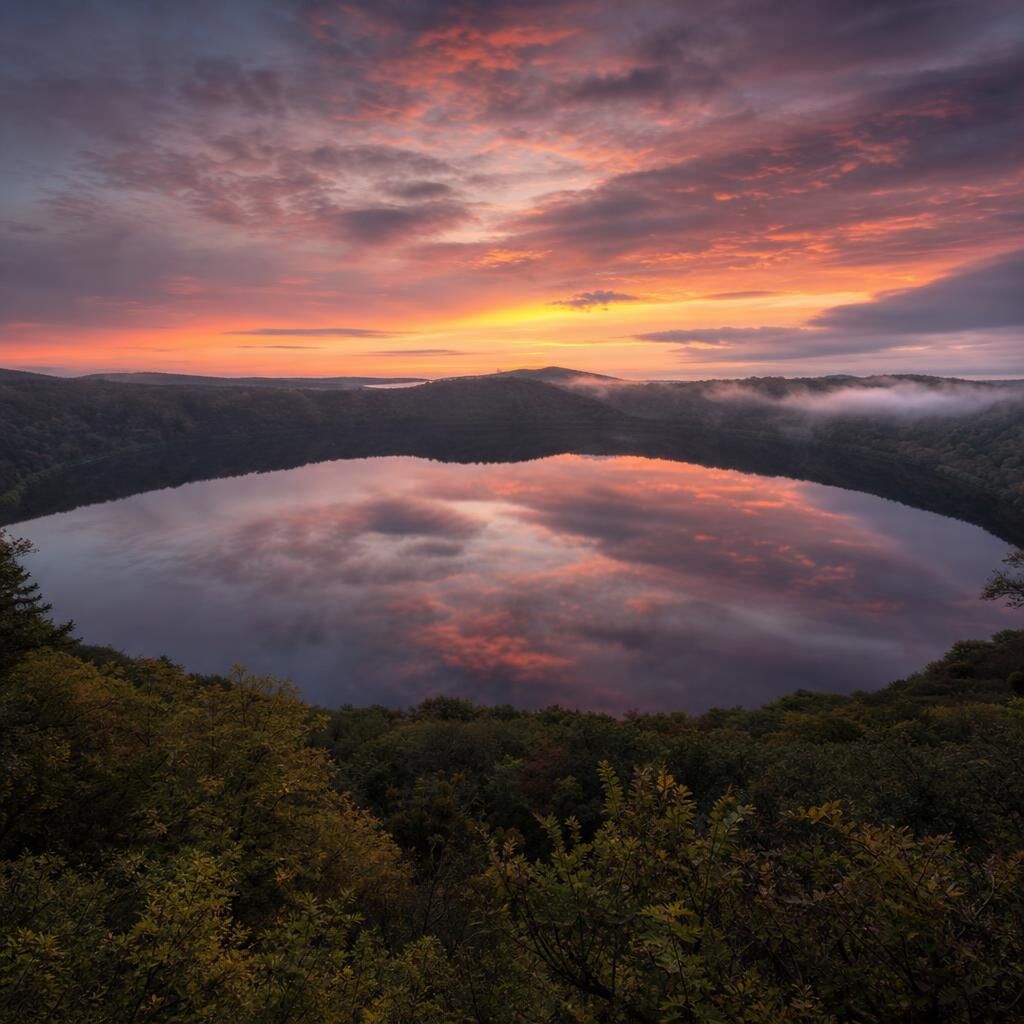
The Eifel's maar lakes are not something that announces itself before you arrive — you walk through dense beech forest for 20 minutes and then the crater simply opens below you, a perfect circular basin holding water of a blue that deepens toward its centre. Laacher See is the largest, a 2-kilometre volcanic crater erupted 12,900 years ago and still hydrothermally active — CO2 bubbles break the south shore's surface in a constant slow disturbance that prevents reflection forming in that quadrant while the north shore holds mirror conditions. The smaller maare at Gemünd and Weinfelder are older, deeper blue, and accessible before 8am without another person in sight — each one a distinct photographic problem of its own.
Kirsten Bruning approaches the Eifel without the landscape photographer's instinct of arriving at a known position and waiting for golden hour — these lakes have no established photographic angle and no famous viewpoint. The expedition works from the forest interior outward, reading each crater as a distinct environment: the specific relationship between water level and treeline, the behaviour of surface mist before the sun reaches the basin, and the long-exposure possibilities that open when the water is truly undisturbed.
Expedition Itinerary
Day 1: Laacher See — The Breathing Crater
3:45am departure reaches the Laacher See crater rim at first light — the only time when the CO2 disturbance on the south shore creates a visible contrast against the north shore's still surface, a clear distinction between the active and quiescent halves of the same lake. The western arc of the crater, where the rim wall casts the longest shadow, holds mirror conditions for the longest period in the morning: forest doubled in water with a 1.8-kilometre fetch across the basin. By 9am the surface texture changes as the air warms and the boundary between still and disturbed sections sharpens further.
The Goal of the Day: Volcanic lake photography in pre-dawn light; long exposure and the contrast between still and CO2-disturbed water surfaces.
Day 2: Gemündener Maar — The Depth-Blue Crater
The Gemündener Maar is 38 metres deep and a remarkable dark blue — a colour that shifts between navy and cobalt depending on the sky above it. Pre-dawn arrival before any light has reached the crater interior means working in pure ambient sky colour: the lake reads as flat tone with no surface texture or shadow, creating a minimalism available only in this narrow window. The Weinfelder Maar 2km to the south is smaller, its crater rim lower, and the light arrives 20 minutes earlier — which allows a sequence: Gemünd in darkness, Weinfelder at first light, back to Gemünd for full morning.
The Goal of the Day: Crater lake photography in blue-hour ambient light; sequential dawn light on two lakes of contrasting scale.
Day 3: Eifel National Park — Unmanaged Beech Forest
The Eifel National Park's core zone has had no forestry management since 2004 — which means fallen trees, dense undergrowth, and the particular light quality that only reaches an unmanaged forest floor: filtered through multiple canopy layers, scattered laterally, and arriving in narrow shafts at angles that a managed plantation cannot produce. The park's stream courses cut through moss-covered basalt and the water moves fast enough to blur to white in exposures of half a second or longer. In late spring the beech canopy is at maximum translucency — a 4-week window when the light through the leaves is genuinely green.
The Goal of the Day: Old-growth forest interior photography in filtered canopy light; long exposure in fast-moving highland streams.
Book Your Expedition
Note: Final price may vary based on specific expedition details and customizations.
Expedition Leaders
Kirsten Bruning is a distinguished L&C Faculty Expedition Leader and Art Marketing Specialist based in the vibrant city of Cologne, Germany. Since joining Light & Composition University in 2019, Kirsten has dedicated her expertise to guiding aspiring photographers and promoting the art of visual storytelling. Her photographic work is characterized by a profound appreciation for the subtle beauty found in nature and a unique ability to capture the emotional narratives embedded within everyday moments. Her approach encourages participants to look beyond the obvious, fostering a deeper connection with their surroundings and their craft.
Kirsten's journey into photography began at an early age, sparked by her father's introduction to the timeless art of analogue photography. This foundational experience instilled in her a meticulous eye and a deep respect for the photographic process, influences that are evident in her diverse range of specialties. She masterfully navigates various genres, including Street, Architecture, Portrait, Landscape, Nature, Long Exposure, Travel, and Documentary photography. Whether she's exploring urban environments or serene natural landscapes, Kirsten consistently seeks to uncover and highlight the often-overlooked details that tell a compelling story.
As an experienced Expedition Leader, Kirsten leads immersive photographic journeys across a rich tapestry of European locations, including Germany, Belgium, the Netherlands, Luxembourg, and France. Her expeditions are more than just photo walks; they are carefully curated experiences designed to inspire creativity, enhance technical skills, and provide participants with unforgettable cultural and visual encounters. Through her warm guidance and extensive knowledge, Kirsten empowers photographers of all levels to refine their vision and capture the world with authenticity and artistic flair, embodying the spirit of discovery and artistic expression.
Travel Information
Local Logistics
Participants should plan for personal vehicle use or coordinate carpooling for efficient travel between Laacher See, the Maare, and Eifel National Park. Ensure your mobile phone has good reception for navigation and communication, as some remote areas may have limited service, and bring a power bank for charging. Pack appropriate gear for varying weather, including rain protection for cameras and personal clothing, as conditions can change rapidly in the Eifel region.
Health and Safety
Be prepared for changeable weather conditions, including rain and cooler temperatures, even in summer; layered clothing is highly recommended. Wear sturdy, waterproof hiking shoes suitable for uneven trails and volcanic terrain, and bring a basic first-aid kit, especially for minor cuts or blisters. Stay on marked paths to avoid hazards like slippery surfaces or protected natural areas, and be aware of wildlife, keeping a respectful distance.
Cultural Guidelines for Photographers
Always be mindful of other visitors and local residents when setting up shots, avoiding obstruction or intrusion into private spaces. Respect private property signs and do not trespass for a better angle; permission should be sought if photographing on private land. When photographing people, always ask for their consent first, and be discreet and respectful in all interactions.
What to Bring
Photography Equipment
- Camera body for nature and landscape photography
- Wide-angle lens 14-24mm range
- Mid-range zoom lens 24-70mm range
- Telephoto zoom lens 70-200mm range
- Sturdy carbon fiber tripod
- Neutral Density filter set for long exposures
- Graduated Neutral Density filter set
- Circular Polarizer filter
- Multiple fully charged camera batteries
- High-speed high-capacity memory cards
- Wired or wireless remote shutter release
- Lens cleaning cloths
- Lens cleaning pen and blower
- Weather-sealed camera backpack
- Headlamp with red light option
- Portable power bank for charging devices
- Portable hard drive for image backup
- Rain cover for camera and lens
- Rain cover for camera backpack
Clothing
- Moisture-wicking base layers
- Warm fleece mid-layer
- Lightweight insulated jacket
- Waterproof and windproof shell jacket
- Durable hiking pants
- Waterproof overtrousers
- Waterproof hiking boots
- Multiple pairs of moisture-wicking hiking socks
- Warm hat or beanie
- Sun hat with wide brim
- Lightweight touch-screen compatible gloves
- Underwear
- Comfortable change of clothes for evenings
Personal Items
- Large hiking backpack for all gear
- Reusable water bottle or hydration reservoir
- High-energy snacks
- Basic first aid kit
- Sunscreen
- Insect repellent
- Biodegradable toiletries
- Personal medications
- Offline maps and compass
- Fully charged mobile phone
- Wallet with ID and cash
- Sunglasses
- Quick-drying small towel
- Universal power adapter for Germany