Expedition Overview
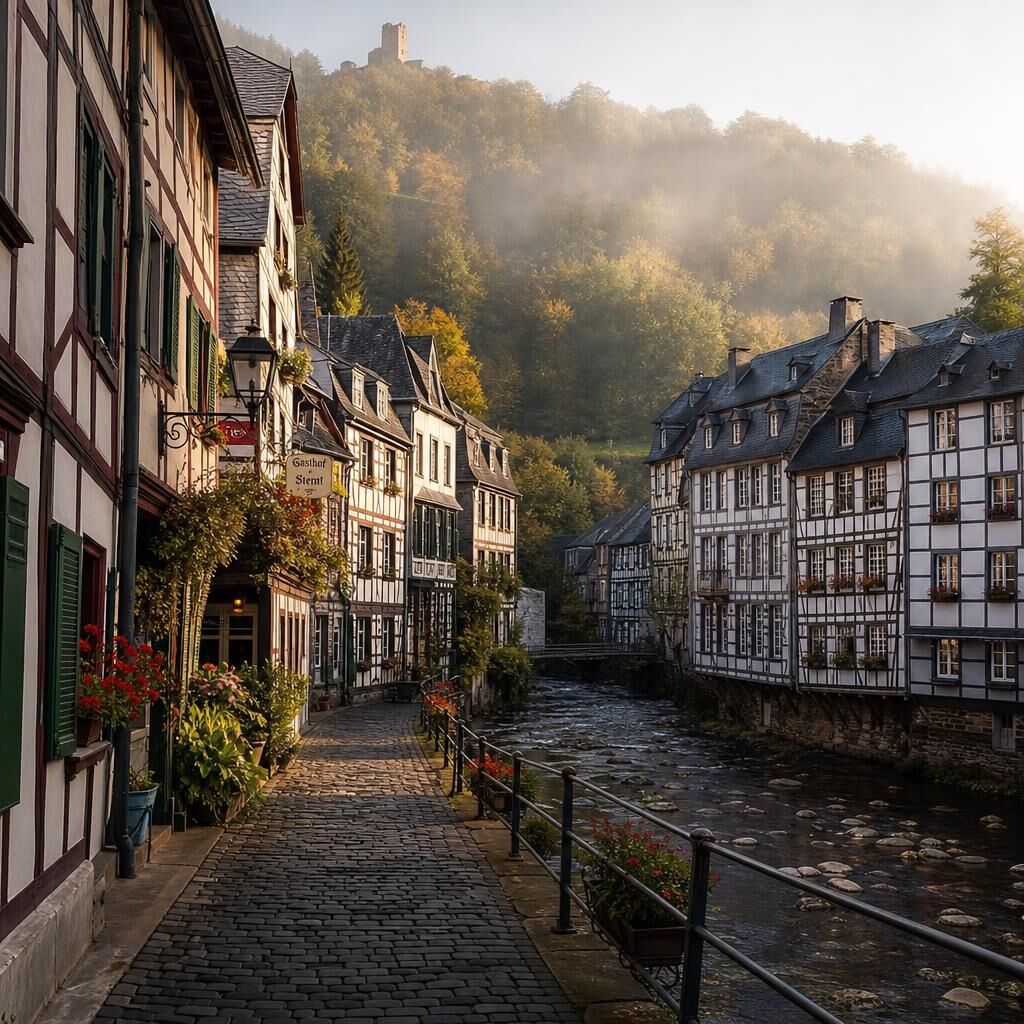
Monschau sits in a tight Eifel valley that the 17th-century wool trade built rich and two world wars left entirely undamaged — a combination so improbable that the result looks fabricated. The half-timbered houses of the cloth merchants, built between 1650 and 1780, are intact and inhabited, their facades pressing directly over the Rur river where the current still runs fast between stone footings. What distinguishes Monschau from Germany's other preserved medieval towns is what the geography adds: the valley is narrow enough and the surrounding hills steep enough that on still mornings a fog layer forms at river level and fills the cleft below the rooflines, leaving the upper storeys of the half-timbered buildings visible above a white floor and the town appearing to float.
Kirsten Bruning approaches Monschau without the instinct to photograph from the famous viewpoints on the surrounding hillsides — the elevated angles that reduce the town to a picturesque cluster and miss the texture of the thing entirely. This expedition moves at river level and works upward, reading the architecture through the relationship between water, stone foundations, and the directional light that enters the valley from the east in sequence as the morning advances lane by lane.
Expedition Itinerary
Day 1: Rur River — The Foundation Level at Dawn
The river enters Monschau from the northeast and the light follows the same axis — meaning the east-facing facades are already lit by 7:30am while the west-facing street fronts are in shadow for another hour. We work the river banks between these two conditions, photographing the half-timbered facades from water level: stone footings in the current, angled timbers and plaster panels above, attic windows from which the cloth merchants once lowered bales to the boats. On still mornings the fog layer sits at 3 to 5 metres above the water surface; the reflection of the buildings appears in the still sections between the rapids.
The Goal of the Day: Half-timbered architecture in directional valley light from water level; fog-layer reflections in the river below the building line.
Day 2: Monschau Hillside Passages — The Mid-Elevation View
Monschau's lanes climb the valley walls via stepped passages and stairways that give different sightlines at different elevations. From mid-height — approximately 15 metres above the river — the view shows the fog layer below and the upper town above it simultaneously: the most complex photographic condition the town offers and the one that requires the specific morning hour to achieve. The Rotes Haus (Red House), the town's most ornate surviving merchant mansion, catches its best light from the southeast approach at 9am; its interior staircase with original 18th-century carved woodwork is accessible on request.
The Goal of the Day: Town-in-mist photography from mid-elevation; architectural detail of the surviving wool-trade merchant class.
Book Your Expedition
Note: Final price may vary based on specific expedition details and customizations.
Expedition Leaders
Kirsten Bruning is a distinguished L&C Faculty Expedition Leader and Art Marketing Specialist based in the vibrant city of Cologne, Germany. Since joining Light & Composition University in 2019, Kirsten has dedicated her expertise to guiding aspiring photographers and promoting the art of visual storytelling. Her photographic work is characterized by a profound appreciation for the subtle beauty found in nature and a unique ability to capture the emotional narratives embedded within everyday moments. Her approach encourages participants to look beyond the obvious, fostering a deeper connection with their surroundings and their craft.
Kirsten's journey into photography began at an early age, sparked by her father's introduction to the timeless art of analogue photography. This foundational experience instilled in her a meticulous eye and a deep respect for the photographic process, influences that are evident in her diverse range of specialties. She masterfully navigates various genres, including Street, Architecture, Portrait, Landscape, Nature, Long Exposure, Travel, and Documentary photography. Whether she's exploring urban environments or serene natural landscapes, Kirsten consistently seeks to uncover and highlight the often-overlooked details that tell a compelling story.
As an experienced Expedition Leader, Kirsten leads immersive photographic journeys across a rich tapestry of European locations, including Germany, Belgium, the Netherlands, Luxembourg, and France. Her expeditions are more than just photo walks; they are carefully curated experiences designed to inspire creativity, enhance technical skills, and provide participants with unforgettable cultural and visual encounters. Through her warm guidance and extensive knowledge, Kirsten empowers photographers of all levels to refine their vision and capture the world with authenticity and artistic flair, embodying the spirit of discovery and artistic expression.
Travel Information
Local Logistics
Monschau Old Town is easily walkable; park your vehicle at designated town entrances as the center is largely pedestrianized. Consider staying overnight within Monschau itself to capture early morning light and evening scenes, with various hotels and guesthouses available. The Rur Valley and Half-timbered Quarter are integral parts of the town's charm and are explored on foot, so comfortable shoes are essential.
Health and Safety
The expedition involves moderate walking on cobblestone streets and some gentle inclines, so wear sturdy, comfortable footwear suitable for uneven surfaces. Be prepared for variable weather conditions, especially rain, by packing waterproof outer layers and checking local forecasts daily. Keep an eye on your belongings in crowded areas, although Monschau is generally very safe, and carry a basic first-aid kit for minor scrapes.
Cultural Guidelines for Photographers
Always be respectful of local residents and their privacy; avoid photographing people without their explicit permission, especially children. When photographing buildings or homes, ensure you are not trespassing or causing obstruction to walkways or businesses. Move discreetly and minimize your equipment's footprint in crowded areas, allowing others to enjoy the scenery undisturbed.
What to Bring
Here's a packing list tailored for a 2-day easy photography expedition to Monschau Old Town, focusing on architecture, street, and portrait photography in a Western European context.---### Monschau Photography Expedition Packing List (2-Day)1. Photography EquipmentCamera Body: Your primary camera body (e.g., DSLR or Mirrorless). Consider a compact mirrorless as a backup or for lighter street shooting if you have one.Lenses:Wide-Angle Zoom (e.g., 1