Expedition Overview
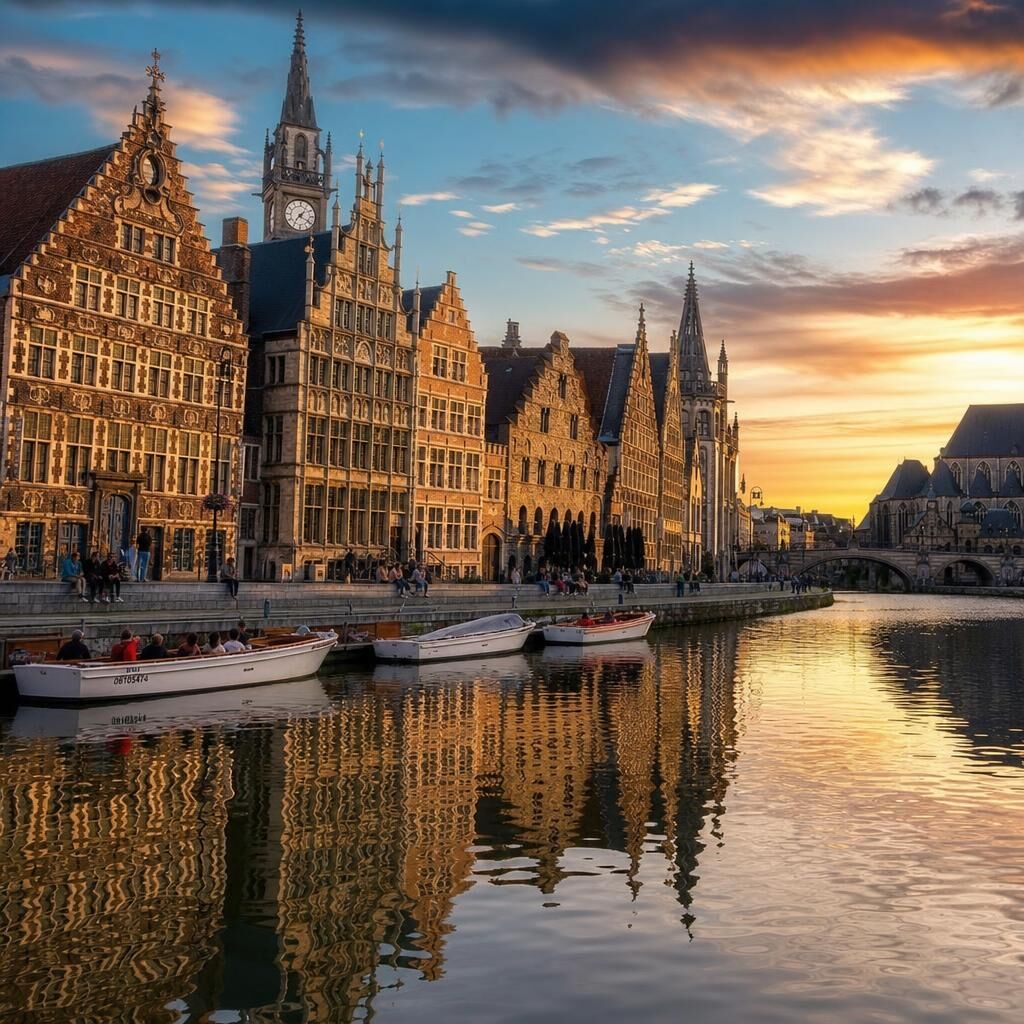
Ghent's Graslei waterfront is a continuous row of guild houses built directly on the water between 1200 and 1440 — the most complete medieval quay in northern Europe, and unlike Bruges, the city behind it is genuinely alive. Ghent has 70,000 university students in a medieval centre that also contains the Van Eyck altarpiece, still in its original chapel, and the Patershol — a cobblestone quarter of 13th-century lanes directly behind Gravensteen Castle where residents hang laundry between buildings that have stood for 700 years. The Graslei facades face east across the Leie river and catch the morning light in a way that rewards the photographer who arrives before the first tourist boat disturbs the reflection.
Kirsten Bruning approaches Ghent without treating the Graslei as a backdrop — the single photographic action most visitors perform and that flattens a complex waterfront into a decorative strip. The expedition reads the Graslei as architecture in depth: multiple facades at different distances, different orientations, and the specific relationship between reflected image and building above it at different hours of the morning.
Expedition Itinerary
Day 1: Graslei Waterfront — Pre-Tourist Reflections
The Graslei faces east across the Leie and the facades begin to catch direct light at 7am in summer — a 90-minute window before the tourist boats begin their runs and the wash disturbs the reflections. We work from the Korenlei opposite bank first: this is the standard photographic angle, but at 7am the light quality — warm, low, directional from the southeast — produces a different image from the flat mid-morning light in every tourist photograph. From 9am we cross to work the Graslei facades in close detail: the guild house carvings, the stepped gable ends, the water-gate arches at the base of the buildings.
The Goal of the Day: Medieval waterfront photography in directional morning light; long exposure reflections before tourist boat wash breaks the surface.
Day 2: Patershol — Cobblestone Lanes of the 13th Century
The Patershol quarter is 800 years old and still entirely residential — cobblestone lanes less than 3 metres wide, overhanging upper storeys, and the quality of light that reaches a street of this width only at midday when the sun is directly overhead. The lane orientation is east-west, which means one side is in permanent shade during morning hours and the other catches a narrow band of direct light from above that descends the wall as the morning advances. Gravensteen Castle, surrounded by its original moat canal, is best photographed from the north bank in the late morning when the reflected curtain wall appears in the water with sufficient height.
The Goal of the Day: Medieval narrow-lane photography in slot light and shade; castle-over-moat reflection photography from close perspective.
Book Your Expedition
Note: Final price may vary based on specific expedition details and customizations.
Expedition Leaders
Kirsten Bruning is a distinguished L&C Faculty Expedition Leader and Art Marketing Specialist based in the vibrant city of Cologne, Germany. Since joining Light & Composition University in 2019, Kirsten has dedicated her expertise to guiding aspiring photographers and promoting the art of visual storytelling. Her photographic work is characterized by a profound appreciation for the subtle beauty found in nature and a unique ability to capture the emotional narratives embedded within everyday moments. Her approach encourages participants to look beyond the obvious, fostering a deeper connection with their surroundings and their craft.
Kirsten's journey into photography began at an early age, sparked by her father's introduction to the timeless art of analogue photography. This foundational experience instilled in her a meticulous eye and a deep respect for the photographic process, influences that are evident in her diverse range of specialties. She masterfully navigates various genres, including Street, Architecture, Portrait, Landscape, Nature, Long Exposure, Travel, and Documentary photography. Whether she's exploring urban environments or serene natural landscapes, Kirsten consistently seeks to uncover and highlight the often-overlooked details that tell a compelling story.
As an experienced Expedition Leader, Kirsten leads immersive photographic journeys across a rich tapestry of European locations, including Germany, Belgium, the Netherlands, Luxembourg, and France. Her expeditions are more than just photo walks; they are carefully curated experiences designed to inspire creativity, enhance technical skills, and provide participants with unforgettable cultural and visual encounters. Through her warm guidance and extensive knowledge, Kirsten empowers photographers of all levels to refine their vision and capture the world with authenticity and artistic flair, embodying the spirit of discovery and artistic expression.
Travel Information
Here's practical travel information for your 2-day easy photography expedition to Graslei & Korenlei, Gravensteen Castle, and Patershol Quarter in Ghent, Belgium.---### 1. Local LogisticsTransport to Ghent: From Brussels Airport (Zaventem - BRU): The easiest way is by train. There are direct trains from the airport station (Brussels Airport-Zaventem) to Gent-Sint-Pieters (Ghent's main train station). The journey takes approximately 1 hour. Tickets can be purchased at the station or via the SNCB (Belgian Railways) app/website. From Brussels City: Take a direct train from Brussels-Midi/Zuid, Brussels-Central, or Brussels-Nord to Gent-Sint-Pieters. The journey is about 30-40 minutes. From Charleroi Airport (CRL): This airport is further out. You'll need to take a shuttle bus (e.g., Flibco) to Brussels-Midi/Zuid station, and then a train to Gent-Sint-Pieters. This route takes considerably longer.Transport within Ghent: From Gent-Sint-Pieters Station to City Center: Tram: Tram line 1 is your best friend. It runs frequently from the train station directly into the city center (stopping near Korenmarkt, which is a short walk to Graslei/Korenlei). Look for "Korenmarkt" or "Gravensteen" as your destination stops. Tickets can be bought at the station, from ticket machines at stops, or via the De Lijn app. Walking: It's a brisk 30-40 minute walk from the station to the city center. While doable, the tram is more efficient, especially with photography gear. Getting Around the City Center (Graslei, Korenlei, Gravensteen, Patershol): Walking is King: Ghent's historic center is compact and incredibly walkable. Graslei, Korenlei, Gravensteen, and Patershol are all within easy walking distance of each other (5-15 minutes between each location). This is the best way to explore and find unique photography angles. No Cars: The inner city is largely car-free or has restricted access, making it pleasant for pedestrians. Bicycles: Ghent is very bike-friendly, but for a photography expedition, walking allows for more spontaneous stops and detailed exploration.Navigation Tips: Offline Maps: Download an offline map of Ghent (e.g., via Google Maps or Maps.me) before you arrive. This saves data and ensures you can navigate even without a signal. Landmarks: Use prominent landmarks like the Belfry, St. Bavo's Cathedral
What to Bring
Here's a packing list tailored for a 2-day easy photography expedition to Ghent, Belgium, focusing on architecture, street, and documentary photography.Important Note: Belgium weather can be unpredictable, even in spring/autumn. Layers are key! Check the forecast closer to your departure.---### 1. Photography EquipmentCamera Body:- Main camera body (DSLR or Mirrorless)- Fully charged spare camera battery (at least one, ideally two for a 2-day trip)- Camera battery chargerLenses (Choose 2-3 to keep it light but versatile):- Wide-angle lens (e.g., 16-35mm, 14-24mm, or a wide prime like 24mm) - Essential for grand architecture, tight streets.- Standard zoom lens (e.g., 24-70mm, 24-105mm,