Expedition Overview
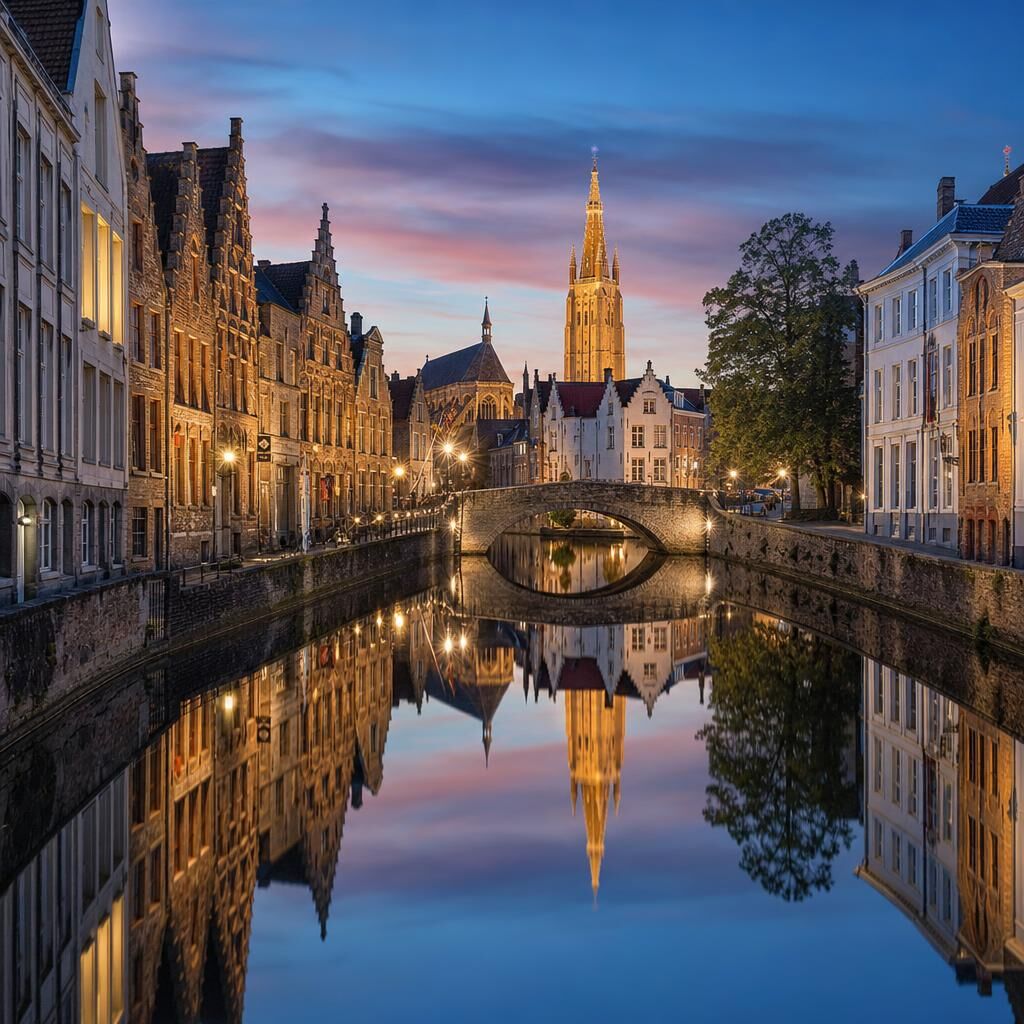
Bruges' connection to the North Sea silted up in 1520, and the city that had been the commercial capital of northern Europe simply stopped — its canal network sealed from tidal flow, its merchant architecture frozen in the moment of the Flemish cloth trade's peak. The still-water canals that resulted from this geographical accident now produce near-perfect reflections of guild houses unchanged since the 15th century. The Rozenhoedkaai bend, where three canal sections converge, is Bruges' most-photographed view and also its most rewarding before 7am: the tourist boats do not run until 10am, the water is genuinely undisturbed, and the glass surface doubles the brick facades and the willow trees above them with an optical clarity unavailable at any other hour.
Kirsten Bruning approaches Bruges without treating the canal reflections as symmetrical compositions — the image that every visitor produces and that reduces the city to a decorative postcard object. The expedition reads the reflections as a photographic variable controlled by time of day, light angle, wind speed, and canal direction — and builds a body of work from Bruges that depends on the hour and the conditions rather than the position.
Expedition Itinerary
Day 1: Rozenhoedkaai — Mirror Conditions Before 7am
The Rozenhoedkaai canal bend faces northeast, which means the morning light enters obliquely — catching the brick facades at an angle that deepens their colour rather than washing it out. Arrival at 5:30am positions us while the city is completely still; the water is undisturbed by the tourist boats that begin at 10am and by 6am has had no movement since before midnight. The Dijver Canal to the south faces a different direction and catches its light from 8:30am — giving a second 90-minute window with a different warmth entirely, allowing the photographer to work two distinct canal conditions in a single morning.
The Goal of the Day: Still-water canal reflection photography in pre-dawn and early morning light; reading directional light change across two canal orientations.
Day 2: Minnewater & Begijnhof — The Southern Quarter
The Minnewater lake at the city's southern edge is 400 metres long with an orientation that catches the morning light from the east directly at 8am — the medieval Minnewaterbrug bridge sits in the beam for a 45-minute window before the angle rises. The Begijnhof enclosure beside it has a whitewashed inner courtyard accessible from 6:30am; at 7am a single shaft of light enters through the gate arch and crosses the cobblestones in a beam that moves visibly in the 15-minute window while the sun is at the right angle. The Begijnhof is one of the few spaces in central Bruges that remains photographic and empty simultaneously.
The Goal of the Day: Still-water lake photography with medieval bridge architecture; interior courtyard beam-light photography in a precisely timed window.
Book Your Expedition
Note: Final price may vary based on specific expedition details and customizations.
Expedition Leaders
Kirsten Bruning is a distinguished L&C Faculty Expedition Leader and Art Marketing Specialist based in the vibrant city of Cologne, Germany. Since joining Light & Composition University in 2019, Kirsten has dedicated her expertise to guiding aspiring photographers and promoting the art of visual storytelling. Her photographic work is characterized by a profound appreciation for the subtle beauty found in nature and a unique ability to capture the emotional narratives embedded within everyday moments. Her approach encourages participants to look beyond the obvious, fostering a deeper connection with their surroundings and their craft.
Kirsten's journey into photography began at an early age, sparked by her father's introduction to the timeless art of analogue photography. This foundational experience instilled in her a meticulous eye and a deep respect for the photographic process, influences that are evident in her diverse range of specialties. She masterfully navigates various genres, including Street, Architecture, Portrait, Landscape, Nature, Long Exposure, Travel, and Documentary photography. Whether she's exploring urban environments or serene natural landscapes, Kirsten consistently seeks to uncover and highlight the often-overlooked details that tell a compelling story.
As an experienced Expedition Leader, Kirsten leads immersive photographic journeys across a rich tapestry of European locations, including Germany, Belgium, the Netherlands, Luxembourg, and France. Her expeditions are more than just photo walks; they are carefully curated experiences designed to inspire creativity, enhance technical skills, and provide participants with unforgettable cultural and visual encounters. Through her warm guidance and extensive knowledge, Kirsten empowers photographers of all levels to refine their vision and capture the world with authenticity and artistic flair, embodying the spirit of discovery and artistic expression.
Travel Information
Local Logistics
Bruges is highly walkable, making it easy to reach Markt Square, Dijver Canal, and Begijnhof on foot. Plan your photography for early mornings or late afternoons to capture the best light and avoid large crowds at popular spots. Ensure you carry extra camera batteries and memory cards, as continuous shooting will drain power quickly. The Groeningemuseum Quarter has specific operating hours, so check these in advance to plan your visit.
Health and Safety
Be mindful of your surroundings, especially when focused on framing shots, and keep personal belongings secure against pickpockets in crowded areas like Markt Square. Wear comfortable walking shoes suitable for cobblestone streets to prevent trips and falls. Check local weather forecasts daily and dress in layers, as conditions can change quickly, especially near the canal. Carry a small first-aid kit for minor scrapes and know the local emergency number for Belgium (112).
Cultural Guidelines for Photographers
Always be respectful when photographing people; ask for permission if taking close-up portraits. The Begijnhof is a serene residential area, so maintain quiet and avoid disturbing residents with loud conversations or intrusive photography. Do not block pathways or obstruct public access while setting up your shots, particularly in busy areas like the Dijver Canal. Be aware of any "no photography" signs inside specific museum exhibits or private establishments.
What to Bring
Here's a packing list for your 2-day easy photography expedition to Bruges, Belgium, focusing on architecture, long exposure, and travel:---### 1. Photography Equipment- Camera Body: Your primary digital camera (DSLR or Mirrorless).- Wide-Angle Lens: Essential for capturing grand architecture (Markt Square, Belfry) and expansive canal views. (e.g., 16-35mm, 14-24mm, or equivalent).- Standard Zoom Lens: A versatile walk-around lens (e.g., 24-70mm, 24-105mm, or equivalent) for general street photography and varied compositions.- Sturdy Travel Tripod: Absolutely crucial for long exposure photography, especially in low light or for motion blur effects on water (Dijver Canal). Look for one that's stable but not overly heavy.- ND Filters (Neutral Density): A set of varying strengths (e.g., 3-stop, 6-stop, 10-stop) for daytime long exposures, creating silky water and cloud movement.- Circular Polarizer (CPL) Filter: Great for reducing glare on water (Dijver Canal), deepening blue skies, and enhancing architectural textures.- Remote Shutter Release: Wired or wireless, to trigger the camera without touching it, preventing camera shake during long exposures.- Multiple Spare Batteries: Cold weather can drain batteries faster, and long exposures consume more power.- High-Capacity Memory Cards: Several, to ensure you don't run out of space.- Camera Bag: Comfortable, weather-resistant, and securely padded to carry all your gear while walking.- Lens Cleaning Kit: Microfiber cloths, lens pen, blower brush for dust and smudges.- Headlamp or Small Torch: Useful for setting up your tripod and camera in low light conditions (early morning/late evening).- Power Bank: For charging your phone or other small USB devices on the go.- European Power Adapter: Type E or F plug for charging camera batteries and other electronics.### 2. Clothing (Western European Context - Layers are Key!)- Waterproof & Windproof Jacket: Essential for unpredictable Belgian weather, which can change quickly.- Comfortable Walking Shoes: Waterproof or water-resistant is highly recommended, as you'll be on your feet exploring cobblestone streets and canals.- Warm Mid-Layer: Fleece jacket or sweater for warmth.- Long-Sleeved Shirts: For layering.- T-shirts: For warmer moments or as a base layer.- Comfortable Trousers: Jeans or travel trousers suitable for walking.- Warm Socks: Wool or synthetic, moisture-wicking socks for comfort during long walks.- Hat: A beanie or warm hat, especially if visiting in cooler months or for early morning/late evening shoots.- Light Gloves: Useful for operating camera controls in chilly weather.- Underwear: Enough for 2 days, plus an extra spare.- Sleepwear: For your accommodation.### 3. Personal Items- Passport/ID Card: Essential for travel.- Wallet: With local currency (Euros) and credit/debit cards.- Mobile Phone & Charger: For navigation, communication, and general use.- Toiletries: Toothbrush, toothpaste, shampoo, soap, deodorant, etc. (travel-sized).- Personal Medications: Any prescriptions, plus basic pain relievers, plasters/band-aids.- Small Daypack/Backpack: For carrying daily essentials, water bottle, snacks, and extra layers.- Reusable Water Bottle: Stay hydrated while exploring.- Snacks: Energy bars or small snacks for on-the-go.- Compact Umbrella: For unexpected rain showers.- Sunglasses: Even on cloudy days, they can help with glare.- Small Notebook & Pen: For jotting down notes or photo ideas.-