Yes, But Why Dad? by Federica Longhin
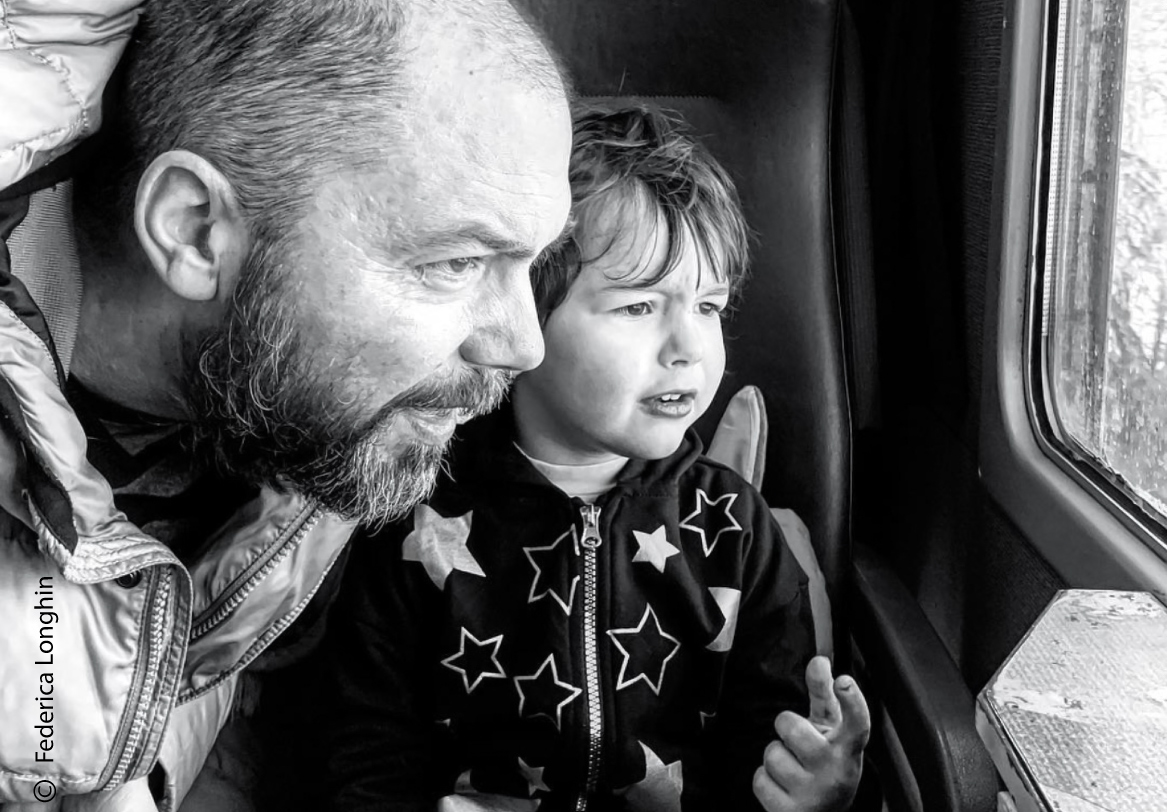
Captured during a train journey, this poignant black and white candid photograph freezes a tender interaction between a young boy and his father. As the rhythmic motion of the train provides a backdrop, the boy’s animated curiosity is met with the father’s patient, smiling responses. The photographer masterfully highlights the palpable emotional bond between the two, using high-contrast monochrome to strip away distractions and focus entirely on the warmth and intimacy of the moment. This image is award-worthy for its authentic storytelling and the ability to transform a mundane transit experience into a timeless exploration of human connection.
Federica Longhin
Born in Bolzano and currently based in Vicenza, Italy, Federica Longhin is an accomplished Art Director whose creative soul finds its fullest expression through the lens of a camera. Her work is defined by a deep-seated passion for black and white photography, a medium she utilizes to capture the raw essence of human journeys and fleeting, intimate moments. Inspired by the romance of travel, the atmosphere of train stations, and the quiet beauty of the night, Longhin crafts evocative narratives that invite viewers to experience the world with renewed curiosity and emotional depth.
Resonance Score Breakdown
Transparency Note: The resonance score (8.0/20) is calculated based on social engagement metrics collected before the award announcement.
Expert Photography Reviews · 8
The Architecture of Inheritance
Public transit is perhaps the most honest laboratory of human geography. Within the confines of a moving carriage, the rigid hierarchies of the city are momentarily suspended, replaced by a temporary, shared intimacy.
Read the reflection →The Weight of an Answer
I usually find the public display of domestic affection to be a bit performative, a staged intimacy that feels more like a claim than a reality.
Read the reflection →Reviews & Comments
Share your thoughts about this award-winning photograph. Your reviews contribute to the community engagement score.

It’s a relief to see a frame without the relentless backscatter I battle daily. In this train carriage, light doesn’t suffer the rapid attenuation of the deep, where red wavelengths vanish within five metres. The clarity here is crisp, unburdened by the refractive index of water. I find myself mesmerized by the boy’s gaze; it’s as inquisitive as a juvenile octopus exploring a reef. It’s a beautiful, dry-world intimacy I rarely get to witness.
The rhythmic, blurred geometry of the train window frames this scene like a cinematic vignette. It’s the harsh, directional light carving out the father’s profile that truly anchors the intimacy here. The cold, metallic transit environment forces them into a private, domestic bubble. I’m genuinely moved by how the stark monochrome turns a simple commute into a sacred space. It’s not just a portrait; it’s a quiet, fleeting sanctuary built entirely from the architecture of travel.
The train’s rhythmic pulse fades, leaving only this quiet exchange. I’ve spent enough hours waiting for the light to know when a soul is truly present. She didn’t force this; she listened to the stillness between father and son. It’s a rare, fleeting grace. Looking at the boy’s upturned face, I feel a sudden, sharp ache for my own childhood. She caught the light exactly when the world stopped moving, and it’s beautiful.
Before the eye identifies the figures, a sudden stillness settles in the chest. It’s the weight of a question hanging in the air, caught between the boy’s urgent tilt and the father’s steady, tired smile. I feel a phantom ache in my own throat, remembering how it feels to be small and seeking. When I return to this, the train’s rhythm fades, leaving only that fragile, fleeting bridge of patience between two human lives.
The rhythmic geometry of the train carriage recalls the candid intimacy of Henri Cartier-Bresson’s transit studies, yet Longhin’s iPhone capture feels startlingly immediate. By stripping away the tonal nuance of traditional silver gelatin, she forces a stark, digital confrontation with the father’s gaze. It’s a quiet, piercing look I haven’t seen captured with such raw, unvarnished digital clarity before. Honestly, it made me stop and remember my own father’s patience. It’s a rare, honest moment.
Stripping the world of its chromatic skin, Longhin forces us to confront the stark, charcoal-grey silence of a train carriage, where the absence of colour feels like a held breath. It’s a monochrome study of light’s architecture, reminiscent of Morandi’s hushed, tonal restraint. I’m genuinely moved by how the silver-toned shadows cling to the boy’s inquisitive brow; it’s a quiet, aching reminder that even without the warmth of ochre, intimacy remains profoundly, undeniably radiant.
We sit on this train, watching the boy lean into his father. It’s a quiet, rhythmic dance of questions and answers. Federica caught a moment where the world outside the window simply ceased to exist. I’ve seen many portraits, but this one makes my chest ache with the memory of my own father’s patience. We look at them and we understand that love isn’t found in grand gestures, but in the simple act of listening.
The frame’s geometry relies on the vertical axis of the window frame to anchor the subjects. It’s a rigid containment of chaos. The boy’s tilted head creates a necessary diagonal, breaking the monotony of the father’s static posture. I’m genuinely unsettled by how the high-contrast grain flattens the depth, forcing the figures against the glass. It’s a claustrophobic architecture. The composition doesn’t just hold; it traps the viewer within the train’s narrow, unforgiving visual field.