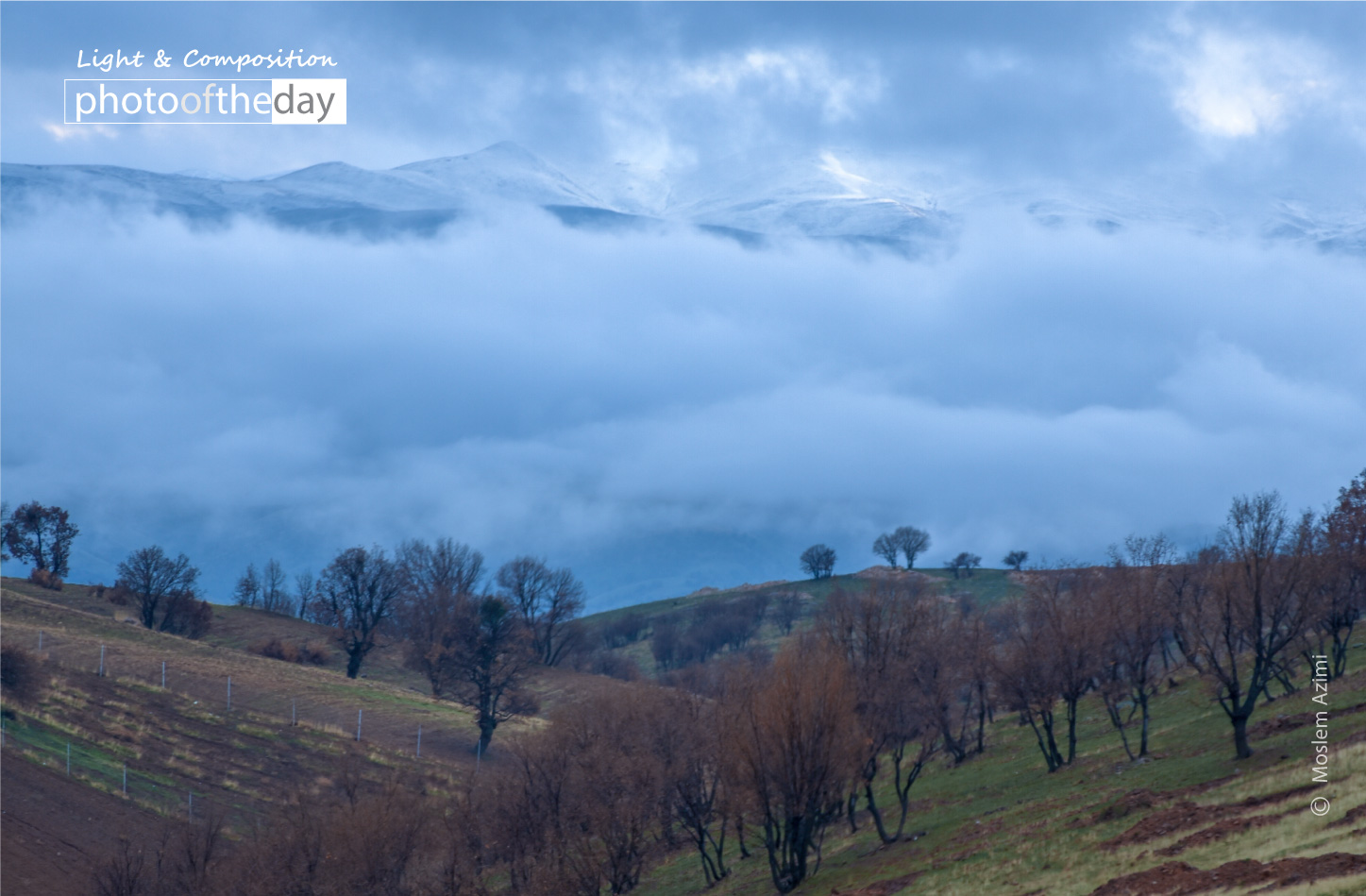
Winter in Spring by Moslem Azimi
Winter in Spring captures the unique, ephemeral beauty of the Kurdistan region, where the seasons collide in a striking display of contrast. The photographer masterfully documents a landscape defined by the coexistence of fog, snow, and vibrant yellow flora, all bathed in exceptional natural light. This image is award-worthy for its ability to harmonize disparate elements—lines, colors, and atmospheric mood—into a cohesive, evocative scene. By freezing this fleeting moment, the photographer highlights the raw, untamed essence of the terrain, inviting viewers to appreciate the complex beauty found within the intersection of winter’s chill and spring’s awakening.
Moslem Azimi
Of Kurdish origin and currently based in Melbourne, Australia, Moslem Azimi is a self-taught photographer who transitioned from a background in English Translation to visual storytelling. His work is deeply rooted in the documentation of Kurdish life, culture, and traditions, serving as a bridge between his heritage and a global audience. Through his participation in numerous national and international exhibitions, Azimi has established himself as a dedicated observer of the human and natural landscape, continuously refining his craft through active engagement with diverse photography communities.
Resonance Score Breakdown
Transparency Note: The resonance score (11.4/20) is calculated based on social engagement metrics collected before the award announcement.
Expert Photography Reviews · 7
The Season That Never Was
It is 3:14 am. The house is holding its breath, and I am sitting here wondering why we are so obsessed with things staying exactly as they are. We want the cold to be cold and the warmth to be warm, as if the world owes us a predictable rhythm.
Read the reflection →The Geography of Resilience
We often mistake the landscape for a passive backdrop, a static stage upon which human history unfolds. Yet, the earth itself is a document of endurance, recording the friction between what is expected and what actually occurs.
Read the reflection →Reviews & Comments
Share your thoughts about this award-winning photograph. Your reviews contribute to the community engagement score.
The yellow flora doesn’t bloom here; it screams against the encroaching frost. It’s a violent collision of seasons, yet I’m struck by how the fog swallows the horizon, refusing to let the eye rest. Heidegger argued that truth happens in the clearing, but here, truth hides in the grey, suffocating depth of the valley. It’s a cold, haunting beauty. I’ve never seen a landscape so desperate to remain unread, holding its secrets beneath the snow.
Before the eye identifies the yellow blooms, something in the chest tightens. It’s a physiological dissonance—the biting chill of snow meeting the insistent, warm pulse of spring. My own breath hitches, caught between seasons. When I return to this, I don’t see a landscape; I feel the quiet ache of transition. It’s the kind of image that follows you into sleep, a reminder that beauty often demands we hold two opposing truths at once.
It’s refreshing to see such clarity without the constant battle against light absorption. Down here, we lose the reds and yellows within meters, but Azimi’s Javanroud landscape keeps its warmth intact. The fog acts like a perfect diffuser, softening the light in a way that would take me hours to replicate with strobes. I’m genuinely envious of that crisp, atmospheric depth. It’s a rare, beautiful reminder that light behaves so differently when it isn’t fighting water.
The frame operates on a rigorous diagonal tension, anchored by the sharp, yellow flora cutting through the lower-left quadrant. It’s a precise 1:2 ratio of saturated foreground to the muted, atmospheric fog above. I’m genuinely captivated by how the snow’s negative space balances the dense, vertical clusters of vegetation. The geometry doesn’t just suggest a seasonal collision; it solves the spatial equation of depth through calculated contrast. It’s a perfectly balanced, cold-blooded structural triumph.
Most landscapes I review this year are just pretty postcards. They’ll be forgotten by Tuesday. But this? The way the yellow flora cuts through that oppressive, freezing fog creates a tension that’s genuinely haunting. It’s the visual friction between life and decay that makes me stop and stare. I’d hang this in my own home. It’s not just a scene; it’s a reminder that beauty often thrives in the most inhospitable, fleeting collisions of time.
Yellow petals push through the frost. It’s a quiet collision. I’ve spent minutes staring at the fog, waiting for the mountains to breathe. They don’t. The space between the snow and the bloom is where the weight lives. It’s heavy. It’s still. Nothing here is accidental. The empty corner is not empty. It’s a pause. I feel a sudden, sharp chill in my chest. A rare, honest silence. It’s enough.
The mist clinging to the Zagros slopes isn’t just weather; it’s a veil that forces the vibrant yellow flora to fight for its existence. I’m struck by how the cold, biting snow forces the landscape into a fragile, shivering intimacy. It’s a portrait of a region caught between cycles. The environment here doesn’t just frame the scene; it dictates the struggle of life. I’ve never seen a place look so lonely, yet so fiercely alive.