White Magic by Athena Constantinou
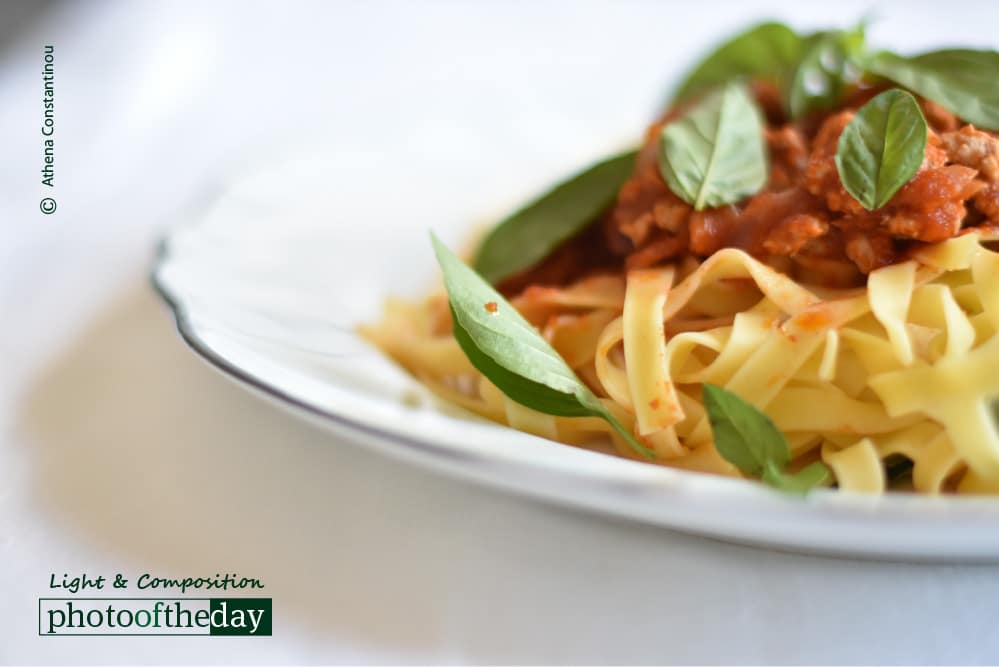
White Magic captures a bold experiment in monochromatic food photography, where the photographer challenged herself to move beyond her signature dark, high-contrast style. By utilizing a strictly white palette—from the plate to the foreground and background—she sought to highlight the subtle textures and inherent contrast of the ingredients. Captured using natural light from a south-facing window, the image demonstrates a masterful command of soft illumination. This piece is award-worthy for its technical bravery and the delicate balance achieved in a challenging, high-key environment, proving that even the most daunting creative constraints can yield striking, harmonious results.
Athena Constantinou
Born in Cyprus with formative years spent in Athens and London, Athena Constantinou has established herself as a versatile food photographer, stylist, and cookbook author. A restless artist who draws inspiration from her extensive global travels, she is recognized for her ability to craft mouthwatering imagery that resonates with a large international audience. As a semi-finalist in the 2016 Pink Lady Food Photography competition, she continues to push the boundaries of her craft, consistently striving to elevate her work to the highest professional standards through her dedicated blog and creative projects.
Resonance Score Breakdown
Transparency Note: The resonance score (13.5/20) is calculated based on social engagement metrics collected before the award announcement.
Expert Photography Reviews · 8
The Quietude of Snow
In the deepest part of winter, when the world is blanketed in a single, heavy tone, the eye begins to crave a different kind of sight. We are taught to look for the vibrant, the loud, and the high-contrast, believing that truth resides in the collision of opposites.
Read the reflection →The Silence of Salt
Winter is not merely a season. It is a stripping away. We spend our lives adding layers—words, possessions, the noise of being known.
Read the reflection →Reviews & Comments
Share your thoughts about this award-winning photograph. Your reviews contribute to the community engagement score.
Most monochromatic food photography is a sterile exercise in boredom, but this succeeds because it treats white not as a void, but as a topography. I’ve seen thousands of high-key attempts fail by washing out the subject, yet here, the subtle grain of the ingredients holds the frame together. It’s brave. Honestly, I found myself wanting to reach out and touch the plate. It’s a rare, quiet victory that will still feel elegant in thirty years.
White on white is a dangerous gamble, a flirtation with the void. Constantinou strips away the comfort of deep shadow, leaving only the fragile topography of grain and cream. It’s unsettling. I find myself squinting, searching for the ghosts of depth that aren’t there. She’s traded the heavy, brooding darkness I crave for a blinding, clinical silence. It’s technically precise, sure, but it feels like a beautiful, hollow room where I’m afraid to speak.
We look at this plate and we don’t just see food; we see a quiet conversation between light and form. Athena has listened to the ingredients, letting their textures whisper rather than shout. It’s a brave, pale landscape that feels like a soft breath in a crowded room. I find myself leaning in, wanting to know the story behind such stillness. It’s a photograph that asks to be returned to, again and again.
Architecture isn’t just steel and stone; it’s the rhythm of light across a surface. Constantinou’s white-on-white study reminds me of a minimalist atrium where the datum is blurred by soft, south-facing illumination. By stripping away color, she forces us to confront the void and the subtle texture of the plate’s edge. It’s a quiet, spatial tension I’ve rarely seen in food work. Honestly, it makes me want to reach out and touch the frame.
Before the eye identifies the plate, a sudden stillness settles in the chest. It’s a sensory deprivation that forces the pulse to slow. The monochromatic palette doesn’t just display texture; it demands a tactile response, making me crave the cool, chalky resistance of the surface. When I return to it, the silence feels heavier, almost clinical. It’s a quiet I’ve carried into my own kitchen, a lingering, ghostly brightness that stays long after I’ve looked away.
Light floods the frame. It’s a quiet surrender. The plate dissolves into the surface, yet the texture remains. I’ve spent minutes watching the shadows trace the edges of the grain. It’s a relief. Nothing here is accidental. The empty corner is not empty. It’s a breath held in the Nicosia sun. I feel my own pulse slow down just looking at it. It’s rare to find such stillness in a kitchen. A beautiful, white silence.
Most food photography is a frantic race against wilting greens. Here, one senses a deliberate stillness. Achieving such tonal nuance in a high-key, monochromatic frame isn’t luck; it’s a stubborn refusal to settle for flat light. I’ve spent enough hours shivering in damp fields to recognize the discipline required to wait for that precise, soft window glow. It’s a quiet, brave piece of work. I find myself actually wanting to sit at that table.
The light hits that white plate and I’m suddenly holding my breath. It’s a high-key sequence that refuses to blink. No shadows to hide in, just the raw, tactile rhythm of grain and glaze. The composition is a locked-off shot where the movement is all in the texture. I’ve seen a thousand food shots, but this one feels like a silent film star caught in a spotlight. It’s brave, quiet, and honestly, it’s just beautiful.