Visitors are Here by Ryszard Wierzbicki
Captured in Bodh Gaya, India, in July 2011, this poignant portrait features two curious children observing the steady stream of visitors to the region. The photographer masterfully documents the spontaneous interaction between local youth and tourists, highlighting the children's genuine fascination with the camera lens. This image is award-worthy for its raw, documentary quality and the photographer’s ability to find profound human connection in fleeting moments. By focusing on the children's expressive gaze, the composition transforms a simple encounter into a compelling narrative about childhood, curiosity, and the intersection of different worlds.
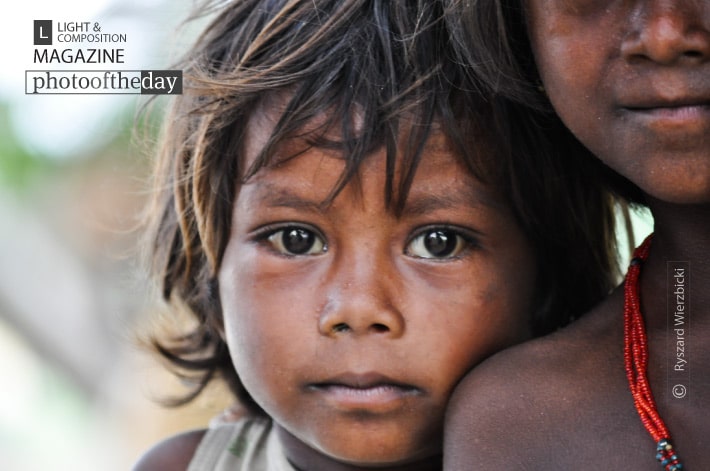
Exposure 1/125sec @ f/5.6 | ISO 800 | Focal Length 200mm
Ryszard Wierzbicki
Born in 1963 and a graduate of the University of Gdańsk, Ryszard Wierzbicki transitioned from a career in social sciences and marketing to a life defined by global exploration and photography. After relocating to the United Kingdom in 2006, he dedicated himself to documenting his travels across South-East Asia, often volunteering with charitable organizations. As a multifaceted creative and PADI instructor, he balances his professional work as a marketing advisor with his passion for capturing the human experience through his lens.
Resonance Score Breakdown
Transparency Note: The resonance score (11.1/20) is calculated based on social engagement metrics collected before the award announcement.
Expert Photography Reviews · 4
The Architecture of a Gaze
In the quiet corners of a room, there is a specific weight to being watched. It is not the scrutiny of a judge, nor the cold assessment of a stranger, but the wide, unvarnished curiosity of the young.
Read the reflection →The Dust of Curiosity
The air in late afternoon has a specific grit to it, a fine, warm powder that settles on the skin like a secret. I remember the feeling of standing in a doorway, my palms pressed against the rough, sun-baked plaster of a wall that had held the heat of the day for hours.
Read the reflection →Reviews & Comments
Share your thoughts about this award-winning photograph. Your reviews contribute to the community engagement score.
1/125sec at f/5.6, 200mm, ISO 800. A telephoto reach on a crop sensor demands stability, yet the motion blur here is undeniable. It’s a technical failure. At 200mm, 1/125sec doesn’t cut it. The shutter speed is lazy. I’ve spent years staring at these files, and the lack of sharpness in the eyes irritates me. It’s a missed opportunity. The composition is fine, but the execution is soft. You can’t document humanity if you can’t hold the camera steady.
Of the thousands of portraits I’ve reviewed, most rely on forced sentimentality. Wierzbicki avoids this by anchoring the frame on the children’s unvarnished, piercing curiosity. It’s the tension between their raw gaze and the blurred, anonymous background that makes this endure. I’ll admit, their eyes still unsettle me after all these years. It’s not just a snapshot of Bodh Gaya; it’s a confrontation. That’s why it’s still relevant—it demands we acknowledge who is actually watching whom.
The ochre dust of Bodh Gaya clings to these children like a veil, a muted, sun-baked terracotta that echoes the weary, earth-bound palettes of Morandi. It’s the way the light catches their skin—a warm, bruised gold—that truly undoes me; I’ve rarely seen such fragile, luminous humanity. One finds the interplay between their dusty, sun-bleached garments and the cool, shadowed depth of the background creates a tension that doesn’t just sit there, it breathes.
It’s easy to snap a shutter when the subjects are staring right at you. One wonders if Wierzbicki spent the morning earning their trust or simply walked by with a zoom lens. The composition is tidy, yet it lacks the grit of a long vigil. I’ve spent enough hours in the dust to know when a photographer has truly settled in. It’s a pleasant enough portrait, but I’m left wanting more commitment to the scene.