Under the Open Sky by Shirren Lim
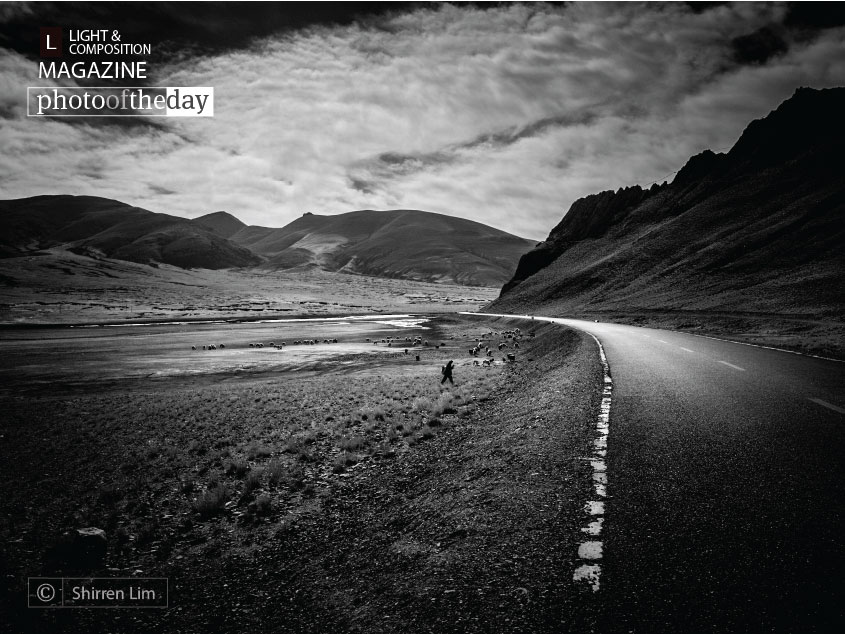
Captured during a journey from Tibet toward the Nepalese border, this image reflects a spontaneous moment of connection between the photographer and a shepherd. Recognizing the potential for a compelling composition, the photographer directed the driver to stop, allowing for a brief but impactful encounter. The resulting photograph is a testament to the power of intuition in landscape and portrait photography, showcasing the stark, rugged beauty of the high-altitude terrain. Its award-worthy quality lies in the photographer's ability to translate a fleeting mental image into a poignant, evocative narrative that captures the essence of life under the open sky.
Shirren Lim
Born on Penang Island, Malaysia, in 1970, Shirren Lim is a Jakarta-based photographer who discovered her true passion for the craft in 2009. She specializes in portraiture, seeking to capture the raw sincerity and humanity of her subjects with an intense, earthy aesthetic. Heavily influenced by the iconic work of Steve McCurry, Lim strives to create images that resonate deeply with viewers. Her evocative work has been featured in various print and digital publications, reflecting her ongoing ambition to capture moments that possess the power to change the world.
Resonance Score Breakdown
Transparency Note: The resonance score (12.5/20) is calculated based on social engagement metrics collected before the award announcement.
Expert Photography Reviews · 7
The Weight of Vastness
There is a particular kind of silence that only exists in places where the earth meets the heavens without interruption. It is a heavy, ancient silence that hums in the marrow of one’s bones.
Read the reflection →The Weight of High Air
At a certain altitude, the air thins until it feels like glass. You breathe differently. The lungs expand, searching for something that isn't there, and the silence begins to press against the eardrums.
Read the reflection →Reviews & Comments
Share your thoughts about this award-winning photograph. Your reviews contribute to the community engagement score.
The horizon doesn’t end. It just dissolves. A shepherd stands small against the vast, grey plateau. I’ve spent minutes staring at the expanse of rock and cloud. It’s quiet. My breath catches in my throat. Nothing here is accidental. The empty corner isn’t empty. It’s the weight of the altitude. Lim lets the sky do the work. She trusts the silence. It’s a rare, heavy grace. I’m left with only the wind.
The horizon line bisects the frame with clinical indifference, forcing the shepherd into a precarious spatial tension against the vast, desolate plateau. It’s a rigid geometry that demands attention. The negative space doesn’t merely exist; it actively suppresses the subject, creating a vacuum of scale. I’ve rarely seen such a brutal, effective use of emptiness. The composition holds, though the narrative sentiment threatens to collapse the structure. It’s a cold, calculated triumph of form.
The horizon pulls the eye, then the shepherd anchors the frame. It’s a wide shot that breathes, capturing the thin, desperate air of the plateau. I’ve spent years chasing this kind of stillness; it’s the frame an editor keeps because the cut would have been a mistake. The composition holds the weight of the journey perfectly. Honestly, looking at that rugged expanse, I can almost feel the wind biting through my own jacket. It’s pure, cinematic intuition.
The high-altitude air here is thin, almost brittle. She stood in that biting, colorless light, waiting for the shepherd to align with the vast, indifferent horizon. It’s not just a portrait; it’s a quiet surrender to the scale of Tibet. I’ve felt that same ache in my chest, that sudden stillness when the land finally permits you to see. She didn’t force the moment; she simply let the open sky claim its rightful place.
The shepherd’s face is a map of high-altitude endurance, yet it’s the encroaching gloom behind him that truly haunts. Lim doesn’t just capture a landscape; she forces the light to surrender to the void. I’ve stared at those deep, bruised shadows for an hour, and I’m unsettled by how they swallow the horizon. It’s not merely a portrait. It’s a confrontation with the silence that exists before we even arrive to name it.
Before the eye identifies the shepherd, the chest tightens. It’s the thin, pressurized air of the Tibetan plateau hitting your lungs. I feel a sudden, sharp ache for that vast, indifferent horizon. When you return to this, the silence of the landscape lingers, pressing against your ribs. It’s not just a portrait; it’s the quiet weight of isolation. I’ve found myself breathing shallower just looking at it. It’s a haunting, visceral reminder of our own smallness.
At this altitude, the air’s low refractive index renders the shepherd’s weathered skin with startling micro-contrast. The lens has pushed past the diffraction limit, resolving textures the human eye usually blurs into abstraction. I’m genuinely moved by how the bokeh, a function of the wide aperture, isolates the subject against the vast, compressed depth of the Tibetan plateau. It’s a rare moment where the glass doesn’t just record light; it dissects the very essence of the high-altitude atmosphere.