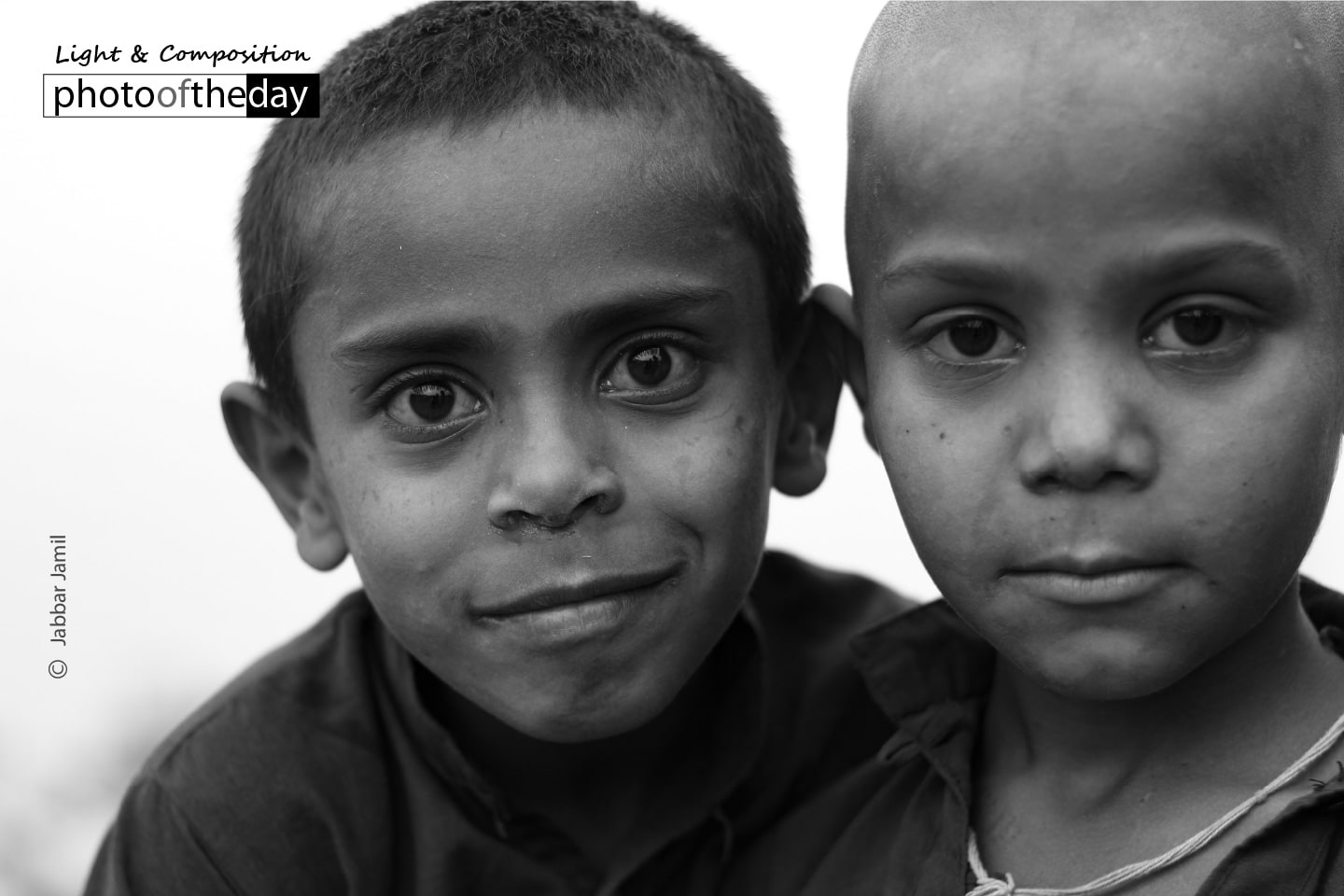
Tiny Frame by Jabbar Jamil
Captured in the late afternoon light of Sialkot, Pakistan, this portrait documents children at play within a local slum. The photographer utilized a 50mm lens on a crop sensor, intentionally choosing a narrow frame to isolate the subjects and focus on their candid interaction. This deliberate technical choice creates an intimate, focused perspective that highlights the raw humanity of the scene. The image is award-worthy for its ability to transform a fleeting, everyday moment into a poignant narrative, demonstrating the photographer's keen eye for finding profound connection and storytelling potential within the complexities of his immediate environment.
Jabbar Jamil
Based in Sialkot, Pakistan, Jabbar Jamil is a dedicated street photographer who views his craft as a vital bridge to the world beyond his comfort zone. His work serves as both a creative outlet and a therapeutic practice, allowing him to document the unfiltered realities of his surroundings with honesty and depth. By focusing on the human element of street life, Jamil seeks to forge connections that transcend the frame, capturing the authentic beauty and grit of the world as he experiences it daily.
Resonance Score Breakdown
Transparency Note: The resonance score (10.4/20) is calculated based on social engagement metrics collected before the award announcement.
Expert Photography Reviews · 7
The Architecture of Joy
We often mistake the vastness of the world for the measure of our happiness, forgetting that the deepest wells are those dug in the smallest patches of earth.
Read the reflection →The Weight of a Whisper
I remember sitting in a dusty courtyard in Marrakech, watching two boys argue over a marble. They weren't fighting about the value of the glass, but about the rules of a game that only they understood. It was a fierce, silent intensity.
Read the reflection →Reviews & Comments
Share your thoughts about this award-winning photograph. Your reviews contribute to the community engagement score.
Using a 50mm lens in a slum requires an intimacy that feels intrusive. I’ve spent weeks in blinds, invisible to my subjects, and I know the difference between earning a moment and merely taking it. Did these children consent to this framing, or were they just props for a narrative? It makes me uncomfortable. When you’re this close, you aren’t observing; you’re imposing. I’d rather see a photographer wait for trust than force a frame.
Most street portraits from Sialkot dissolve into background noise, but Jabbar’s choice of a 50mm lens forces a claustrophobic intimacy that’s hard to ignore. It’s the tension in the children’s hands that anchors this. I’ve seen thousands of slum studies, yet this one lingers because it doesn’t romanticize poverty; it just demands you look at their play. It’s a small, sharp ache in my chest. In thirty years, this honesty will still feel vital.
The 50mm focal length compresses the depth, forcing the subjects against a flattened, chaotic backdrop. It’s a claustrophobic geometry. The frame doesn’t breathe, yet the alignment of the children’s limbs creates a necessary fulcrum. I’m genuinely unsettled by how the negative space is choked out here. It’s a rigid, uncompromising structure. While the narrative leans toward sentiment, the visual architecture holds its ground. The composition demands attention, even if it’s entirely devoid of grace.
Sialkot’s late afternoon light hits these children, but the 50mm lens feels like a wall, not a bridge. Why isolate them in a slum if you aren’t engaging with their reality? It’s a claustrophobic choice that strips away the context of their home. I’ve seen this “raw humanity” trope too often, and frankly, it leaves me cold. Does this framing honor their play, or does it just turn their poverty into a tidy, aesthetic object?
You waited for that light to hit their faces, didn’t you? Using a 50mm in a slum is a gutsy move; it forces you to get close, to be part of the chaos instead of watching from the sidelines. I felt a lump in my throat looking at their expressions. It’s not just a portrait of kids playing. It’s the weight of their joy in a hard place. You were really there. That’s rare.
The vertical axis here is anchored by the children’s alignment, creating a tight, compressed vector that forces the eye upward. Jamil’s 50mm choice establishes a 1:1 ratio between the subjects and the encroaching negative space of the slum walls. It’s a claustrophobic geometry, yet the diagonal tension of their limbs resolves the chaos into a perfect, fragile equilibrium. I’ve rarely seen such a tense spatial equation; it’s honestly breathtaking how the frame holds their joy so securely.
Sialkot’s late light hits these kids, and I’m right there in the dust with them. Using a 50mm on a crop sensor is a bold, tight squeeze, but it works. The timing? It’s sharp. One tenth of a second later and the interaction dissolves into chaos. Jamil caught the exact flicker of humanity before it vanished. It’s raw, it’s honest, and honestly, it makes me miss the chaos of the streets. He didn’t blink.