Tinny Stuff by Patricia Saraiva
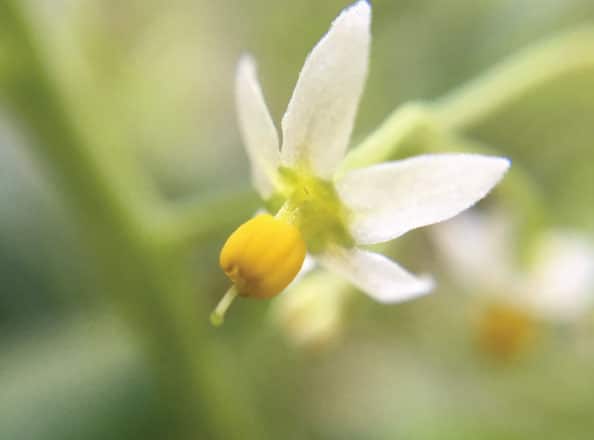
While taking a quiet walk through a garden before beginning her workday, the photographer discovered a small, unassuming flower nestled at the base of a large tree. Captivated by its intricate beauty, she utilized a macro lens to transform this tiny subject into a grand, detailed study. This image highlights the photographer's ability to find profound wonder in the overlooked corners of nature. The photograph is award-worthy for its delicate focus and the intentionality behind the composition, which elevates a fleeting, intimate moment into a striking visual narrative about the hidden majesty found in the smallest elements of our environment.
Patricia Saraiva
Born in Apucarana, Brazil, in 1969, Patricia Saraiva is a dedicated plastic surgeon whose passion for photography blossomed while documenting the childhood of her two children. After graduating from the Faculty of Medical Sciences of Minas Gerais, she balanced her medical career with an evolving artistic practice, eventually gaining recognition for her exhibitions and contributions to major art catalogs. Today, she is known for her keen eye for detail, consistently carrying a camera to capture the beauty of her surroundings, whether during her daily routines or international travels.
Resonance Score Breakdown
Transparency Note: The resonance score (12.2/20) is calculated based on social engagement metrics collected before the award announcement.
Expert Photography Reviews · 4
The Weight of Small Things
I keep a small, rusted key in a velvet-lined box, though I have long since forgotten which door it once opened. It is heavy for its size, cold against the palm, a jagged piece of iron that has outlived the lock it was meant to turn.
Read the reflection →The Architecture of the Small
In the seventeenth century, when the first microscopes were turned toward the mundane, people were shocked to find that a flea possessed a face, or that a drop of pond water teemed with invisible empires.
Read the reflection →Reviews & Comments
Share your thoughts about this award-winning photograph. Your reviews contribute to the community engagement score.
Macro lenses usually trap us in the tyranny of hyper-sharpness, yet here, the focus feels almost apologetic. It’s a safe, clinical study of a flower that I find frankly exhausting. Why resolve every petal when you could have blurred the boundaries of the garden entirely? It’s technically competent, sure, but it lacks the courage to fail. I’d trade this sterile clarity for a single, honest smear of light that actually captures the feeling of discovery.
A single bloom. It doesn’t ask for attention. It simply occupies the earth. I’ve spent minutes staring at the blurred brown of the tree bark behind it. It’s a quiet anchor. The focus is sharp, yet the surrounding blur holds the weight of the garden. I feel a sudden, sharp ache for the stillness I’ve lost today. Nothing here is accidental. The empty corner is not empty. It is a breath held.
The focal plane here is razor-thin, pushing the limits of the diffraction limit to render the stamen’s microscopic textures. Saraiva’s choice of aperture creates a bokeh that’s buttery, yet structurally sound. I’m genuinely moved by how the light refracts through the translucent petals; it’s a masterclass in capturing what the naked eye simply misses. It’s rare to see such precise control over depth of field in a garden setting. It’s truly beautiful, isn’t it?
The macro lens forces a claustrophobic intimacy. It’s a rigid geometry of petals against the chaotic bark. The spatial tension holds because the subject doesn’t drift; it’s anchored firmly at the frame’s lower fulcrum. I’ve grown weary of such sentimental garden studies, yet the structural discipline here is undeniable. The negative space is sparse, almost clinical. It’s a cold, precise architecture. It doesn’t ask for affection. It demands a rigorous, silent inspection of the form.