Tibetan by Shirren Lim
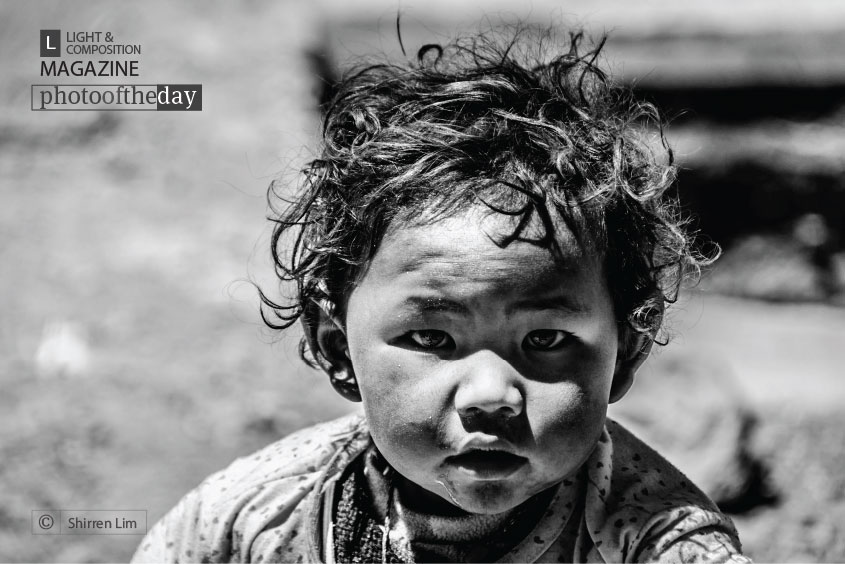
While traveling through Xegar, the photographer stepped away from a lunch stop to observe the local children at play. This portrait captures a fleeting, candid moment of childhood in the Tibetan landscape, rendered with a telephoto lens that isolates the subject against the environment. The image is award-worthy for its raw, authentic connection to the subject and the photographer’s ability to find profound humanity in an impromptu encounter. By focusing on the sincerity of the child’s expression, the photographer transforms a simple travel stop into a compelling narrative of life in the high-altitude region.
Shirren Lim
Born in Penang Island, Malaysia, in 1970, Shirren Lim is a Jakarta-based photographer who discovered her true passion for the craft in 2009. Specializing in portraiture, she seeks to capture the sincere, uncovered expressions of humanity with an intense and earthy aesthetic. Heavily influenced by the iconic work of Steve McCurry, Lim strives to create images that resonate with global significance, aiming to document the human condition through simple, heart-centered compositions that have been featured in various international publications.
Resonance Score Breakdown
Transparency Note: The resonance score (12.0/20) is calculated based on social engagement metrics collected before the award announcement.
Expert Photography Reviews · 4
The Salt of High Altitudes
The air at this height tastes of dry stone and ancient, frozen wind. It is a thin, sharp flavor that catches in the back of the throat, leaving a metallic tang that reminds you how little oxygen there is to spare.
Read the reflection →The Quiet Wisdom of Childhood
There is a particular kind of stillness found in the eyes of those who live close to the sky. It is a gaze that has not yet been clouded by the rush of the world, a clarity that arrives when one is simply allowed to be.
Read the reflection →Reviews & Comments
Share your thoughts about this award-winning photograph. Your reviews contribute to the community engagement score.
Most portraits from Xegar are mere souvenirs, but this one sticks. The 200mm compression flattens the background, forcing the child’s gaze to anchor the frame. It’s the raw, unposed defiance in those eyes that hits me—I felt a genuine ache looking at it. Many photographers would’ve over-processed the grit, but Lim let the light do the heavy lifting. It’s a rare, honest document that’ll still matter in thirty years because it captures a soul, not just a location.
Shadow isn’t merely the absence of light here; it’s the threshold where the Tibetan plateau’s harshness meets the child’s fragile gaze. Lim’s telephoto compression forces the background into a blurred, indifferent void, leaving only the subject’s face to anchor our existence. I’ve stared at this portrait for an hour, and it’s the darkness in the eyes that haunts me. It doesn’t invite us in. It demands we acknowledge the weight of a life lived against such silence.
The shutter snaps, and the world stops breathing. It’s a tight, 200mm isolation that forces us into the child’s orbit. The depth of field is a razor’s edge, blurring the Xegar landscape into a soft, cinematic bokeh. I’m struck by the eyes; they hold a gravity that demands the camera stay fixed. The cut would’ve been a mistake. It’s the frame the editor keeps because it’s where the story finally finds its pulse.
The 200mm compression flattens the Tibetan plateau into a singular, vertical plane. It’s a calculated isolation. The subject’s gaze anchors the frame, while the blurred periphery provides necessary spatial tension. The weight of the child’s head against the negative space of the sky creates a precise fulcrum. It’s structurally sound, though I’m admittedly exhausted by the sentimental framing of the subject’s expression. Still, the geometry holds. The composition doesn’t collapse under the weight of its own narrative.