The Window by Faisal Khan
Captured in Alphabet City, New York, this conceptual photograph explores the metaphorical relationship between literature and light. The photographer observed a collection of books positioned behind a window, drawing a parallel between the way light filters through glass and how reading expands the human perspective. By focusing on the interplay of illumination and the physical presence of the books, the image serves as a visual meditation on knowledge and openness. The composition is award-worthy for its ability to transform a simple, everyday scene into a profound statement on how both windows and books act as portals to the outside world.
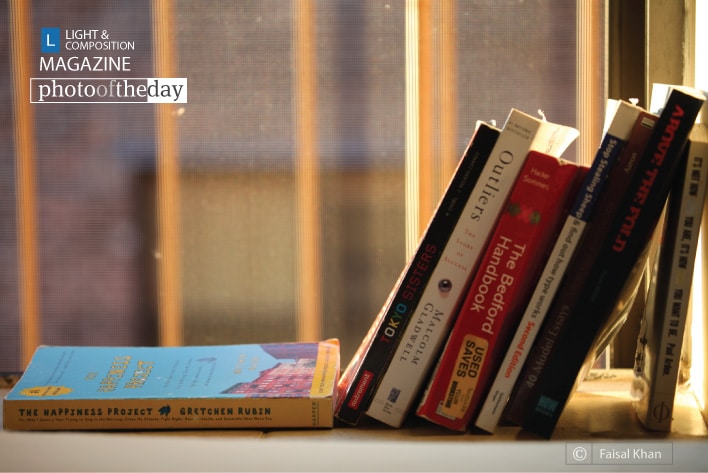
Exposure 1/40sec @ f/4.5 | ISO 200 | Focal Length 120mm
Faisal Khan
Raised in Saudi Arabia and currently based in Casablanca, Morocco, Faisal Khan is a chemical engineer turned photographer whose work is deeply rooted in his extensive global travels across 30 countries. His photographic practice serves as a meditative extension of his spiritual journey, focusing on self-discovery, nature, and the contemplation of creation. Through his lens, Khan seeks to inspire others toward positive personal transformation, viewing each captured moment as a deliberate act of awareness and a testament to the majesty of the world around him.
Resonance Score Breakdown
Transparency Note: The resonance score (11.4/20) is calculated based on social engagement metrics collected before the award announcement.
Expert Photography Reviews · 6
Portals of Quiet Light
There is a particular stillness that gathers around things left waiting. When we set a book aside, we do not merely close a story; we leave a bridge unfinished, a quiet space where the mind can return to wander.
Read the reflection →The Architecture of Silence
If a story is never read, does it still possess the weight of truth, or does it simply dissolve into the quiet dust of the room? We often treat our possessions as static anchors, things that sit still while we move around them.
Read the reflection →Reviews & Comments
Share your thoughts about this award-winning photograph. Your reviews contribute to the community engagement score.
The light here isn’t just illumination; it’s a quiet invitation. Faisal stood in the cooling hour, watching how the glass softens the world outside, turning those books into anchors of stillness. I’ve spent enough dawns waiting for the atmosphere to settle to recognize that patience. It’s a rare, fragile clarity. Looking at these spines, I feel a sudden, sharp ache for the stories we leave behind in the rush of the city. It’s beautiful, really.
Before the eye identifies the books, something in the chest softens. It’s the quiet weight of dust motes dancing in that filtered light. I feel a strange, phantom ache for a room I’ve never entered. When I return to this window a year later, the books feel less like objects and more like a held breath. It’s a rare, fragile stillness that follows me into sleep, reminding me how much we carry in silence.
We look at these books behind the glass and we aren’t just seeing paper; we’re seeing the ghosts of the people who held them. Faisal Khan has listened to the silence of Alphabet City, finding the stories waiting to be read. It’s a quiet, aching portrait of human curiosity. I find myself leaning in, wanting to touch the spines, feeling the weight of all those unshared secrets. It’s a photograph that asks to be returned to.
1/40sec at f/4.5, 120mm. Handheld telephoto work in Alphabet City demands stability, yet here we have motion blur. It’s a technical failure. At f/4.5, the depth of field is too shallow to render both glass and spine with necessary clinical precision. I’ve spent years chasing sharpness; seeing this softness hurts. The intent was a meditation on clarity, but the execution is fundamentally fuzzy. It’s a conceptual argument undermined by a shaky shutter hand.
Glass isn’t merely a transparent barrier here; it’s a filter for the soul’s own opacity. Khan’s books sit in a purgatory of half-light, trapped between the street’s chaotic glare and the interior’s heavy silence. I’ve stared at this frame for an hour, feeling a sudden, sharp ache for the stories we leave unread in the dark. It’s not about knowledge. It’s about the shadow that claims the spine of every book before we ever touch it.
At 120mm and f/4.5, the focal plane barely clings to the book spines, letting the glass’s refractive index soften the Alphabet City light into a gentle, chromatic haze. It’s a delicate dance of diffraction. I’m genuinely moved by how the lens resolves the dust motes against the paper’s texture; it’s as if the optics are breathing. Khan’s captured a fleeting optical truth here—the way knowledge filters through glass, blurring the world into pure, luminous potential.