The Wallarah Jetty by Leanne Lindsay
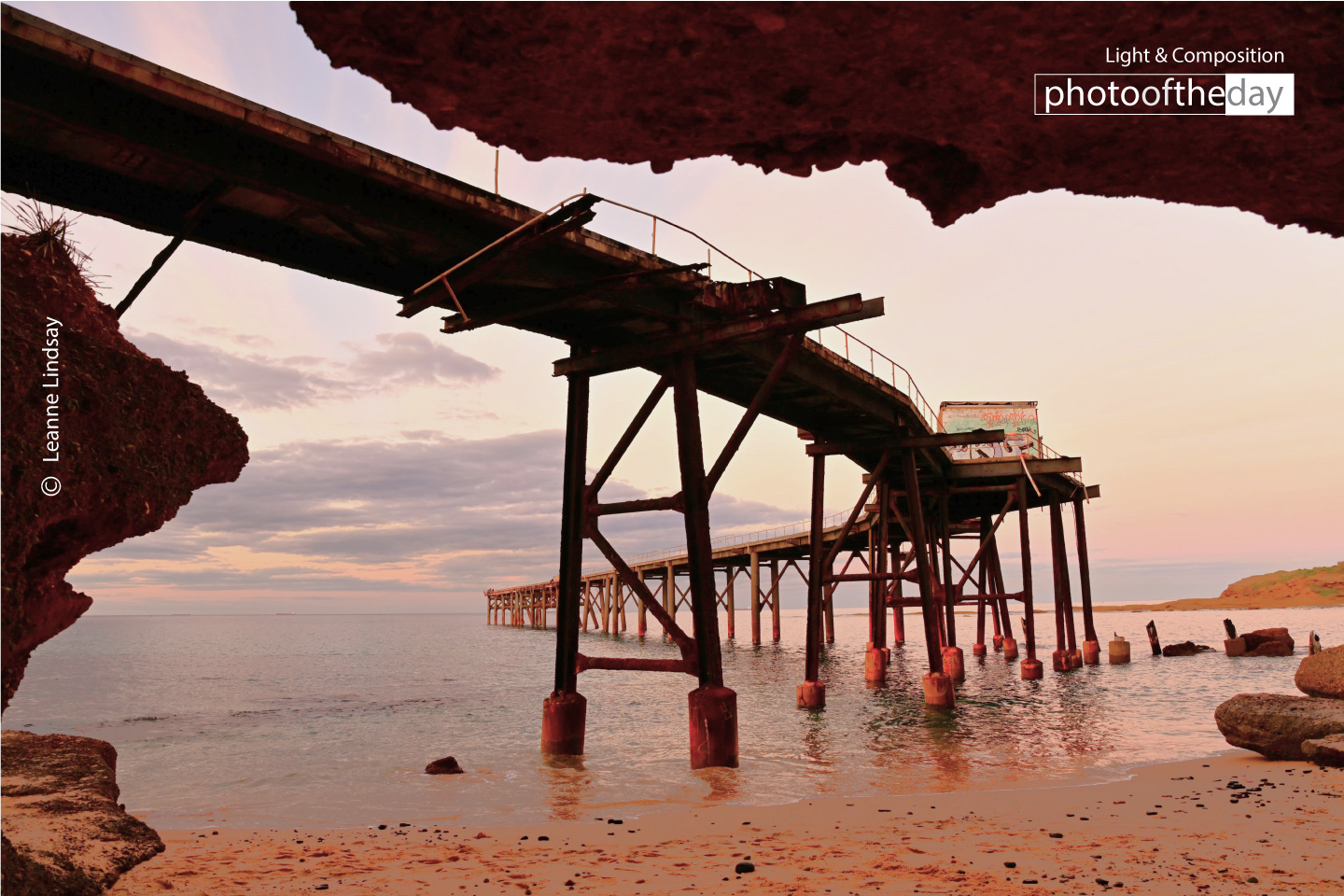
Captured during the golden hour from the vantage point of a secluded cave, this image of Wallarah Jetty at Catherine Hill Bay masterfully balances historical resonance with natural beauty. The photographer utilized the warm, fading light to cast a tranquil glow over the weathered, disintegrating piers as they merge with the ocean. By exploring various angles, the photographer successfully captured the jetty’s enduring charm, transforming the industrial relic into a mesmerizing silhouette. This photograph is award-worthy for its evocative composition and the poetic way it documents the convergence of human history and the resilient coastal landscape.
Leanne Lindsay
Born in Adelaide in 1962, Leanne Lindsay relocated to Sydney during her youth. Though her early photographic journey was interrupted by the loss of her equipment, she rediscovered her creative passion in her late fifties. Now based in Sydney, Lindsay specializes in family and newborn portraiture while maintaining a profound interest in architectural and landscape photography, capturing the world with a renewed sense of wonder and technical precision.
Resonance Score Breakdown
Transparency Note: The resonance score (7.5/20) is calculated based on social engagement metrics collected before the award announcement.
Expert Photography Reviews · 6
Where the Land Ends
I spent this morning trying to organize my bookshelf, pulling out old journals that I haven't opened in years. I found a pressed flower from a trip I took when I was twenty, and for a moment, I was back on that beach, feeling the salt air against my skin.
Read the reflection →The Architecture of Decay
Why do we find such profound comfort in things that are slowly returning to the earth? We build structures of wood and iron, convinced that our permanence is etched into the landscape, yet time is a patient sculptor that eventually claims everything for itself.
Read the reflection →Reviews & Comments
Share your thoughts about this award-winning photograph. Your reviews contribute to the community engagement score.

Before the eye identifies the jetty, a sudden stillness settles in the chest. The golden light doesn’t just illuminate the wood; it softens the edges of my own restlessness. I feel the salt air cooling my skin. When I return to this, I find the decay of the piers mirrors my own quiet losses. It’s a haunting, rhythmic pulse. I’ve found myself tracing those silhouettes in my sleep, anchored by the tide’s slow, inevitable pull.
Framing the Wallarah Jetty from a secluded cave turns a site of industrial extraction into a romanticized relic. It’s a pretty view, but I feel a strange discomfort here. Why do we sanitize this history of coal shipping by bathing it in golden light? Does the aesthetic pleasure of the silhouette erase the environmental cost of what happened on those piers? We’re looking, but are we actually seeing the scars left on this coastline?
One suspects Leanne didn’t stumble upon this cave by accident. Finding that specific angle requires a fair bit of scrambling over wet, unforgiving rock. It’s a decent composition, though I’ve seen the jetty photographed until it’s practically threadbare. Still, the light here feels honest. She’s clearly put in the hours, and frankly, my own knees ache just looking at the perspective. It’s a quiet, earned moment. She’s paid the price, and it shows.
The decaying piers evoke Hiroshi Sugimoto’s seascapes, yet the framing through the cave’s mouth adds a claustrophobic tension absent in his work. It’s a clever dialogue between industrial ruin and the eternal tide. While the golden hour light feels a bit conventional, the way the Z7ii renders the texture of those weathered pylons against the surf genuinely stopped me in my tracks. It’s a haunting, tactile reminder of how quickly our human imprints dissolve into the salt.
At f/6.3, the Sigma’s glass resolves the jetty’s splintered timber with clinical precision, pushing right against the diffraction limit. The light’s refraction through the cave’s aperture creates a stunning micro-contrast across the weathered pylons. I’m genuinely moved by how the focal plane holds that decaying wood against the soft, rolling bokeh of the Tasman Sea. It’s a rare moment where the physics of the lens perfectly captures the quiet, entropic beauty of a vanishing industrial history.
The shutter speed is too slow for the surge. At 1/40sec, the water’s motion is blurred into a soft, milky haze, losing the sharp, violent snap of the wave hitting the pylons. I’ve spent my life chasing the exact millisecond of impact, and this just doesn’t have it. It’s a pretty scene, sure, but it lacks the kinetic tension of the ocean. I wanted to feel the spray, but it’s just gone quiet.