The Spreading Lights by Rezawanul Haque
In this captivating still life, Rezawanul Haque captures the ethereal dance of light filtering through precisely designed apertures, creating a modern-day laser show with a classical, organic aesthetic. By employing a long 13-second exposure, the photographer allows the light to bloom and stretch, transforming simple illumination into a complex, rhythmic display. This image is award-worthy for its masterful control of light and shadow, demonstrating a sophisticated understanding of how technical patience can elevate a mundane subject into a mesmerizing, abstract visual experience that challenges the viewer's perception of space and luminosity.
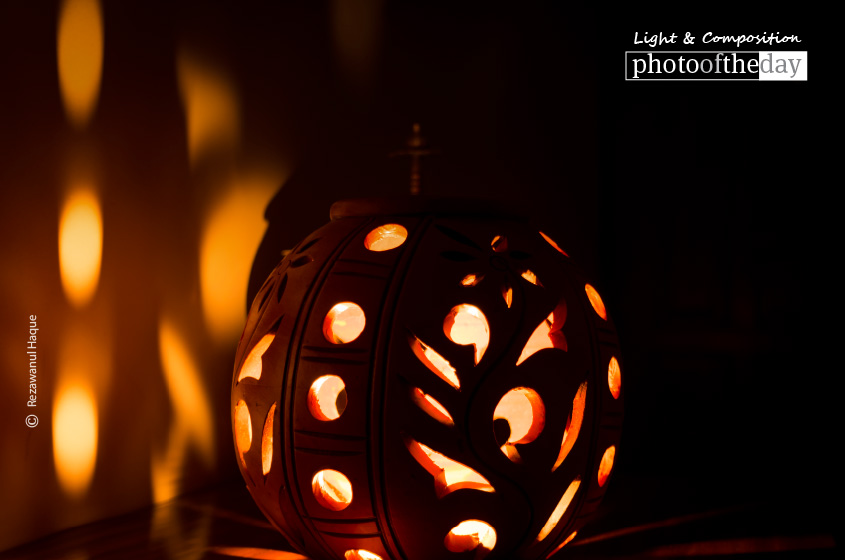
Exposure 13sec @ f/4.8 | ISO 100 | Focal Length 40mm
Rezawanul Haque
Born in the picturesque city of Rajshahi, Rezawanul Haque—also known as Saffan—is a photographer currently based in Dhaka, Bangladesh. Driven by a deep passion for exploring new cultures and culinary experiences, he views photography as a profound reflection of individual creativity and thought. His work is characterized by a playful, experimental approach to color and light, consistently seeking to capture the vibrant essence of the world around him through a unique and thoughtful lens.
Resonance Score Breakdown
Transparency Note: The resonance score (12.5/20) is calculated based on social engagement metrics collected before the award announcement.
Expert Photography Reviews · 5
The Persistence of Glow
There is a moment when the day has fully surrendered, yet the world refuses to go dark. We leave lamps burning in empty rooms, a habit born of a deep, ancestral fear of the void. We want to believe that if we keep the light alive, the silence will remain manageable.
Read the reflection →The Architecture of a Breath
In the quiet hours of the morning, before the kettle whistles or the house begins its rhythmic creaking, there is a stillness that feels almost heavy. We often mistake silence for an absence, a void waiting to be filled by the noise of our own making.
Read the reflection →Reviews & Comments
Share your thoughts about this award-winning photograph. Your reviews contribute to the community engagement score.
Most long exposures in this category feel like technical parlor tricks, but this one sticks. It’s the restraint in those thirteen seconds that keeps the light from becoming chaotic noise. I’ve seen thousands of light-trail experiments, yet the way these beams anchor into the frame creates a genuine sense of architectural weight. It’s rare to find such stillness in motion. Honestly, it makes me want to reach out and touch the air. That’s why it endures.
13 seconds at f/4.8, 40mm, ISO 100. It’s a calculated gamble on sensor noise versus motion blur. The D3200’s dynamic range is pushed, yet the long exposure holds the light trails with surprising discipline. I’ve seen enough shaky long exposures to know this required a rigid tripod. It’s technically sound, though the mid-range aperture feels a bit timid. Still, the precision here actually makes me stop and stare. It’s a rare, clean execution.
The frame’s architecture relies on the rhythmic repetition of light streaks. It’s a calculated geometry. The long exposure forces a stillness that anchors the chaotic luminosity. I’m genuinely unsettled by how the negative space doesn’t collapse under the weight of the bloom. It’s a rare instance where the technical duration justifies the spatial tension. The composition holds because the apertures dictate the boundaries. It’s precise. It’s rigid. It’s exactly what the frame demands.
Before the eye identifies the light, a sudden stillness settles in the chest. It’s a rhythmic, hypnotic bloom that pulls my pulse into its own slow, thirteen-second cadence. I feel a strange, phantom ache in my fingers, as if I’m reaching for those stretching beams. When I return to it, the darkness feels heavier, more intimate. It doesn’t just occupy space; it colonizes my quietest thoughts, lingering long after I’ve looked away. It’s hauntingly beautiful.
At f/4.8, the Nikon’s sensor captures a delicate diffraction pattern, stretching photons across the focal plane during that thirteen-second integration. It’s a fascinating study in how aperture geometry dictates the bloom of these light sources. I’m genuinely moved by the way the lens resolves these streaks; it’s as if the glass itself is breathing. The chromatic aberration is remarkably controlled, allowing the light to dance without bleeding into the shadows. It’s a beautiful, precise optical performance.