The Magnificent Mausoleum by Dipsankar Saha
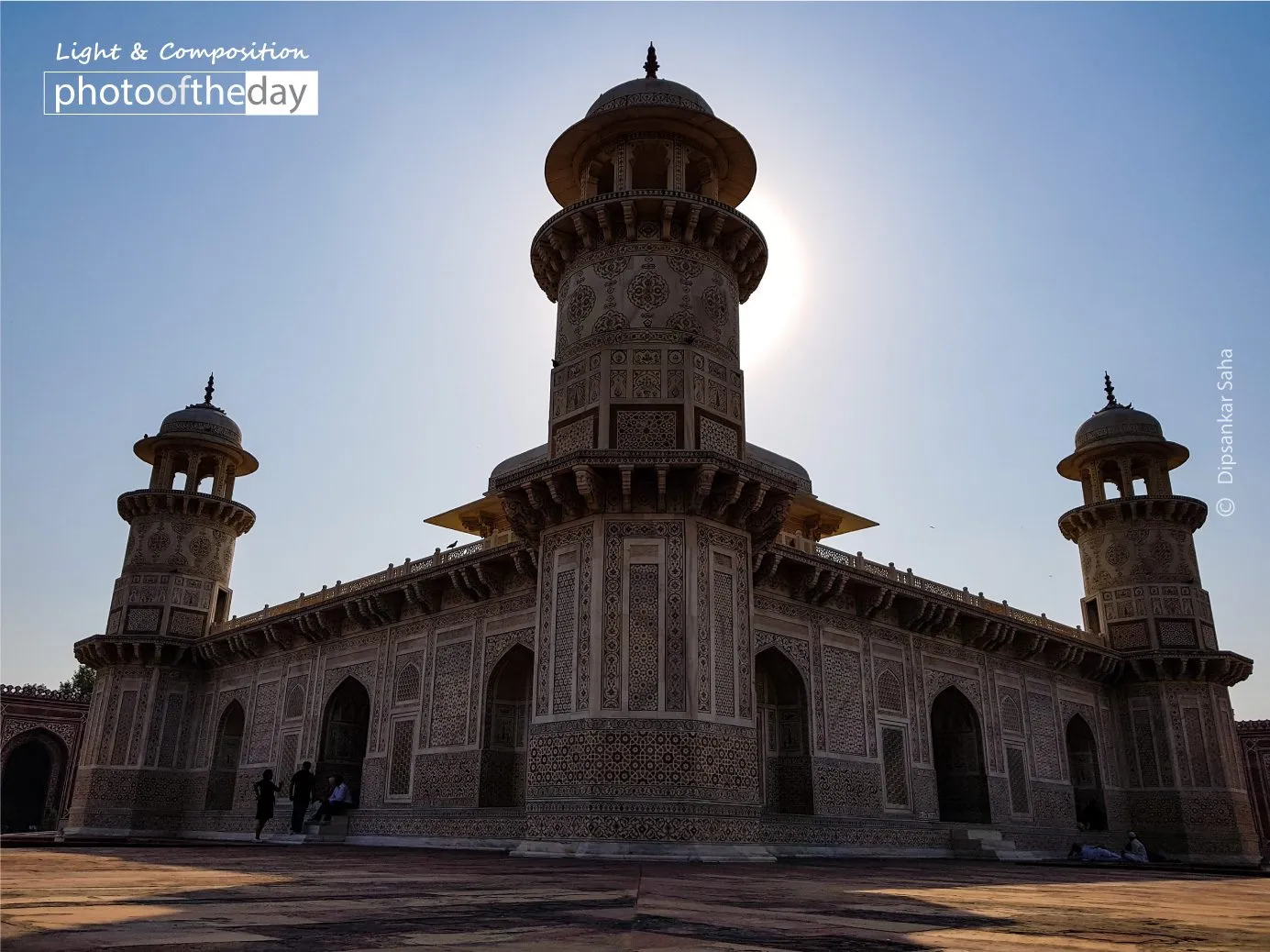
Captured at the historic Itimad-ud-daulah's Tomb in Agra, this photograph highlights the exquisite marble craftsmanship of India’s first tomb of its kind. The photographer was drawn to the site's architectural precision, specifically timing the shot to align the sun directly behind the structure. This creative decision emphasizes the building's symmetrical beauty and intricate design. The resulting image is award-worthy for its masterful use of natural light to accentuate the geometric perfection of the mausoleum, transforming a historical landmark into a striking, balanced composition that celebrates both heritage and technical photographic execution.
Dipsankar Saha
Based in the vibrant city of Kolkata, India, Dipsankar Saha is a dedicated explorer who uses photography as a lens to deepen his engagement with the world. His work is driven by a lifelong passion for travel and a desire to interact with diverse cultures far removed from his own. By documenting his adventures through an artistic perspective, he transforms fleeting experiences into intense, meaningful visual narratives that reflect his curiosity and commitment to the craft.
Resonance Score Breakdown
Transparency Note: The resonance score (11.2/20) is calculated based on social engagement metrics collected before the award announcement.
Expert Photography Reviews · 4
The Weight of Stilled Time
I often find myself wandering the backstreets of memory, looking for the places where the noise of the present finally goes quiet.
Read the reflection →The Architecture of Silence
We spend our lives building walls to keep the world out, forgetting that stone is merely earth that has learned to hold its breath. There is a quiet gravity in structures that outlive their makers, a stubborn geometry that insists on order even as the seasons erode the mortar.
Read the reflection →Reviews & Comments
Share your thoughts about this award-winning photograph. Your reviews contribute to the community engagement score.
The sun hits the lens and the frame flares, but it doesn’t break. It’s a locked-off wide, holding the symmetry of the Itimad-ud-daulah like a final act reveal. I love how the light bleeds into the marble, turning stone into something weightless. It’s a high-speed shutter freeze that catches the architecture mid-breath. The cut would’ve ruined the rhythm. It’s the frame the editor keeps because it’s the only one that truly matters. Pure, cinematic stillness.
1/7376sec at f/1.7, ISO 40, 4mm. A smartphone sensor pushed to its absolute limit. Shooting wide open at f/1.7 against the sun creates inevitable chromatic aberration along the mausoleum’s edges. It’s a messy trade-off for that shutter speed. I’m frustrated by the digital noise reduction smearing the marble’s intricate inlay work. You’ve prioritized the sunburst over the architecture’s actual texture. It’s a technical compromise that doesn’t quite hold up under scrutiny. The math simply isn’t there.
The vertical axis here is absolute, bisecting the frame into two near-perfect mirror images. Saha’s placement of the sun at the apex creates a singular point of convergence, forcing the eye to resolve the mausoleum’s complex lattice into a singular, radiant vector. I’m genuinely breathless at how the 1:1 symmetry anchors the composition. It’s a rigorous spatial equation solved with precision. When the geometry aligns this cleanly, the architecture doesn’t just exist; it vibrates.
You’ve nailed the symmetry, but I’m looking for the pulse of the place. It’s technically perfect, yet it feels a bit cold, like a postcard. I’ve stood in that heat, and I know the weight of those stones. You captured the light, but did you feel the silence of the tomb? I’d trade some of that geometric precision for a single human shadow. There’s beauty here, but it’s missing the ghost of the person who built it.