The Hunger Games by Jyoti Omi Chowdhury
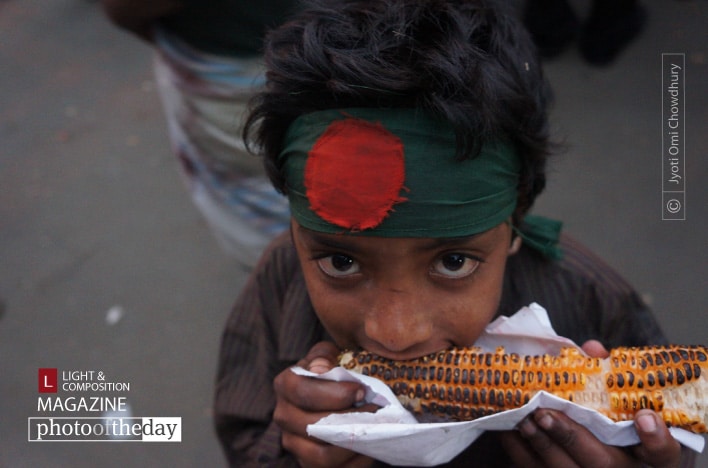
In this poignant portrait, a young boy draped in flags gazes directly into the lens, his bold expression contrasting sharply with the physical reality of his hunger. Captured in Dhaka, the image serves as a powerful meditation on the resilience of the human spirit amidst profound hardship. The photographer masterfully balances the child's patriotic display with the vulnerability of his circumstances, creating a narrative that is both intimate and universal. The image is award-worthy for its raw emotional honesty and the photographer's ability to find profound human dignity within the stark realities of life in a developing nation.
Jyoti Omi Chowdhury
Born in Dhaka, Bangladesh, Jyoti Omi Chowdhury spent his formative years navigating the complexities of a military dictatorship before pursuing academic excellence at Harvard. His photography, which explores the delicate balance between human identity and environment, has been shaped by his extensive fieldwork in conflict zones across the globe. Chowdhury’s work—celebrated for its focus on the undying human spirit—has been featured in prestigious publications like Vogue Italia and exhibited in galleries from Berlin to Abu Dhabi, establishing him as a compelling voice in contemporary portraiture.
Resonance Score Breakdown
Transparency Note: The resonance score (12.9/20) is calculated based on social engagement metrics collected before the award announcement.
Expert Photography Reviews · 6
The Weight of Flags
We are born into stories we did not write. We are wrapped in colors we did not choose, told they are our own, told they define the boundaries of our worth. There is a specific heaviness to a cloth that carries the weight of a nation when the stomach is empty.
Read the reflection →The Salt of Belonging
There is a specific grit to the air before a storm, a metallic tang that settles on the back of the tongue like copper coins. I remember the feeling of wool against my neck, damp and heavy, smelling of rain and the soot of a city that never quite stops breathing.
Read the reflection →Reviews & Comments
Share your thoughts about this award-winning photograph. Your reviews contribute to the community engagement score.
Most portraits of poverty lean on sentimentality, but this boy’s defiance cuts through that. The flags aren’t just props; they’re a jarring, saturated armor against his hollowed cheeks. I’ve seen thousands of shots from Dhaka, yet this one sticks because of that gaze—it’s not asking for pity, it’s demanding recognition. It makes me ache, honestly. It’ll endure because he isn’t a victim here; he’s a citizen, and that distinction is exactly why it won.
The boy’s gaze doesn’t ask for pity. It demands space. The flags drape him, yet the shadows behind him hold the true weight. I’ve spent minutes staring into that dark, unlit corner. It’s heavy. It’s quiet. Nothing here is accidental. The empty space isn’t empty; it’s where the hunger lives. It makes my chest ache, honestly. Chowdhury knows the discipline of restraint. He leaves enough room for the silence to breathe. It’s a rare, brutal grace.
Before the eye identifies the flags, a sharp, hollow ache settles in the chest. It’s the boy’s gaze—unblinking, heavy with a hunger that feels ancient. I’ve returned to this portrait for years, and each time, the stillness of his expression triggers a sudden, involuntary catch in my own breath. It doesn’t just document poverty; it forces a visceral, physical recognition of a dignity that refuses to be consumed by the circumstances surrounding it.
The light here isn’t the golden warmth of a landscape, but the harsh, unforgiving glare of a Dhaka afternoon. It’s flat, exposing every hollow in the boy’s face. He stood there, draped in those heavy flags, waiting for a mercy the sun doesn’t provide. I’ve felt that same stillness in the desert, where the land demands everything. It’s heartbreaking. You can see he’s listening to the light, even if it’s only telling him to endure.
1/25sec at f/4, ISO 3200, 22mm. A Sony Nex 5N pushed to its breaking point. That shutter speed is dangerously slow for a handheld portrait, yet the motion blur is negligible. It’s a technical gamble that paid off. I’ve spent years loathing high-ISO noise, but here, the grain actually reinforces the grit of the subject. It’s a harsh, clinical choice that works. I hate that I find the technical execution this compelling. It’s precise.
The frame’s geometry is tight, almost claustrophobic. The boy’s gaze anchors the center, yet the flag’s chaotic folds threaten to collapse the picture plane. It’s a precarious balance of mass. The negative space doesn’t offer relief; it traps the subject against the wall. I’m genuinely unsettled by how the composition forces the eye to confront the lack of depth. It’s a rigid, unforgiving structure that refuses to let the viewer look away from the tension.