The Hand of a Smoker by Lenka Vojtechova
In this evocative portrait, the photographer captures the weathered hand of her father while he works in the garden, a cigarette held between his fingers. Inspired by the poignant philosophy of Kurt Cobain, the image explores the quiet, contemplative nature of a habit often associated with destruction. By focusing on the texture of the skin and the delicate plume of smoke, the photographer transforms a mundane moment into a meditation on mortality and legacy. The stark, monochromatic treatment emphasizes the raw humanity of the subject, earning recognition for its powerful composition and emotional resonance.
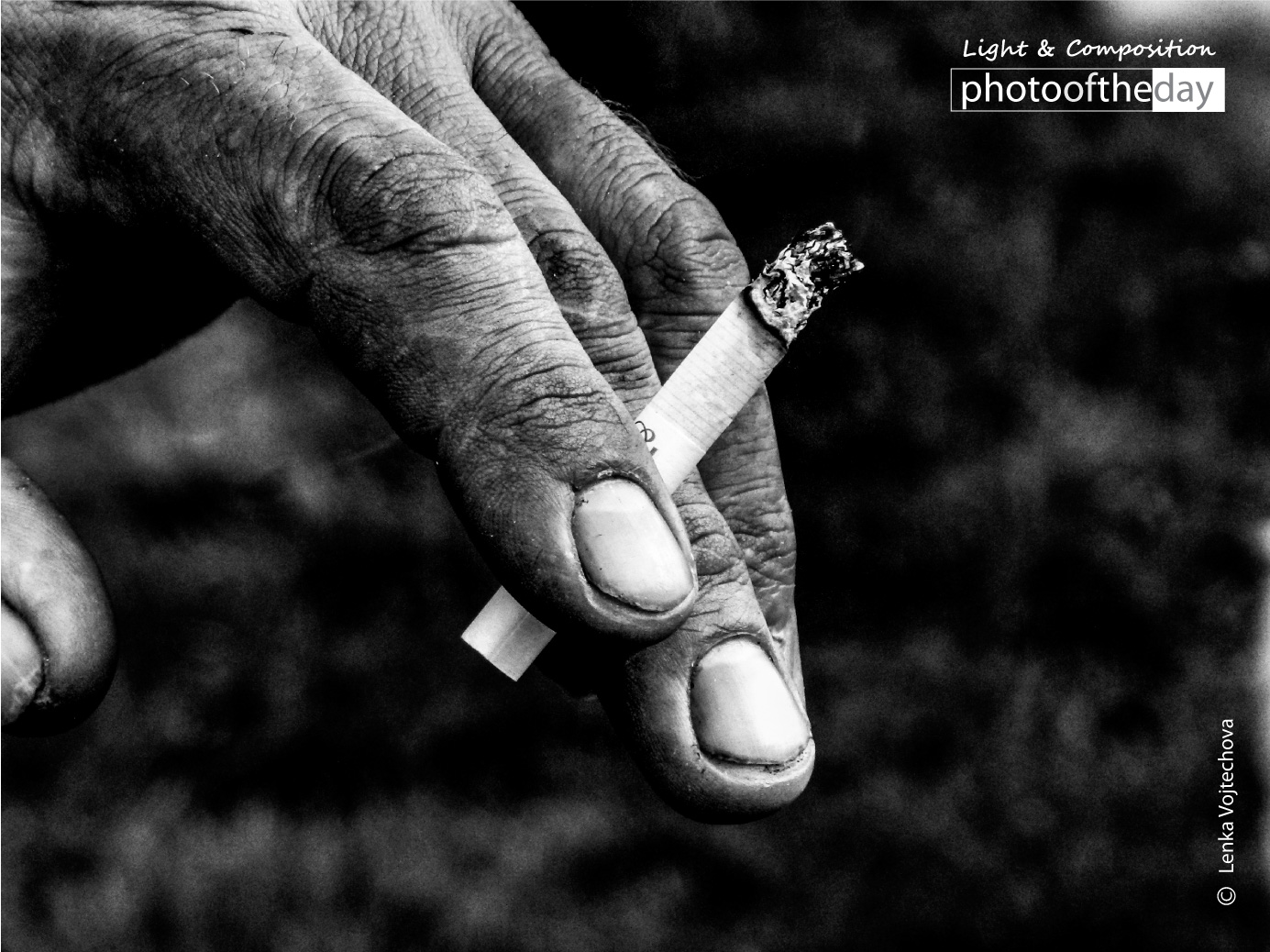
Lenka Vojtechova
Born in a small village near Tachov, Czech Republic, Lenka Vojtechova views photography as a profound form of personal therapy. A dedicated music enthusiast, she frequently draws inspiration from the energy of live performances, which she captures with a keen eye for detail. Her work is defined by a strong preference for black and white photography, a medium she believes best conveys the raw emotions, hidden feelings, and the true soul of her subjects.
Resonance Score Breakdown
Transparency Note: The resonance score (10.4/20) is calculated based on social engagement metrics collected before the award announcement.
Expert Photography Reviews · 8
The Weight of Time
Seneca once observed that we are not given a short life, but that we make it short through our own neglect.
Read the reflection →The Weight of a Quiet Life
When I was ten, I used to watch my grandfather sit on the back porch as the sun began to dip behind the orchard. He had hands that looked like maps of places I hadn't yet visited—deep, dark lines etched into skin that felt like dry parchment.
Read the reflection →Reviews & Comments
Share your thoughts about this award-winning photograph. Your reviews contribute to the community engagement score.
Most portraits of aging are sentimental, but this one avoids that trap by focusing on the friction between the skin’s topography and the cigarette’s fleeting ash. It’s a brutal, honest study of time. I’ve seen thousands of hands in frames, yet this one makes me ache for the inevitable decay of my own parents. It survives because it doesn’t romanticize the habit; it simply documents the slow, quiet erosion of a life well-lived.
The light here isn’t just illumination; it’s a quiet conversation with time itself. I’ve spent enough hours in gardens to know that specific, heavy stillness. She stood there, watching the smoke drift against the grain of his skin, waiting for the exact moment his mortality became visible. It’s a haunting, fragile grace. Looking at those weathered knuckles, I feel a sudden, sharp ache for my own father. She didn’t rush; she simply listened to the air.
Before the eye identifies the cigarette, a sudden stillness settles in the chest. The skin’s topography—those deep, etched lines—triggers a visceral recognition of time’s erosion. It’s a quiet, heavy ache. When I return to this, I don’t see a garden; I feel the phantom warmth of a hand I’ve never held. That plume of smoke isn’t just air; it’s the physical manifestation of a life slowly exhaling into the gray. It’s hauntingly intimate.
The garden’s rough textures press against the frame, grounding the subject in a life of tactile labor. That plume of smoke, curling like a ghost against the dark, isn’t just a habit; it’s a dialogue with the air itself. I’m genuinely moved by how the soil-stained skin mirrors the earth he tends. It’s a quiet, aching reminder that we’re all just transient marks on the landscape. The environment doesn’t just frame him; it defines his mortality.
Stripping away the chromatic spectrum reveals a profound, charcoal-dusted silence, reminiscent of Morandi’s muted, dusty still lifes. It’s a monochromatic meditation where the silver-grey smoke curls like a ghost against the deep, furrowed topography of skin. I’m genuinely moved by how the absence of colour forces one to confront the tactile decay of time itself; it’s a stark, aching beauty that doesn’t need a palette to whisper its heavy, mortal truths to us.
Vojtechova’s focus on the epidermis recalls the tactile obsession of Edward Weston’s late nudes, yet here, the smoke introduces a fleeting, ephemeral quality that feels distinctly post-industrial. It’s a quiet study of mortality that avoids the sentimentality of Steichen’s early portraits. I’ve spent decades cataloging these weathered hands, but the way she captures the ash against the skin’s topography actually made me catch my breath. It’s a rare, honest conversation with time itself.
The frame’s geometry hinges on the diagonal axis of the index finger. It’s a sharp, structural anchor. The smoke’s diffuse volume provides necessary counterweight to the skin’s granular topography. It doesn’t collapse into sentimentality because the negative space is held with such clinical discipline. I’ve rarely seen such a precise fulcrum. The tension between the rigid phalanges and the ephemeral plume is exquisite. It’s a rare instance where the architecture actually justifies the subject’s weight.
That plume of smoke is a fleeting nebula, dissipating in seconds while the carbon in those weathered fingers has been forged in stars for eons. It’s a quiet, terrestrial entropy. I find myself staring at the texture of his skin, thinking of the thermal noise of a sensor pushed too far. We’re all just cooling embers in the dark. It’s a fragile, beautiful collapse. I’ve never felt the weight of a human life quite like this.