The Crab That Played with the Sea by Rezawanul Haque
Captured on the sandy shores of Cox's Bazar, this intimate close-up portrays a red king crab navigating the rhythmic tides of the sea. Drawing inspiration from Rudyard Kipling’s literary classic, the photographer highlights the creature’s vibrant presence against the vast, shifting backdrop of the ocean. The image is a testament to the beauty found in nature’s smallest inhabitants, utilizing a tight focal length to isolate the crab’s intricate textures and bold colors. This award-winning shot succeeds by transforming a fleeting moment on the beach into a compelling narrative of life at the water's edge, celebrating the intersection of wildlife and the sea.
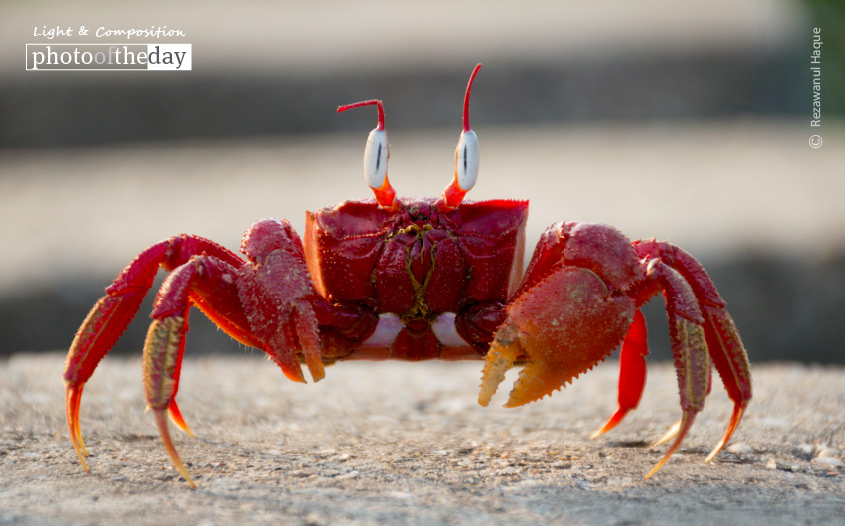
Exposure 1/125sec @ f/5.6 | ISO 200 | Focal Length 140mm
Rezawanul Haque
Born in the picturesque city of Rajshahi, Rezawanul Haque currently resides in Dhaka, Bangladesh. A passionate explorer with a deep appreciation for the sensory experiences of life, he views photography as a profound reflection of individual creativity and thought. Haque is particularly drawn to the interplay of color and flavor, translating his curiosity for the world into vivid, evocative imagery. Through his lens, he seeks to document the unknown and capture the essence of his subjects with a distinct artistic perspective.
Resonance Score Breakdown
Transparency Note: The resonance score (12.4/20) is calculated based on social engagement metrics collected before the award announcement.
Expert Photography Reviews · 7
The Architecture of the Shore
In the nineteenth century, naturalists often spoke of the shoreline as a borderland, a place where the rules of the earth and the laws of the deep collide in a perpetual, foaming negotiation. It is a messy boundary. Nothing there stays fixed for long.
Read the reflection →Small Lives, Big Tides
I spent an hour this morning watching an ant navigate the cracks in my kitchen floor. It kept hitting obstacles—a crumb, a stray hair, the sudden drop of a tile edge—but it never seemed to hesitate. It just adjusted its path and kept moving.
Read the reflection →Reviews & Comments
Share your thoughts about this award-winning photograph. Your reviews contribute to the community engagement score.
We look at this crab and we aren’t just seeing a creature; we’re meeting a traveler. Rezawanul Haque didn’t just point a lens at the sand. He waited, listening to the rhythm of the tide until the crab felt like a character in a fable. It’s a portrait of resilience. I find myself leaning in, wanting to hear the secrets it’s brought from the deep. It’s a photograph that asks to be returned to, again and again.
The crab’s shell burns with a defiance that mocks the encroaching tide. It’s a violent red, a stubborn punctuation mark against the grey, indifferent sand. I’m unsettled by how the shadows here don’t merely frame the creature; they swallow the horizon, forcing us to confront the creature’s isolation. It doesn’t play with the sea; it endures it. When I look at those dark, wet crevices, I feel the cold weight of a world that doesn’t care.
Before the eye identifies the crab, a sudden stillness settles in the chest. That vibrant, impossible red against the muted, rhythmic grey of the sand triggers an immediate physiological shift—a held-breath moment. It’s an anchor in the vastness. When I return to it, I don’t see a creature; I feel the tide’s pull. It’s a quiet, persistent ache for the shore. I’ve never felt so small, yet so perfectly, intensely present.
1/125sec at f/5.6, 140mm. It’s a narrow margin for error. At 140mm, the depth of field is razor-thin, yet the crab’s texture remains sharp. The shutter speed is barely adequate for a moving subject, but it holds. I’ve spent years hating kit lenses, but this Nikon 18-140mm actually works here. It’s a precise isolation of the subject. I’m genuinely surprised the focus didn’t drift. The technical discipline here is solid. It’s a correct, calculated capture.
At 140mm, the focal plane is razor-thin, isolating the crab’s exoskeleton against a soft, creamy bokeh. The Nikon’s sensor resolves the chitinous textures with surprising clarity, though I’d have preferred a narrower aperture to push past the diffraction limit and sharpen the peripheral legs. Still, the way the light catches those granular, wet surfaces is beautiful. It’s a rare, tactile intimacy that makes me want to reach out and touch the sand myself.
Most macro shots of crustaceans are clinical, but this one breathes. It’s the way the crab’s shell mimics the wet, granular texture of the Cox’s Bazar sand that caught me; I actually leaned in, half-expecting the tide to shift. Of the hundreds of wildlife entries I’ve judged, this succeeds because it doesn’t just document a creature. It anchors a fleeting, vibrant life against the indifferent, vast blue, ensuring we’ll still care about this tiny survivor in thirty years.
You waited for that crab to find its footing on the wet sand, and I can feel the patience in your frame. It’s a small, quiet life you’ve caught against that vast, indifferent tide. I’ve spent enough time on beaches to know how quickly these moments vanish. You didn’t just snap a picture; you looked closely enough to see the world from its perspective. There’s something honest happening here. It’s a beautiful, lonely little encounter.