The Brown-headed Gull by Saniar Rahman Rahul
Captured during the Asian Water Bird Census in February, this striking image of a Brown-headed Gull highlights the migratory beauty of a species that journeys from the high plateaus of Central Asia to the coastal wetlands of Bangladesh. The photographer utilized a 420mm focal length to isolate the gull against its natural habitat, demonstrating exceptional patience and technical precision. The photograph is award-worthy for its sharp detail and the intimate perspective it offers of this wintering visitor, masterfully freezing a fleeting moment of avian grace against the serene backdrop of the Nijhum Dwip islands.
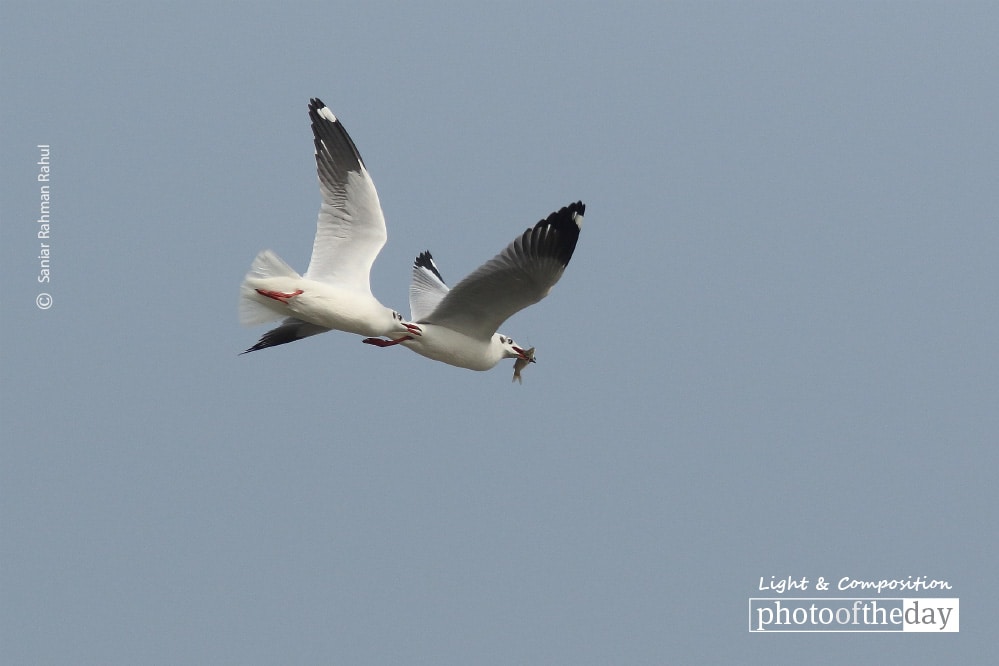
Exposure 1/3200sec @ f/7.1 | ISO 400 | Focal Length 420mm
Saniar Rahman Rahul
Based in Dhaka, Bangladesh, Saniar Rahman Rahul is an accomplished Art Director at Grey Worldwide with a career deeply rooted in the creative arts. His journey into photography began in childhood, inspired by his father, and was later refined through his extensive professional background in graphic design and advertising. Since rediscovering his passion for the lens in 1997, Rahul has become a celebrated figure in the photography community, recognized for his technical expertise and his ability to capture the natural world with a professional designer's eye for composition.
Resonance Score Breakdown
Transparency Note: The resonance score (12.1/20) is calculated based on social engagement metrics collected before the award announcement.
Expert Photography Reviews · 7
The Long Way Home
I met a woman in a cafe in Ulaanbaatar who spent her winters tracking the migration of birds across the steppes.
Read the reflection →The Architecture of Migration
To be a traveler is to live in a state of perpetual departure, carrying the map of the sky within one’s own bones.
Read the reflection →Reviews & Comments
Share your thoughts about this award-winning photograph. Your reviews contribute to the community engagement score.
Isolation is a choice, not a natural state. By stripping the Brown-headed Gull from the context of its migratory struggle, we reduce a survivor to a mere aesthetic object. Why must we sanitize the wetlands to make the bird palatable? I find the clinical sharpness here unsettling; it’s as if we’re pinning a butterfly to a board. Does this frame serve the gull, or does it simply satisfy our desire for a clean, detached view of nature?
Getting a gull to sit still while you’re knee-deep in the silt of Nijhum Dwip isn’t a task for the impatient. One suspects Rahul spent more time shivering in the reeds than he did pressing the shutter. The plumage detail is crisp, and the isolation against that soft, muted backdrop suggests he didn’t just stumble upon the bird; he earned its presence. I’ve been that cold, and frankly, it’s a decent price to pay for this.
Before the eye identifies the gull, a sudden stillness settles in the chest. The bird’s sharp, amber eye anchors the frame, pulling my pulse into its rhythmic, migratory urgency. It’s a lonely sort of clarity. When I return to this, I don’t see a bird; I feel the cold, damp wind of the Hatiya coast against my own skin. It’s haunting how such a fleeting, frozen wingbeat can make me feel so profoundly untethered.
We look at this gull and we aren’t just seeing a bird; we’re meeting a traveler who’s crossed mountains to reach the Hatiya coast. Saniar Rahman Rahul didn’t just snap a shutter; he waited until the bird felt safe enough to reveal its weary, sharp-eyed soul. It’s a portrait of migration itself. I feel a sudden, quiet ache for the distance this creature has covered. It’s a photograph that asks to be returned to, again and again.
The gull’s plumage, a muted, dusty parchment, drifts against the water’s surface—a liquid expanse of bruised, slate-grey melancholia that recalls the quiet, tonal restraint of a Morandi still life. It’s a haunting, monochromatic symphony, and I’m utterly undone by the way the light catches the bird’s eye, a sharp, obsidian spark against such soft, desaturated tides. One finds here a profound, aching stillness, where the atmosphere itself seems to hold its breath in winter.
The gull’s trajectory creates a sharp diagonal, slicing the frame into a precise 1:3 ratio of negative space. It’s a masterclass in vector alignment; the bird’s wing-span mirrors the horizon’s subtle curve, anchoring the visual gravity in the upper-right quadrant. I’m genuinely struck by how the soft bokeh resolves the background into a perfect, non-distracting plane. It’s a clean, solved equation of motion against stillness. Rahul’s geometry here is simply impeccable. I’ve rarely seen such elegant spatial economy.
The gull hangs in the air. A single point of white against the grey blur of the wetlands. It’s quiet here. I find myself holding my breath, waiting for the wings to beat, but they don’t. The frame is mostly water and distance. It’s a relief. Nothing here is accidental. The empty corner is not empty. It’s the space where the bird’s journey finally rests. I’ve never felt such stillness in a migration.