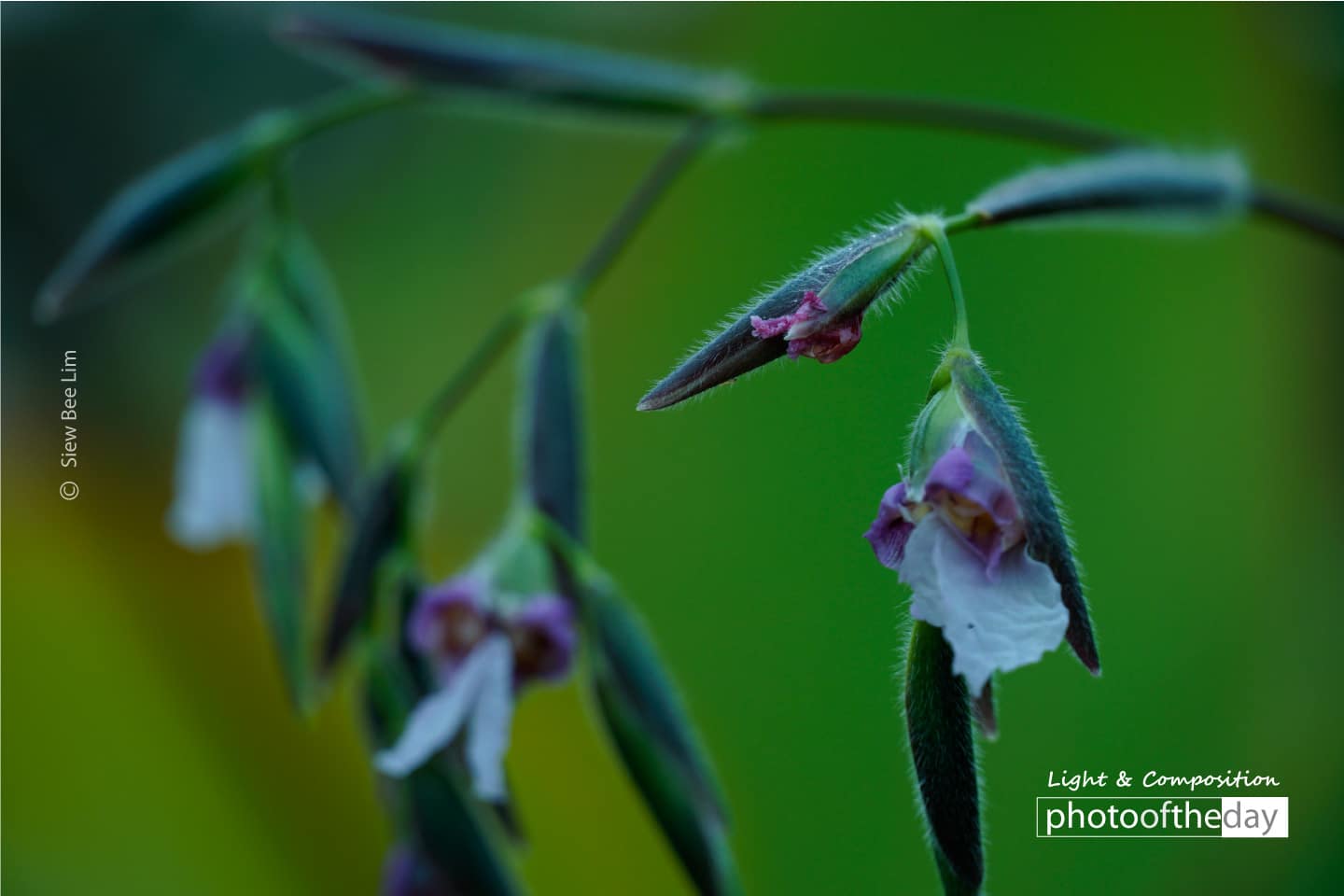
The Bent Alligator-flag by Siew Bee Lim
Captured on a bright September morning at the Chinese and Japanese Gardens, this image highlights the delicate beauty of a bent alligator-flag, or Thalia geniculata. The photographer utilized the soft, directional morning sunlight to graze the surface of the flower, emphasizing its unique texture and elegant curve against the pond's edge. By carefully balancing the exposure at 1/500 second and f/5.6, the shot achieves a crisp clarity that isolates the subject from its surroundings. This photograph is award-worthy for its masterful use of natural light and the photographer's keen eye for finding subtle, botanical elegance in a serene, natural environment.
Siew Bee Lim
Born in Singapore in 1965, Siew Bee Lim is a dedicated photographer who has rekindled her passion for the craft through the Light & Composition platform. Although she began her journey as a hobbyist during her early career as a programmer, she is now committed to formalizing her skills and developing a deeper artistic perspective. Drawing inspiration from her lifelong appreciation for literature and traditional Chinese painting, she continues to refine her technical execution, proving that a creative eye can be cultivated at any stage of life.
Resonance Score Breakdown
Transparency Note: The resonance score (11.7/20) is calculated based on social engagement metrics collected before the award announcement.
Expert Photography Reviews · 5
The Weight of the Curve
There is a specific, heavy stillness that arrives just before the sun fully asserts itself, when the air is thick with the residue of the night’s cooling. In the north, we learn to watch for the moment a stem begins to bow under the weight of its own vitality.
Read the reflection →The Grace of the Bend
Seneca once remarked that the man who is prepared for the changes of fortune is the only one who remains unshaken. We often mistake rigidity for strength, believing that to stand tall and unyielding is the highest virtue. Yet, nature teaches a different lesson entirely.
Read the reflection →Reviews & Comments
Share your thoughts about this award-winning photograph. Your reviews contribute to the community engagement score.
It’s technically competent, sure, but that’s precisely the problem. By freezing the Thalia geniculata at 1/500th, Lim has suffocated the plant’s inherent movement. I’d have traded that clinical sharpness for a long exposure that allowed the wind to smear the alligator-flag into a ghost. Why resolve every vein when you could capture the rhythm of the pond? It’s a safe, polite observation, but it leaves me cold. Where’s the risk? Where’s the blur?
You waited for that light to catch the curve, and it shows. There’s a quiet patience in how you isolated that bent alligator-flag. I’ve spent years chasing human faces, but looking at this, I felt a sudden, strange stillness—like the morning air itself. It’s not just a plant; it’s a breath held in the heat. You didn’t force the scene. You let the garden speak, and I respect that kind of restraint. It’s honest work.
Before the eye identifies the curve of the Thalia geniculata, something in the chest softens. It’s a quiet, rhythmic activation. The light grazing that bent stem feels like a held breath, a stillness I’ve felt only in the deepest parts of a garden. When I return to this, I don’t see a plant; I feel the weight of that morning sun. It’s a fragile, elegant ache that stays with me long after I’ve turned away.
It’s a clean bit of work, though one wonders if the morning dew required a second visit or just a lucky Tuesday. The light grazes that curve with a precision that suggests a photographer who didn’t mind getting their knees damp. I’ve spent enough hours waiting for a breeze to die down to appreciate the stillness here. It’s a quiet, earned moment. I find myself wanting to touch the petal, which is high praise indeed.
Architecture isn’t just stone and steel; it’s the rhythm of the landscape. Lim’s alligator-flag captures that delicate tension between solid and void. The light grazes the curve, defining its mass against the pond’s depth. I’ve spent years studying how fenestration dictates our movement, but here, the plant’s geometry creates its own threshold. It’s a quiet, structural elegance that makes me want to reach out and trace that arc. It’s a rare, honest moment of stillness.