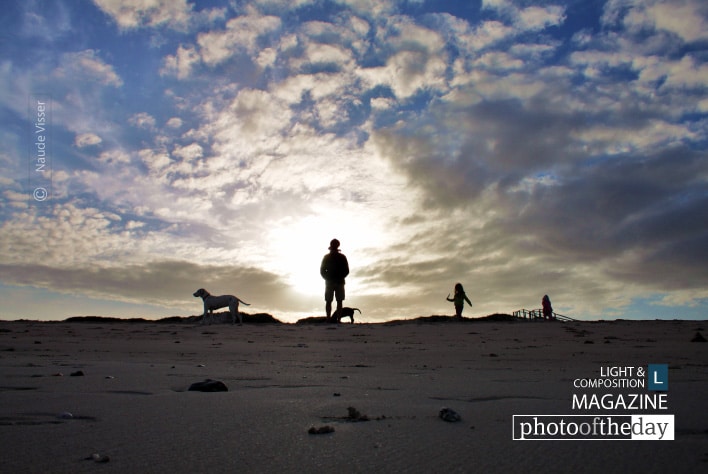
Sunset Silhouette by Naude Visser
Capturing the fleeting magic of twilight, Naude Visser utilized a low-angle perspective to emphasize the textures of the shoreline. By mounting his camera on a tripod and employing a self-timer, he successfully integrated himself into the frame alongside the children and dogs. This deliberate choice of composition transforms a simple beach scene into a compelling narrative of connection and leisure. The silhouette against the vibrant sunset highlights the interplay between light and shadow, demonstrating a keen eye for artistic storytelling that elevates this candid moment into an award-worthy photograph.
Naude Visser
Born in Harrismith and raised in Pretoria, Naude Visser is a South African lawyer who has recently embraced photography as a creative pursuit. Based in the Vredehoek suburb of Cape Town, he frequently draws inspiration from the scenic landscapes along the route to his family holiday home in Struis Bay. Though he considers himself a novice, his work reflects a dedicated willingness to learn and a deep appreciation for the natural beauty of the Western Cape.
Resonance Score Breakdown
Transparency Note: The resonance score (10.6/20) is calculated based on social engagement metrics collected before the award announcement.
Expert Photography Reviews · 8
The Ink of Evening
We are all, in the end, just shadows cast against the closing of the day. There is a specific language to the hour when the sun dips low, turning the world into a theater of silhouettes.
Read the reflection →The Hour of Long Shadows
I remember sitting on the porch in Oamaru with an old fisherman named Elias. He told me that the best time to understand a person isn't when they are speaking, but when they are walking away from you, toward the water, at the end of the day.
Read the reflection →Reviews & Comments
Share your thoughts about this award-winning photograph. Your reviews contribute to the community engagement score.
The tide pulls back, leaving a stage of wet sand. It’s a wide shot, low and intimate. Visser steps into his own frame, anchoring the composition. The silhouette of the dogs and children against that bruised, golden horizon feels like the final beat of a film before the credits roll. I’ve seen a thousand beach sunsets, but this one holds. It’s the frame the editor keeps because the rhythm of the light is just perfect.
Before the eye identifies the figures, a sudden stillness settles in the chest. It’s the weight of that low horizon, pulling the breath downward. I feel a phantom ache in my own shins, remembering the cold, wet sand of Struis Bay. When you return to this, the silhouettes don’t just represent connection; they become your own lost evenings. It’s a quiet, rhythmic pulse of memory that follows me into sleep, long after the light fades.
The frame resolves into a precise 1:2 ratio of foreground texture to atmospheric gradient. Visser’s low-angle placement creates a powerful convergence, pulling the eye along the shoreline’s diagonal toward the central cluster of silhouettes. That grouping acts as the image’s visual gravity, anchoring the expansive sky. It’s a beautifully solved spatial equation. I’m genuinely struck by how the dogs’ vectors mirror the children’s, balancing the frame’s weight perfectly. It’s geometry that breathes, and I love it.
The horizon line bisects the frame with clinical indifference. It’s a rigid anchor, yet the foreground clutter disrupts the spatial tension. The silhouettes lack the necessary geometric discipline to command the picture plane. They’re merely scattered noise against a gradient. I’ve grown weary of such sentimental framing. It doesn’t hold. The composition demands a more rigorous placement of mass to justify the low-angle perspective. It’s technically sound, but compositionally, it’s just drifting.
You stepped into the frame, and that changes everything. It’s not just a sunset; it’s a memory you’re sharing with those kids and dogs. I’ve spent years chasing moments, and there’s something honest happening here. You waited for the light to die, and you didn’t just watch—you belonged there. It makes me miss my own childhood summers. You didn’t just take a picture; you lived in it. That’s the only way to get this right.
The tide recedes. It leaves behind a mirror of wet sand. Figures stand small against the horizon. They don’t crowd the frame. They inhabit the silence. I’ve spent minutes watching the dogs trace the water’s edge. It’s quiet here. The vast sky pulls the eye upward, away from the noise of the day. Nothing here is accidental. The empty corner is not empty. It’s a breath held in the cooling air. I feel a sudden, sharp peace.
At f/11, the diffraction limit begins to soften the micro-contrast, yet Visser’s 18mm focal plane holds the wet sand’s texture with surprising rigor. The light’s refraction across the tidal film creates a luminous, planar geometry that’s physically arresting. I’m genuinely moved by how the silhouette’s edge-acutance separates the figures from the chromatic bleed of the horizon. It’s a rare moment where the sensor’s limitations don’t matter; the physics of the sunset simply resolve into pure, quiet joy.
Most beach silhouettes are forgettable, but this one sticks. By placing himself in the frame, Visser shifts the focus from a pretty sunset to a shared human experience. It’s the low angle that saves it; the wet sand’s reflection anchors the figures, grounding their fleeting joy against the vast, fading light. I’ve seen thousands of these, yet this one makes me miss my own childhood. It’s a quiet, enduring anchor in a sea of digital noise.