Sunset by Payman Mollaie
Captured during the golden hour in Taleghan, this photograph highlights the serene interplay between a solitary tree and the fading light of a sunset. The photographer skillfully utilized the soft, diffused glow of the evening to emphasize the tree's silhouette, creating a tranquil and evocative atmosphere. By carefully adjusting the exposure, the image achieves a delicate balance between the warmth of the sky and the intricate details of the landscape. This piece is award-worthy for its masterful use of natural light and its ability to transform a simple, classic subject into a poignant study of stillness and beauty.
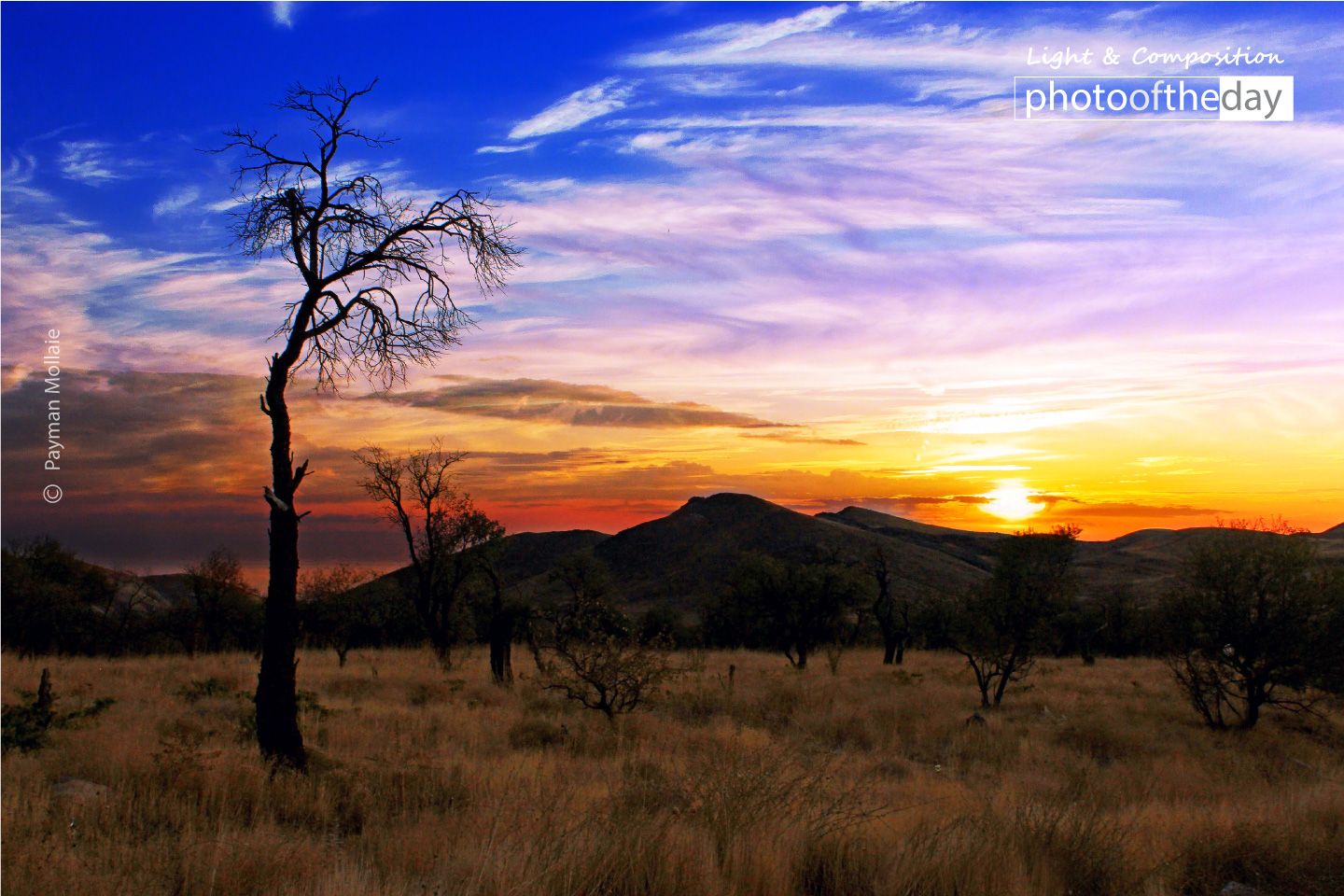
Exposure 1/40sec @ f/7.1 | ISO 640 | Focal Length 27mm
Payman Mollaie
Born in 1981 in Qazvin, Iran, Payman Mollaie is a dedicated photographer with a profound appreciation for the minimalist aesthetic. While he frequently works with analogue equipment like his Yashica camera, his portfolio demonstrates a keen eye for composition and a deep passion for travel. Mollaie is particularly drawn to the stark, clean beauty of snow-covered landscapes, which he believes offer the perfect canvas for his minimalist approach to photography. His work continues to capture the quiet, atmospheric essence of the Iranian countryside.
Resonance Score Breakdown
Transparency Note: The resonance score (1.4/20) is calculated based on social engagement metrics collected before the award announcement.
Expert Photography Reviews · 6
The Architecture of the Evening
In the high deserts of the mind, there is a quiet shift that occurs just before the stars assert their claim. It is not quite day, and it is certainly not yet night. The light seems to thicken, turning the air into a substance you could almost hold in your palm.
Read the reflection →The Long Shadow of Evening
There is a specific grace in the way the day surrenders to the night. It is not a sudden departure, but a slow, deliberate folding of light into shadow. We spend so much of our lives chasing the high noon of productivity, fearing the dimming of our own internal sun.
Read the reflection →Reviews & Comments
Share your thoughts about this award-winning photograph. Your reviews contribute to the community engagement score.
The frame’s architecture relies on the tree’s verticality to anchor the horizon’s drift. It’s a precarious balance. The negative space above the canopy doesn’t quite hold the weight of the foreground, creating a slight, unsettling tilt. I’ve grown weary of such sunset tropes, yet the silhouette’s sharp edge against the gradient provides a necessary, rigid geometry. It’s technically sound, though the composition’s fulcrum remains dangerously soft. It’s a disciplined study, even if it’s nearly too quiet.
1/40sec at f/7.1, ISO 640, 27mm. The sensor noise at ISO 640 on a 550D is a poor trade-off for a handheld sunset. It’s grainy where it should be crisp. Stopping down to f/7.1 was the right call for depth, but the shutter speed is sluggish. I’ve spent years staring at these histograms; the lack of shadow recovery hurts. It’s technically compromised. I find myself wishing for a tripod and a lower base ISO.
You waited for the light to die, and it paid off. There’s a quiet ache in that solitary tree against the Taleghan sky that feels like a long-held breath. I’ve spent enough time in landscapes like this to know that silence isn’t empty; it’s heavy. You didn’t just capture a sunset. You captured the feeling of being small in a vast, fading world. It’s honest work. I felt a genuine peace looking at it.
Before the eye identifies the silhouette, something in the chest tightens. It’s the sudden, quiet gravity of the Taleghan dusk. My pulse slows, matching the stillness of that solitary tree against the fading amber. I’ve returned to this frame three times today, and each time, the horizon feels a little further away. It doesn’t just capture a sunset; it triggers a hollow, aching recognition of solitude that lingers long after I’ve looked away.
Of the thousands of landscapes I’ve judged, most rely on cheap drama. This one doesn’t. It’s the restraint that matters here. By keeping the tree’s silhouette grounded against that muted, bruised horizon, Mollaie avoids the usual sunset clichés. It’s quiet, and honestly, it makes me want to breathe deeper. In thirty years, this stillness will still feel honest. It’s not just a pretty view; it’s a rare, disciplined study of light that refuses to shout.
Taleghan’s light hits different, doesn’t it? I’m looking at this silhouette and I feel that familiar ache of a day ending. It’s quiet, sure, but is it decisive? Cartier-Bresson would’ve waited for a bird to break that horizon. One tenth of a second later and the light shifts, the frame breathes. It’s beautiful, but it’s a landscape, not a pulse. I want the street’s chaos, not just the sun’s slow, predictable descent.