Stairs by Patricia Saraiva
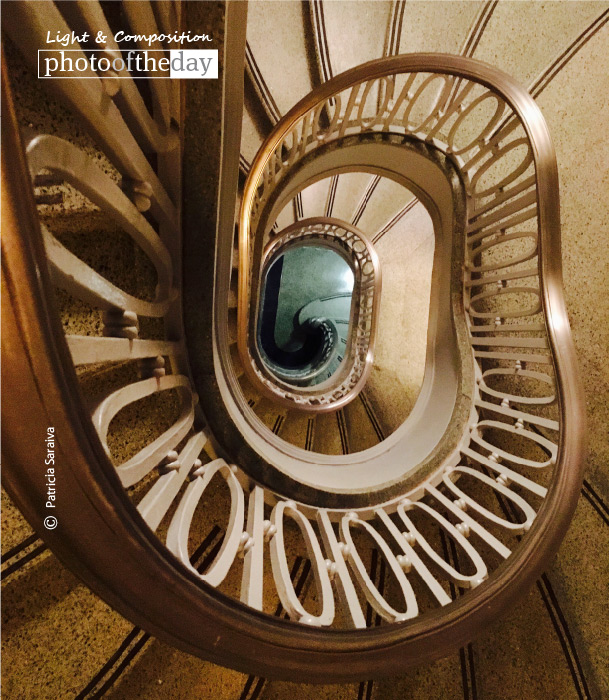
While staying in a hotel, the photographer opted for the stairs instead of the lift, discovering a stunning architectural marvel. The scene captures a golden handrail winding in a perfect spiral, a geometric delight that transformed a mundane transit moment into a beautiful surprise. The image is award-worthy for its keen eye for hidden beauty in everyday environments, utilizing the natural symmetry of the staircase to create a compelling, rhythmic composition. By focusing on the interplay of light and form, the photographer elevates a simple architectural detail into a striking visual narrative.
Patricia Saraiva
Born in Apucarana, Brazil, in 1969, Patricia Saraiva is a dedicated plastic surgeon who discovered her passion for photography while documenting the growth of her two children. Her work has evolved from personal family records to professional recognition, including her notable 2011 exhibition, 'Barcelona Balconies,' and contributions to the catalog of Baroque artist Antonio Francisco Lisboa. Today, she balances her medical career with a committed photographic practice, capturing the world around her with both professional cameras and mobile devices to share her unique perspective with an international audience.
Resonance Score Breakdown
Transparency Note: The resonance score (12.3/20) is calculated based on social engagement metrics collected before the award announcement.
Expert Photography Reviews · 6
The Architecture of Transit
We often treat the city as a series of destinations—points on a map connected by the shortest possible distance. In this rush, we overlook the connective tissue of our environment: the stairwells, the corridors, and the thresholds that facilitate our movement.
Read the reflection →The Rhythm of Ascent
We often move through our days as if we are walking on flat ground, eyes fixed on the destination, forgetting that life is a series of gentle elevations.
Read the reflection →Reviews & Comments
Share your thoughts about this award-winning photograph. Your reviews contribute to the community engagement score.
The camera tracks the descent, catching the golden rail as it cuts through the frame like a rhythmic edit. It’s a dizzying, kinetic loop. I’ve walked past a thousand stairwells, but this one stops the clock. The shutter speed at 1/15sec captures a blur of intent, turning a mundane transit into a sequence that refuses to resolve. It’s the frame the editor keeps because the movement is already trapped inside the steel. I’m breathless.
Before the eye identifies the architecture, a sudden vertigo pulls at the stomach. That golden spiral doesn’t just sit there; it demands a rhythmic, hypnotic descent. I feel my breath hitching, caught in the repetition of the curve. It’s a dizzying, beautiful trap. When I return to this months later, the silence of that stairwell still echoes in my chest. It’s the kind of geometry that makes you feel small, yet perfectly, terrifyingly centered.
The spiral’s geometry dictates the frame’s internal logic. It’s a relentless, rhythmic descent. The golden handrail acts as a fulcrum, anchoring the negative space against the stark verticality of the stairwell. It doesn’t rely on sentiment; it relies on the absolute precision of the curve. I’ve rarely seen a mundane transit point hold such structural authority. The composition demands total attention. It’s a rare instance where the architecture’s inherent tension is perfectly contained by the lens.
There’s a quiet holiness in this spiral. Patricia didn’t just find a staircase; she listened to the way the light climbed those golden rails, turning a mundane transit into a prayer of geometry. I’ve spent hours waiting for such stillness in the wild, yet here it is, tucked away in a Chicago hotel. It makes me catch my breath. She waited for the light to settle, and in that patience, she found the infinite.
At f/2.2, the iPhone’s tiny sensor struggles with the diffraction limit, yet the golden handrail’s curvature remains remarkably crisp. The focal plane tracks that spiral with a precision that’s frankly startling for such a small optic. I’m genuinely moved by how the light catches the metal’s edge, creating a rhythmic, geometric tension. It’s a rare moment where the limitations of mobile glass don’t matter; the physics of the spiral simply command your total attention.
1/15sec at f/2.2, ISO 640, 4.2mm. The iPhone 6s sensor is screaming at that ISO. You’ve got significant noise in the shadows, and the motion blur from a 1/15 shutter speed is unforgivable for architectural geometry. It’s a handheld compromise that muddies the spiral’s precision. I’m genuinely frustrated by the lack of a tripod here. The composition is rhythmic, sure, but the technical execution is lazy. It’s a missed opportunity for true clarity.