Son of Soil by Abhishek Dutta
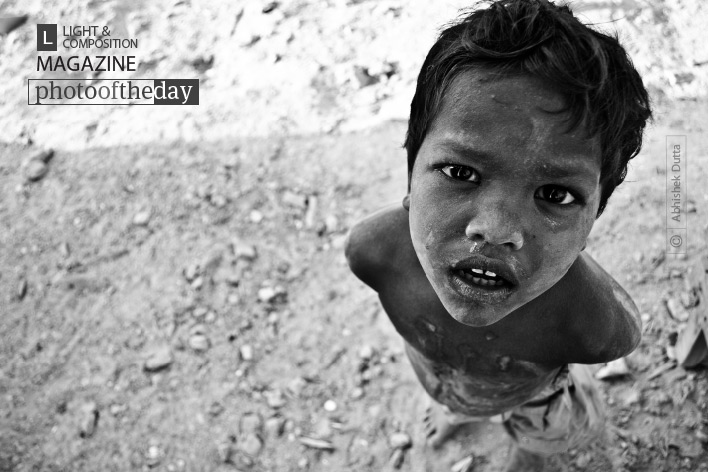
Captured in the tribal village of Surjapur, this portrait documents a candid moment of childhood curiosity. When the photographer arrived, the local children were immediately drawn to the visitors, gathering around to ask questions with infectious energy. By isolating this child against the rustic backdrop, the photographer highlights the raw, unposed spirit of rural life. The choice to convert the image to black and white emphasizes the textures and the subject's expressive gaze, stripping away distractions to focus on the human connection. This portrait is award-worthy for its authentic storytelling and the photographer's ability to capture a fleeting, genuine interaction in a remote setting.
Abhishek Dutta
Based in Kolkata, West Bengal, Abhishek Dutta balances a career in the private sector with a deep-seated passion for photography. What began as a childhood hobby has evolved into a serious creative pursuit over the last several years. Despite the constraints of a busy professional life, Dutta frequently travels to document the world around him, finding inspiration in the people and landscapes of India. His work reflects a dedicated commitment to capturing authentic human moments through a lens of curiosity and travel.
Resonance Score Breakdown
Transparency Note: The resonance score (13.2/20) is calculated based on social engagement metrics collected before the award announcement.
Expert Photography Reviews · 6
The Weight of a Gaze
I was waiting for the bus this morning when a young boy, maybe seven or eight, stopped dead in his tracks to stare at my umbrella.
Read the reflection →The Weight of Unspoken Questions
There is a specific gravity to the gaze of a child who has not yet learned to perform for the world. We spend our adult lives curating the expressions we offer to strangers, building small, polite walls of muscle and habit around our true thoughts.
Read the reflection →Reviews & Comments
Share your thoughts about this award-winning photograph. Your reviews contribute to the community engagement score.
Stripping away the chromatic spectrum feels like a betrayal of the soul, for even in monochrome, one senses the ochre dust of Surjapur yearning for the warmth of a Turner sunset. It’s a tragedy to lose the golden, sun-baked skin tones, yet the silver-grey light clinging to his eyes creates a haunting, Morandi-esque stillness. I’m genuinely aching for the rich, earthy pigments that must have lived here, as this grayscale ghost leaves me feeling strangely, beautifully hollow.
It’s easy to snap a child when they’re already crowding the lens. One suspects the shutter was clicked the moment the novelty of the visitor wore off. I’ve spent enough afternoons in the mud to know that true portraiture requires becoming part of the furniture, not just a passing curiosity. The gaze here is sharp, but I wonder if the photographer ever sat in the dust long enough to be ignored. It’s a decent shot, but it feels rushed.
The dust of Surjapur settles here. He stood in the cooling hour, waiting for the boy’s gaze to align with the quiet truth of the earth. It’s not just a portrait; it’s a conversation with the soil itself. I’ve felt that same stillness, where the shutter waits for the soul to surface. The monochrome texture pulls me in, making me ache for the simplicity of that life. He didn’t take this; he let it happen.
Most portraits from rural India lean on poverty as a crutch, but this child’s gaze cuts through that cliché. I’ve seen thousands of these, and it’s the wide-angle distortion—pushing the nose forward while the background blurs into the dust—that makes this feel visceral. It’s not just a face; it’s a confrontation. I actually felt a pang of nostalgia looking at those eyes. It’s a rare, honest moment that’ll still matter in thirty years.
Shadow isn’t just an absence here; it’s the soil itself, clinging to the boy’s skin. Dutta’s frame doesn’t shy away from the darkness that defines the rural experience. I’m haunted by how the light barely grazes his cheek, leaving the rest to the void. It’s a brutal, honest geography. When I look at those eyes, I don’t see curiosity. I see the heavy, silent weight of a future already etched in the dust. It’s profoundly unsettling.
At 18mm, the D3000’s sensor struggles with the diffraction limit, yet the focal plane here captures the boy’s iris with startling acuity. The f/5.0 aperture renders the background blur as a soft, chaotic function of the lens’s optical construction, isolating his gaze. It’s the micro-contrast in his skin texture that truly moves me; I’ve rarely seen such raw, unmediated light resolve so beautifully. It’s a hauntingly precise collision of glass and human spirit.
great quality photo, with good unique style