Snow on Rose Hips by Lothar Seifert
In this evocative close-up, Lothar Seifert captures the delicate interplay between winter’s chill and the vibrant resilience of nature. The image highlights bright red rose hips dusted with fresh snow, creating a striking color contrast that emphasizes the beauty of the season. By focusing on the intricate textures of the frozen fruit, Seifert transforms a simple natural subject into a compelling study of form and light. The photograph is award-worthy for its precise composition and the photographer's ability to find profound, quiet beauty in the small, often overlooked details of the winter landscape.
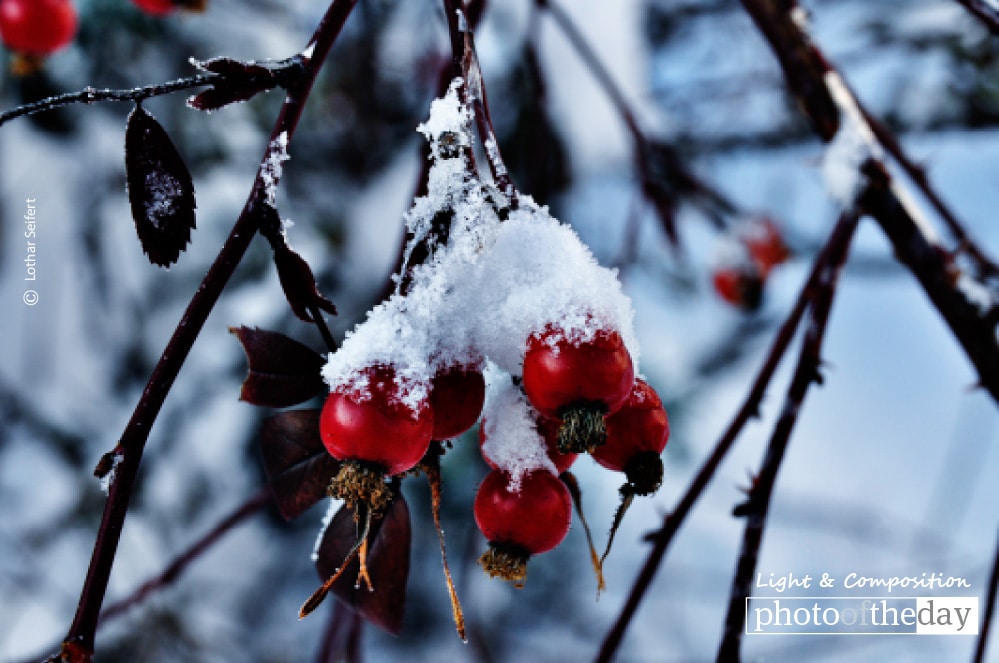
Exposure 1/250sec @ f/10 | ISO 360 | Focal Length 70mm
Lothar Seifert
Born in Germany in 1955, Lothar Seifert resides in a small village in Upper Lusatia, where he balances his professional career as a design engineer with a deep passion for photography. His work is heavily influenced by his extensive travels through Asia, particularly his experiences in Nepal, Kashmir, and India, which have fostered a profound interest in road and portrait photography. Beyond his cultural documentation, Seifert is a dedicated macro photographer who uses his lens to highlight the beauty of nature and advocate for environmental conservation.
Resonance Score Breakdown
Transparency Note: The resonance score (12.2/20) is calculated based on social engagement metrics collected before the award announcement.
Expert Photography Reviews · 8
Winter’s Quiet Persistence
I walked to the mailbox this morning in a heavy coat, shivering as the wind cut through my scarf. Everything looked gray and tired, the kind of day that makes you want to retreat back under the covers.
Read the reflection →The Resilience of the Margin
We often mistake the city for its stone and steel, forgetting that the most vital urban narratives are written in the margins. In the cracks of the sidewalk or the neglected corners of a public park, life persists in defiance of the master plan.
Read the reflection →Reviews & Comments
Share your thoughts about this award-winning photograph. Your reviews contribute to the community engagement score.

Before the eye identifies the red, something in the chest tightens. It’s the sudden, sharp intake of air that comes with a frost-bitten morning. The contrast between the biting white snow and those bruised, crimson hips triggers a visceral memory of winter’s silence. I’ve returned to this piece three times today; it doesn’t just sit on the screen. It settles into my pulse, reminding me that even in the deepest freeze, something is still holding on.
The cinnabar intensity of these rose hips, bleeding warmth against the crystalline, chalky white of the frost, evokes a Morandi-esque stillness that I find utterly intoxicating. It’s a chromatic collision where the frigid, pale blue shadows of the snow don’t merely frame the fruit; they amplify its visceral, pulsing vitality. One feels the biting Saxon air, yet the sheer, saturated heat of that red makes my own heart ache with a sudden, quiet longing.
The frame holds its breath. It’s a tight, rhythmic close-up where the winter chill bites hard against that defiant, bleeding red. Seifert’s shutter speed caught the exact moment the snow settled, freezing the motion of a season mid-sentence. I’ve spent hours watching winter footage, but this single shot feels like the perfect cut. It’s quiet, precise, and honestly? It makes me want to reach out and brush the frost away. A beautiful, lingering take.
The composition relies on a tight triangular distribution of the rose hips, creating a stable, recurring geometric rhythm. The negative space in the upper-left quadrant balances the dense, textured clusters on the right, maintaining a perfect equilibrium. I’m genuinely struck by how the white snow vectors intersect the red spheres, effectively breaking the frame into precise, calculated segments. It’s a beautifully solved spatial equation; the geometry doesn’t just hold the subject, it defines the winter chill itself.
1/250sec at f/10, 70mm, ISO 360. A calculated aperture choice. By stopping down to f/10, Seifert ensures the rose hips’ texture remains sharp across the plane, though the D5000’s sensor noise at ISO 360 is a minor, unnecessary tax on the image. It’s a clinical approach that works. I’ve spent years staring at histograms, but the crisp, frozen detail here actually made me pause. It’s a technically sound execution of a cold, precise winter vision.
You stood in the Naundorf cold for this, didn’t you? I can feel the bite of that winter air just looking at these frozen hips. It’s not just a study of red against white; it’s a quiet reminder that life persists when everything else goes dormant. I’ve spent years chasing stories in crowded streets, but there’s something honest happening here. You waited for the light to hit that snow just right. I respect that patience.
At f/10, Seifert’s focal plane is razor-thin, yet the diffraction limit hasn’t compromised the crystalline structure of the snow. I’m genuinely moved by how the lens resolves those microscopic ice shards against the rose hips’ waxy cuticle. It’s a precise marriage of optics and biology. While the bokeh doesn’t dissolve the background entirely, it’s a calculated choice that keeps the winter chill tangible. It’s rare to see such technical clarity hold so much quiet, frozen emotion.
The red skin holds the cold. It’s a sharp, sudden heat against the white. I’ve spent minutes staring at the blur behind the hips. It’s not just background. It’s the breath of the winter air itself. Nothing here is accidental. The empty corner is not empty. It’s a quiet weight. I feel a strange, sudden shiver looking at it. The stillness is absolute. It doesn’t ask for attention. It simply exists.