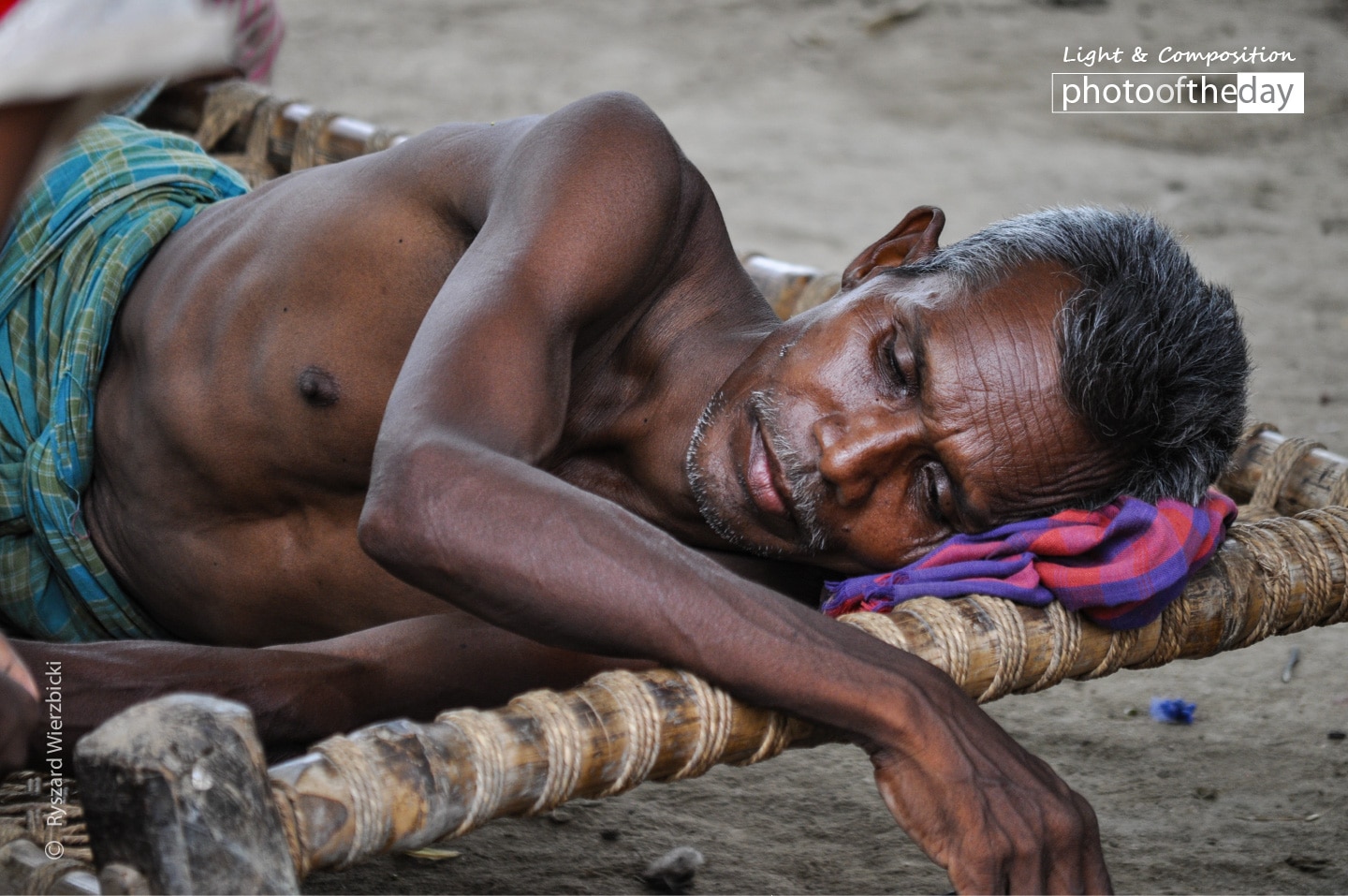
Sleepyhead by Ryszard Wierzbicki
Captured near the historic Dungeshwari Cave in Bodh Gaya, this portrait offers a poignant glimpse into the lives of those residing along the Falgu River. The photographer utilized a 190mm focal length to isolate the subject, creating a shallow depth of field that emphasizes the man's weary yet dignified expression. The image serves as a powerful testament to the human condition in a region steeped in spiritual history, standing just kilometers from the Mahabodhi Temple. Its award-worthy quality lies in the intimate connection established between the lens and the subject, transforming a common street scene into a timeless, evocative narrative of resilience.
Ryszard Wierzbicki
Born in Poland in 1963, Ryszard Wierzbicki transitioned from a diverse career in education and marketing to a life dedicated to global exploration and photography. After relocating to the United Kingdom in 2006, he shifted his focus toward documenting the human experience across South-East Asia, often blending his travels with humanitarian volunteer work. As the founder of the photography and travel forums Instant Travelling and World Around, Wierzbicki has established himself as a passionate chronicler of the world, utilizing his camera to bridge the gap between different cultures and landscapes.
Resonance Score Breakdown
Transparency Note: The resonance score (5.0/20) is calculated based on social engagement metrics collected before the award announcement.
Expert Photography Reviews · 4
The Weight of Rest
There is a profound grace in the act of letting go. We spend so much of our lives holding on—to plans, to worries, to the constant rhythm of our own ambition. Yet, there is a sacredness in the moment when the body finally yields to the pull of the earth.
Read the reflection →The Weight of Waking
The blue wool blanket that lived at the foot of my grandmother’s bed is gone, and with it, the specific smell of cedar and dust that defined her winters.
Read the reflection →Reviews & Comments
Share your thoughts about this award-winning photograph. Your reviews contribute to the community engagement score.
The dusty, ochre textures of the riverbank aren’t merely a backdrop; they’re the grit of a life lived in the shadow of ancient caves. That soft, hazy light clinging to the man’s worn shawl feels almost tactile, grounding him in the earth of Bodh Gaya. I’m truly moved by how the blurred landscape cradles his exhaustion. It’s not just a face; it’s a soul anchored by the very dust he calls home. It’s hauntingly beautiful.
The shallow depth of field at 190mm suggests a photographer keeping their distance, which I respect. It’s a quiet, dignified portrait, yet I can’t help but wonder if the subject was aware of the lens. When I’m in the field, I look for that moment where the subject forgets I’m there. Here, the man’s weary gaze feels slightly guarded. It’s a beautiful frame, but I’m left questioning if this connection was truly earned or merely taken.
At 190mm, the compression flattens the facial planes, forcing the subject’s weary gaze into a razor-thin focal plane. The f/5.6 aperture renders the background bokeh with a soft, creamy transition, isolating the skin’s texture from the chaotic environment. I’m genuinely moved by how the lens resolves the fine, dusty grit on his cheek—it’s a tactile, microscopic reality the naked eye would surely miss. It’s a beautiful, precise capture of human fragility through cold, hard glass.
The 190mm compression flattens the picture plane, forcing the subject against a blurred, indistinct background. It’s a rigid, claustrophobic geometry. The subject’s gaze anchors the frame, yet the shallow depth of field creates a precarious spatial tension. It doesn’t offer comfort. I’m genuinely unsettled by how the heavy, dark mass of the head dominates the upper quadrant. The composition holds, but it’s a fragile equilibrium. Structure dictates the narrative here, not the sentiment.