Skywards by Jabbar Jamil
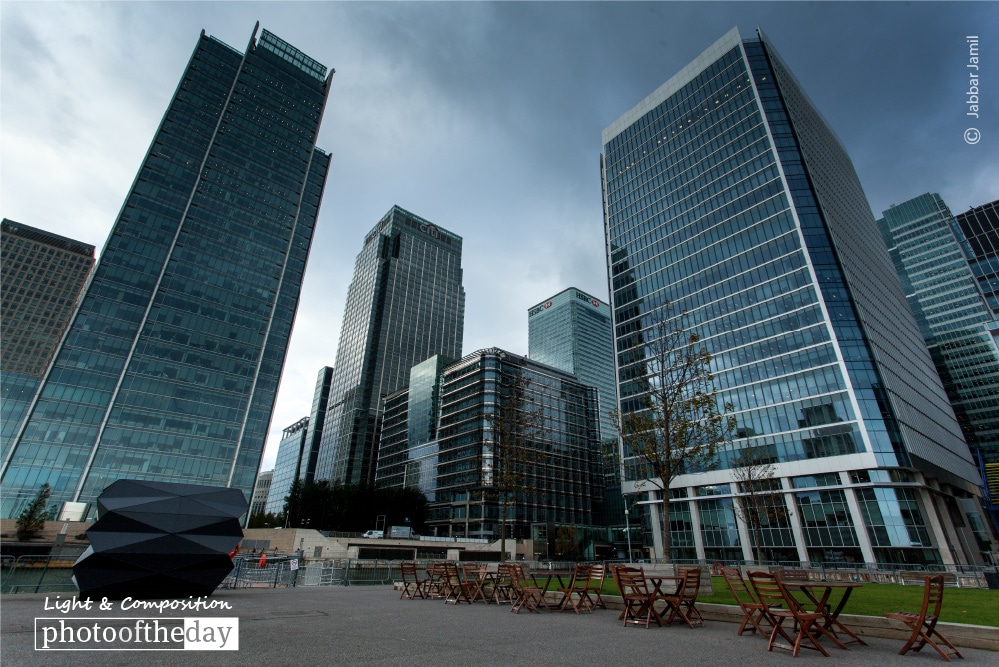
Captured amidst the towering glass structures of Canary Wharf, this photograph explores the dramatic verticality of modern urban architecture. The photographer utilized a wide-angle lens to emphasize the soaring height of the buildings, transforming a fleeting moment of transit into a compelling geometric study. By focusing on the interplay between the sky and the rigid lines of the cityscape, the image captures the imposing scale of the environment. This work is award-worthy for its clean composition and the photographer’s ability to find profound visual rhythm within the dense, structured landscape of London.
Jabbar Jamil
Based in Sialkot, Pakistan, Jabbar Jamil is a dedicated street photographer who views his craft as a vital bridge to the outside world. His work serves as both a creative outlet and a meditative practice, allowing him to document the raw, unfiltered realities of the environments he encounters. By stepping outside his comfort zone, Jamil captures human connections and urban narratives, consistently seeking to express his unique perspective through the lens of his camera.
Resonance Score Breakdown
Transparency Note: The resonance score (11.9/20) is calculated based on social engagement metrics collected before the award announcement.
Expert Photography Reviews · 8
The Geometry of Longing
We spend so much of our lives looking down, focused on the path beneath our feet, the weight of our own steps, and the immediate tasks that demand our attention. Yet, there is a quiet invitation in the vertical world.
Read the reflection →The Weight of Upward
There is a specific ache in the back of the neck that comes from staring too long at the heavens. It is a physical surrender, a pulling of the spine until the skin at the nape feels tight, like a drumhead stretched thin.
Read the reflection →Reviews & Comments
Share your thoughts about this award-winning photograph. Your reviews contribute to the community engagement score.

Of the thousands of architectural shots I’ve reviewed, most are just cold geometry. What separates this from the rest is the tension between the rigid steel and that sliver of London sky. It’s a precarious balance that makes me feel small, almost dizzy, standing in that canyon. While the wide-angle distortion nearly compromised the frame, the vertical alignment holds firm. It’s a clean, honest study that will still feel relevant when these glass monoliths eventually age.
Steel and glass usually feel cold, but here, Jabbar found a heartbeat in the geometry. He stood among those giants, waiting for the light to soften against the sharp edges of Canary Wharf. It’s a dizzying climb for the eyes. I’ve spent hours watching clouds drift over such canyons, and I find myself catching my breath, feeling small beneath that sliver of sky. He didn’t just frame a building; he listened to the silence between the steel.
We look up at these glass giants and feel small, don’t we? Jabbar Jamil hasn’t just framed Canary Wharf; he’s captured the silence of a city that’s forgotten how to listen. The rigid lines pull our eyes toward the clouds, yet I find myself searching for a human pulse in the reflection. It’s cold, almost lonely. I feel a sudden, sharp ache for a face to break this geometry. It’s a photograph that asks to be returned to.
Canary Wharf’s verticality is a relentless assault on the human scale, and Jamil’s 17mm frame captures that vertigo perfectly. By pushing the fenestration toward an impossible vanishing point, he’s turned the solid-void relationship into a dizzying geometric rhythm. It’s a cold, calculated view, yet I’m struck by how the light rakes across those glass planes, softening the steel’s rigidity. It doesn’t tell me what it’s like to work there, but it’s a beautiful, honest lie.
Before the eye identifies the glass, something in the chest tightens. There’s a sudden, sharp vertigo, a physical recoil from the sheer verticality of Jamil’s Canary Wharf. It’s an aggressive geometry that demands a held breath. When I return to it, the cold blue light feels heavier, almost suffocating. I’ve felt this exact, lonely insignificance standing on those London pavements. It doesn’t just frame architecture; it forces the body to acknowledge its own small, fragile scale.
Canary Wharf, stripped of its noise. Glass edges slice the blue. It’s a cold geometry, yet I feel a sudden, sharp relief in the void above the steel. The frame doesn’t crowd the eye. It breathes. Nothing here is accidental. The empty corner is not empty. It’s the weight of the sky pressing against the architecture. I’ve spent minutes just watching the light hit those panels. It’s quiet. Finally, a moment of stillness in London.
1/200sec at f/9, 17mm. It’s a standard architectural baseline. The aperture choice is correct; it keeps the glass facades sharp from corner to corner without inviting diffraction blur. I’ve seen enough wide-angle distortion to know when it’s handled well, and here, the verticality holds. It’s technically sound, though it doesn’t push boundaries. Honestly, the clinical precision of these lines makes me feel a rare, cold sense of calm. It’s a job done right.
It’s a familiar vertigo, echoing the Constructivist rigor of Rodchenko’s Soviet perspectives, yet Jamil’s 17mm distortion pushes the glass canyons into a more aggressive, contemporary abstraction. While it’s clearly indebted to the formalist tradition of the 1920s, the way the steel frames slice the sky feels remarkably sharp. I’ve spent decades staring at urban geometry, but this particular convergence of light and rigid, cold architecture actually made me catch my breath. It’s a compelling, modern rhythm.