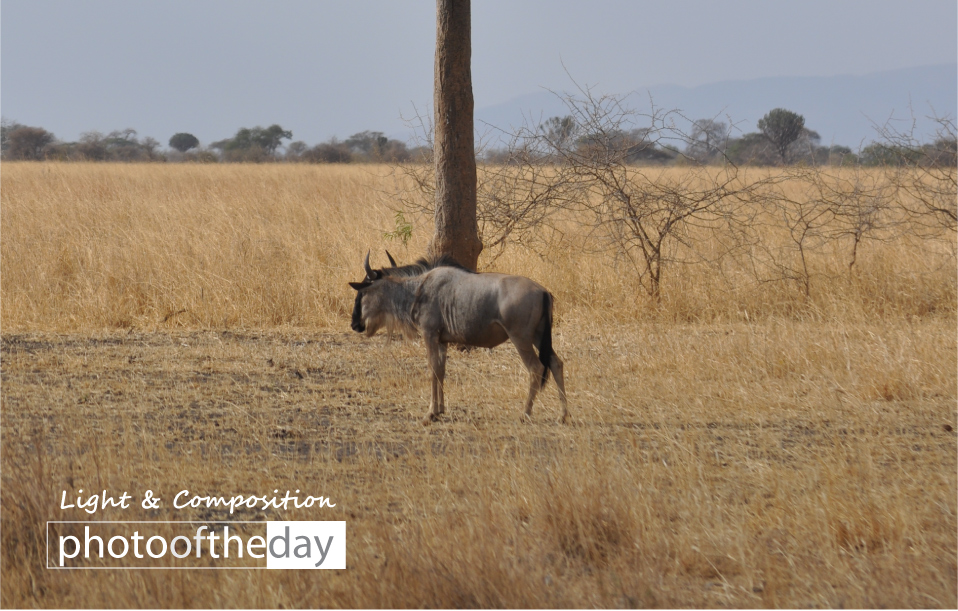
Serengeti Gnu by Ryszard Wierzbicki
Captured during the final stages of the Great Migration in Serengeti National Park, this photograph documents a solitary gnu silhouetted against the vast African horizon. The photographer utilized a 105mm focal length to isolate the subject, emphasizing the animal's stoic presence amidst the expansive landscape. This image is award-worthy for its masterful use of negative space and the poignant narrative it constructs, transforming a fleeting encounter on the savannah into a timeless portrait of wildlife resilience. The composition highlights the raw, untamed beauty of the Serengeti, capturing a moment of quiet reflection as the massive migration cycle draws to a close.
Ryszard Wierzbicki
Born in 1963 and a graduate of the University of Gdańsk, Ryszard Wierzbicki transitioned from a diverse career in social sciences and marketing to become a dedicated traveler and photographer after emigrating to the United Kingdom in 2006. His work is deeply influenced by his extensive explorations across South-East Asia and his commitment to charitable causes, such as supporting Thai and Burmese orphans. As the founder of the photography and travel forums Instant Travelling and World Around, Wierzbicki balances his professional life as a marketing advisor with a profound passion for documenting the natural world and underwater environments.
Resonance Score Breakdown
Transparency Note: The resonance score (8.4/20) is calculated based on social engagement metrics collected before the award announcement.
Expert Photography Reviews · 8
The Architecture of Solitude
There is a specific weight to being alone in a vast space, a gravity that pulls the spirit toward the earth. We often fear the open horizon, mistaking the absence of others for a lack of purpose, yet there is a profound dignity in standing solitary against the sky.
Read the reflection →The Weight of the Horizon
Wildebeest are driven by a singular, ancient impulse: the search for rain. They follow the scent of moisture across hundreds of miles, moving in a vast, rhythmic pulse that dictates the life of the entire savannah.
Read the reflection →Reviews & Comments
Share your thoughts about this award-winning photograph. Your reviews contribute to the community engagement score.

The frame holds. It’s a wide, breathless silence. The gnu is a silhouette against the Serengeti, a single beat of stillness in a migration that never stops. I’ve watched a thousand cuts, but this one? It’s the frame the editor keeps because it’s the only one that breathes. The 105mm lens isolates the weight of the animal perfectly. It’s haunting. I felt my own pulse slow down just looking at it. A beautiful, lonely rhythm.
At f/6.7, the 105mm focal plane renders the gnu’s silhouette with surgical precision, avoiding the diffraction limit that often softens such expansive horizons. The light’s transition across the animal’s flank is remarkably clean, free of the chromatic aberration I’d expect in high-contrast savannah heat. It’s a rare, quiet clarity. Honestly, seeing the subtle micro-contrast in that dark, stoic form against the vast, atmospheric haze makes my pulse quicken. It’s optics meeting pure, raw endurance.
Using a 105mm lens on a wildebeest in the Serengeti isn’t just a choice; it’s a bold gamble on the animal’s tolerance. I’ve spent enough time in the dust to know that getting this close without causing a flight response requires immense stillness. It’s a relief to see a frame that feels earned rather than forced. The silence in this shot is palpable. It’s rare to find such restraint in a landscape so often crowded by engines.
The horizon is a razor’s edge. I’m looking at this gnu and I feel that familiar, sharp ache of the migration—the silence before the stampede. Wierzbicki caught the silhouette perfectly. One tenth of a second later and the animal’s posture would’ve lost its tension against that sky. It’s not just wildlife; it’s a street shot on the savannah. He didn’t hesitate. He saw the geometry of the plains and he took it. That’s the decisive moment.
The horizon bleeds into a bruised, ochre sky, pressing down on the savannah with a weight that feels almost physical. It’s a vast, indifferent stage. When I look at this gnu, I don’t just see an animal; I feel the crushing loneliness of the migration. The landscape isn’t a backdrop here—it’s the protagonist. That silhouette, carved against the emptiness, tells me more about survival than any close-up ever could. It’s hauntingly beautiful, really.
The ochre of the Serengeti floor bleeds into a bruised, atmospheric violet, a palette reminiscent of Turner’s most melancholic skies, where the gnu’s silhouette emerges not as a mere animal, but as a dark, ink-stained punctuation mark against the fading light. It’s breathtaking, really; I’m struck by how the warmth of the dust-choked horizon quarrels with the cool, encroaching shadows, creating a chromatic tension that feels like the very end of the world.
The silhouette of this gnu echoes the stark, graphic minimalism of Brandt’s early nudes, yet it’s placed within a landscape that feels almost like a nineteenth-century calotype’s empty stage. It’s a quiet, lonely geometry I’ve seen echoed in the work of Peter Beard, though Wierzbicki’s 105mm choice flattens the horizon into a haunting, abstract line. I’m genuinely moved by how the negative space swallows the subject; it’s a rare, elegant restraint in an era of over-saturated wildlife clichés.
The horizon swallows the earth. A single gnu stands against the void. It’s a heavy, quiet weight. I’ve spent minutes looking, and I still feel the stillness in my own chest. The space around the animal isn’t just air. It’s the distance between life and the end of the migration. Nothing here is accidental. The empty corner is not empty. It’s the breath before the silence takes over. I find it hard to look away.