Sahadah by Ahmad Jaa
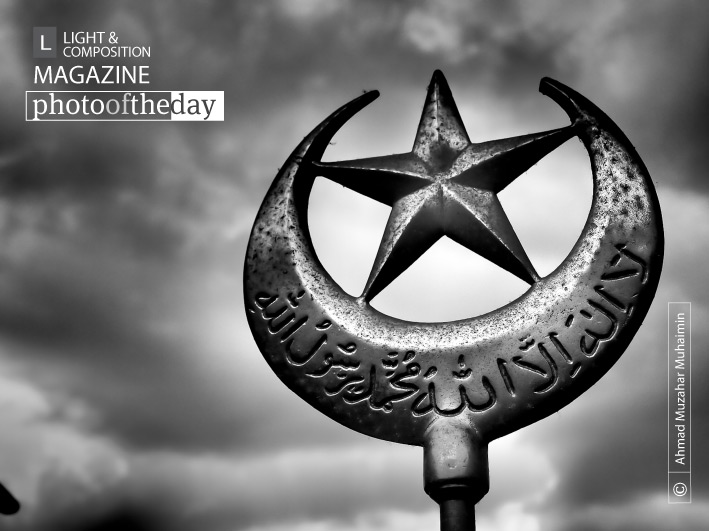
In this thought-provoking image, the photographer captures the essence of the Sahadah, the fundamental declaration of faith in Islam. By focusing on the Arabic calligraphy that defines the submission to the divine, the composition serves as a visual meditation on spiritual devotion. The photographer intentionally contrasts the sacred text with a critique of cultural iconography, such as the crescent moon and star, urging viewers to look beyond historical symbols toward the deeper, reasoned signs of creation found in the universe. This image is award-worthy for its ability to marry theological reflection with crisp, technical precision, inviting the audience to contemplate the straight path through a lens of clarity and purpose.
Ahmad Jaa
Based in Kuala Lumpur, Malaysia, Ahmad Jaa is an emerging photographer who approaches his craft with a deep sense of joy and curiosity. Though he describes himself as an amateur who finds pleasure in the simple act of capturing what interests him, his work reflects a growing dedication to experimentation and visual storytelling. Driven by the belief that photography should be a fulfilling and happy pursuit, he continues to refine his technical skills while exploring themes that resonate with his personal faith and observations of the world around him.
Resonance Score Breakdown
Transparency Note: The resonance score (14.2/20) is calculated based on social engagement metrics collected before the award announcement.
Expert Photography Reviews · 4
The Ink of the Unseen
We often mistake the map for the territory, forgetting that a line drawn on paper is merely a suggestion of the earth beneath our feet.
Read the reflection →The Weight of a Name
We spend our lives gathering words. We use them to build walls, to mark boundaries, to claim a space in the vast, indifferent cold. We think that if we name a thing, we own it.
Read the reflection →Reviews & Comments
Share your thoughts about this award-winning photograph. Your reviews contribute to the community engagement score.
I LIKE THIS
It’s a crisp composition, though one wonders if the light was caught on a whim or a vigil. The calligraphy is sharp, yet I find myself searching for the grit of a long wait. Did he return until the atmosphere surrendered? It’s technically sound, but I’m left wanting more of the photographer’s own discomfort. It’s a clean shot, certainly, but I’ve yet to feel the cold or the heat that truly earns a frame.
Of the thousands of submissions I’ve reviewed, most rely on tired religious iconography. Jaa avoids that trap. By anchoring the frame on the calligraphy rather than the crescent moon, he forces a confrontation with the text itself. It’s a rare, intellectual rigor that makes this endure. I’ll admit, the starkness of the composition actually made me hold my breath. It’s not just a technical exercise; it’s a quiet, reasoned argument for faith that will still resonate in thirty years.
The calligraphy anchors the frame, establishing a rigid verticality that demands total submission from the viewer’s eye. It’s a disciplined architecture. The crescent moon provides a necessary counterweight, preventing the composition from collapsing into mere sentiment. I’ve rarely seen such structural economy. While the negative space feels slightly underutilized, the tension at the fulcrum holds. It’s a rare instance where the geometry doesn’t just support the subject; it dictates the entire visual logic.
The ochre of the calligraphy bleeds into the shadows like the dust of a Vermeer studio, grounding the spirit in a tactile, earthen weight that I’ve found utterly arresting. It’s a chromatic dialogue between the sacred and the mundane, where the light doesn’t merely illuminate but breathes, casting a hushed, golden warmth that makes my own pulse slow in reverence. One feels the divine isn’t distant, but woven into the very pigment of existence.