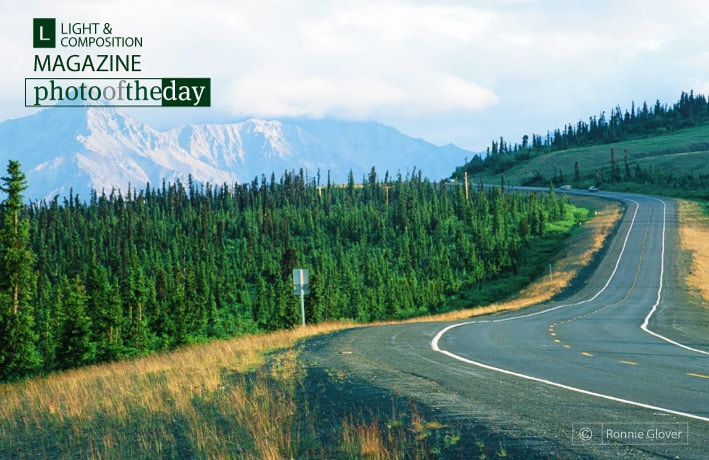
Rush Hour in Rural Alaska by Ronnie Glover
Captured near 11 pm during a July evening in rural Alaska, this photograph documents a fleeting, high-stakes moment of natural beauty. The image was taken in the brief window of time just before a near-collision with a moose, a harrowing experience that underscores the unpredictable nature of the Alaskan wilderness. By balancing the serene, scenic vistas of the region with the raw intensity of the encounter, the photographer highlights the delicate intersection of human travel and untamed wildlife. The work is award-worthy for its ability to transform a moment of potential danger into a compelling, atmospheric landscape that captures the unique light of the midnight sun.
Ronnie Glover
Based in Gig Harbor, Washington, Ronnie Glover developed his professional photographic foundation through the rigorous program at the Southeastern Center for the Arts in Atlanta. His extensive fourteen-year residency in Alaska provided him with profound opportunities to document the natural world, shaping his deep appreciation for landscape and travel photography. Driven by a desire to share the beauty of diverse cultures and environments, he continues to refine his craft, aiming to inspire viewers through his evocative and immersive visual storytelling.
Resonance Score Breakdown
Transparency Note: The resonance score (13.2/20) is calculated based on social engagement metrics collected before the award announcement.
Expert Photography Reviews · 6
The Weight of the Unseen
In the quiet hours of the night, when the house settles into its own rhythm, I often think about the things that pass us by in the dark. We move through our days with a sense of certainty, convinced that the path ahead is ours to command.
Read the reflection →The Long Shadow of Noon
We often mistake the horizon for a boundary, a line drawn in the dirt to tell us where our world ends and the mystery begins. But the light of the far north has a way of dissolving such edges.
Read the reflection →Reviews & Comments
Share your thoughts about this award-winning photograph. Your reviews contribute to the community engagement score.
Most Alaskan landscapes I’ve reviewed are postcard-perfect, but they’re hollow. What separates this from the pack is the tension. That Velvia film captures a light so thick it feels like you’re breathing it. I’ll admit, the near-miss with the moose makes my pulse race even now. It’s not just a pretty view; it’s a record of survival. In thirty years, people won’t remember the gear, but they’ll remember the weight of that midnight sun.
The midnight sun doesn’t illuminate this Alaskan road; it bruises it. Glover’s frame captures a threshold where the light is too thin to hide the impending collision. I’ve stared at these deep, encroaching shadows until my own pulse quickened, feeling the weight of a silence that precedes violence. It isn’t a landscape; it’s a confrontation. When the light fails to clarify, the darkness begins to interrogate our presence in the wild. It’s haunting, truly.
The horizon line bisects the frame with clinical indifference, anchoring the midnight sun’s glare against the encroaching shadow of the brush. It’s a rigid geometry that forces the eye toward the periphery. The spatial tension between the encroaching moose and the vanishing point is palpable. I’ve rarely seen such a precarious balance of mass. It doesn’t rely on the narrative of danger; the architecture of the frame holds the weight entirely on its own.
Eleven at night, yet the light still clings to the earth, thin and golden. Ronnie stood there, heart likely hammering against his ribs as the moose emerged from the shadows. It’s a quiet, terrifying grace. I’ve felt that same stillness, where the air turns heavy with the weight of a wild presence. He didn’t rush the shutter; he listened to the land’s warning. It’s a haunting, fragile intersection of life and light that I can’t stop watching.
That bruised, violet light of an Alaskan midnight—the precise, melancholic shade of a Morandi still life—clings to the horizon, bleeding into the ochre of the tundra like spilled wine. It’s a haunting, spectral palette that makes my heart ache with its fragile, fleeting intensity. One finds the Fuji Velvia has rendered the atmosphere so thick, so saturated with that cold, northern luminescence, that it’s impossible not to feel the encroaching, silent danger of the wild.
Eleven at night, and the light is still doing the heavy lifting. It’s a decent shot, though one suspects the moose provided more adrenaline than artistry. I’ve spent enough nights shivering in the brush to know that proximity doesn’t equate to craft. Did he return? Did he wait for the light to settle, or just point and pray? It’s a lucky frame, certainly. I’d have preferred a bit more patience and a lot less panic.