Riding in the Rain by Siew Bee Lim
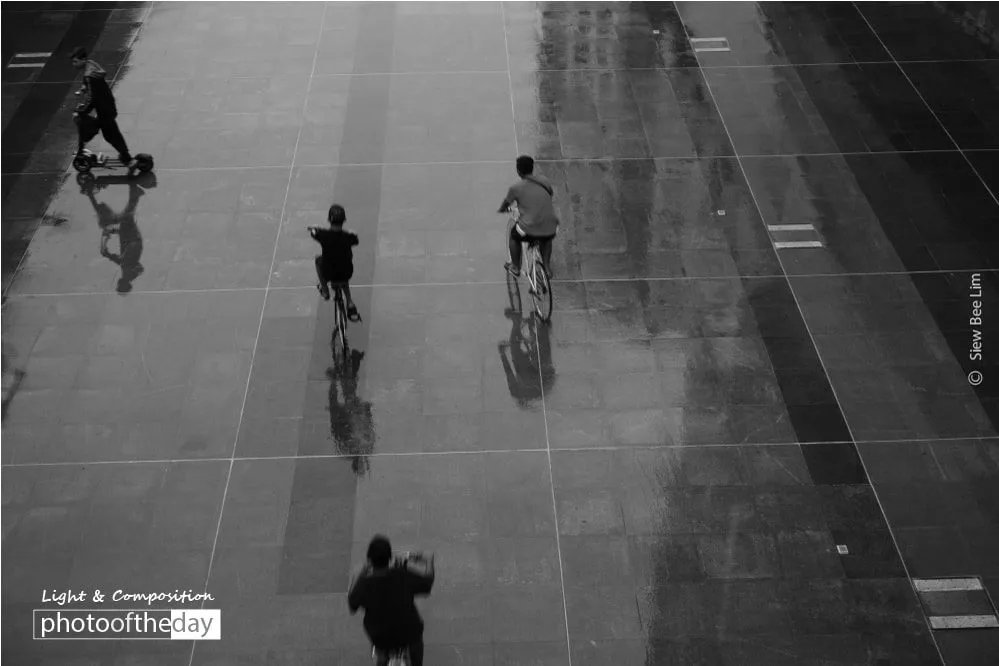
On a rainy afternoon, the photographer ventured outside a shopping mall to capture the quiet atmosphere of the empty, rain-swept plaza. The scene transformed when a group of young cyclists rode into the open space, their playful energy contrasting with the gloomy weather. By timing the shutter to catch their movement against the backdrop of the shelter, the photographer created a dynamic composition that highlights the joy of youth amidst the elements. This image is award-worthy for its candid storytelling and the effective use of natural light to frame a fleeting, spontaneous moment of urban life.
Siew Bee Lim
Born in Singapore in 1965, Siew Bee Lim has long nurtured a passion for photography as a creative outlet. Currently refining her craft through the Light & Composition platform, she demonstrates a commitment to lifelong learning and artistic growth. Her work often focuses on capturing the candid, everyday moments of urban life in Singapore, reflecting a keen eye for human interaction and environmental storytelling.
Resonance Score Breakdown
Transparency Note: The resonance score (12.9/20) is calculated based on social engagement metrics collected before the award announcement.
Expert Photography Reviews · 8
The Rhythm of the Downpour
There is a peculiar geometry to a storm in the city. We tend to think of rain as a curtain, a grey veil that separates the interior world from the exterior, but it is actually a bridge.
Read the reflection →The Unplanned Rhythm
Urban planners often treat the city as a static grid, a collection of zones designed for efficiency and flow. They map out where we should work, where we should shop, and where we should pass through.
Read the reflection →Reviews & Comments
Share your thoughts about this award-winning photograph. Your reviews contribute to the community engagement score.
Most street photography is just noise, but this caught me off guard. It’s the tension between the slick, grey concrete and those blurred, kinetic streaks of youth that makes it endure. I’ve seen thousands of rainy plaza shots, yet this one avoids the usual clichés by letting the architecture frame the chaos rather than contain it. It’s a fleeting, honest slice of Singaporean life that I’ll still be thinking about in thirty years. It’s simply vital.
Rain doesn’t merely fall here; it constructs a threshold. These cyclists aren’t just riding; they’re carving fleeting trajectories through a void that threatens to swallow their joy. I’m struck by how the deep, encroaching shadows beneath the shelter anchor their motion, forcing the light to surrender its dominance. It’s a haunting tension. They’ve dared to exist within the dark, and in doing so, they’ve made the silence of the plaza feel heavy, almost unbearable. It’s beautiful, and it hurts.
Before the eye identifies the cyclists, a sudden stillness settles in the chest. It’s the rain, isn’t it? That grey, rhythmic dampness that usually slows the pulse. But then, the blur of motion cuts through the gloom. I feel a sharp, phantom chill on my own skin, followed by the warmth of their fleeting momentum. It’s a kinetic memory of childhood freedom. Returning to this, I find the silence of the plaza feels heavier, yet somehow more alive.
At f/4.5, the Sony’s 30mm focal length renders the rain-slicked plaza with a crispness that defies the gloomy light. The diffraction of light across those wet surfaces is, in the strictest physical sense, extraordinary. I’m genuinely moved by how the shutter speed captures the cyclists’ motion without losing the fine detail of the droplets. It’s a rare moment where the lens’s resolution perfectly resolves the kinetic energy of youth against the static, grey geometry of the architecture.
Stripped of chromatic distraction, one finds the silver-grey of a Singaporean deluge, a tonal range reminiscent of Morandi’s dustiest still lifes, where the absence of hue forces the eye to worship the rain’s liquid texture. It’s a melancholic, monochromatic ache that I find utterly intoxicating; the cyclists’ blurred motion against the concrete’s charcoal depths creates a rhythmic friction, a visual hum that feels like the quiet, wet breath of a city caught in mid-shiver.
You waited for the rain to stop being a nuisance and start being a stage. I can feel the dampness on the pavement and that sudden, sharp burst of energy from those kids. It’s a relief to see youth cutting through the gloom of a concrete plaza. You didn’t just snap a frame; you felt the joy of that movement. It’s honest. And honestly, it makes me miss being that young, just riding through the storm.
Grey concrete. The relentless rhythm of rain. It’s a vast, wet stage. Then, the cyclists. They’re ghosts of motion against the stillness of the shelter. I feel a sudden, sharp ache for the brevity of their joy. Nothing here is accidental. The empty corner is not empty. It’s the weight of the storm, pressing down on the frame. They’ve carved a path through the silence. It’s enough. I’m left watching the ripples fade.
Most folks would have retreated to the nearest cafe the moment the heavens opened. Instead, Siew Bee Lim stood in the damp, waiting for the plaza to offer something beyond a grey puddle. It’s a decent bit of timing, catching those cyclists mid-splash. I’ve spent enough hours shivering in the rain to appreciate the commitment here. It’s not just a lucky snap; it’s a small, sodden victory. One respects the patience required to get wet.