Ready-to-use Ingredients by Rodrigo Aliaga
In this meticulously composed food study, the photographer utilizes natural, diffused light streaming from a side window to create soft, evocative shadows. By employing a wide aperture, the depth of field is intentionally narrowed, ensuring that only the vibrant paprika and garlic remain in sharp focus. This technical choice effectively isolates the primary subjects, drawing the viewer's eye to the textures and raw beauty of the ingredients. The image stands out for its masterful balance of light and focus, transforming everyday kitchen elements into a compelling, artistic narrative that highlights the photographer's keen eye for detail and composition.
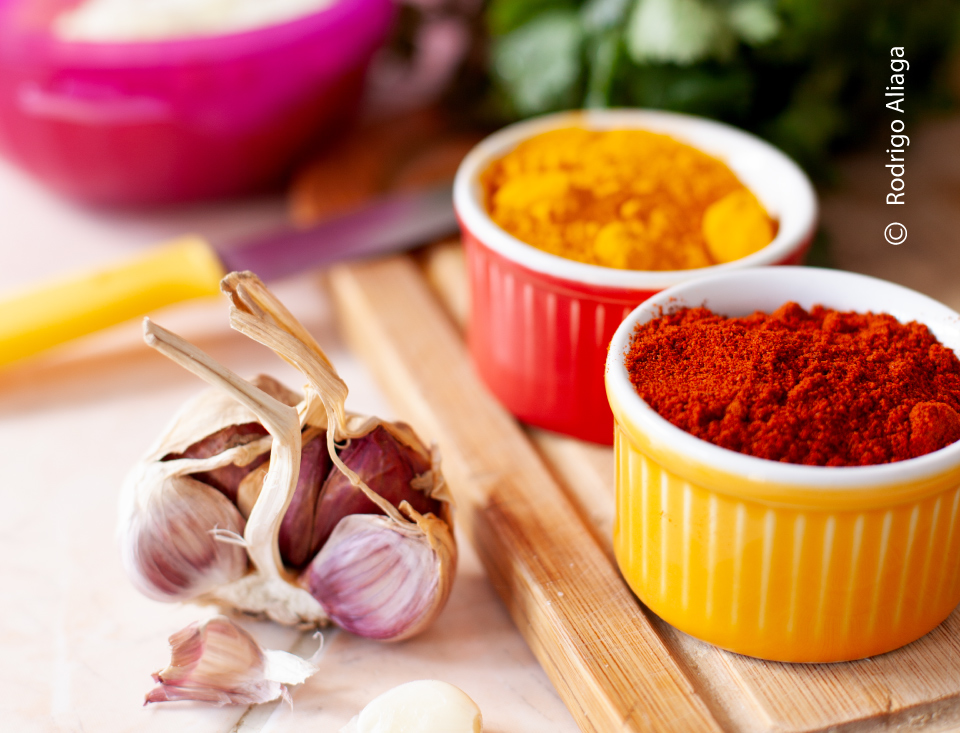
Exposure 1/125sec @ f/2.8 | ISO 250 | Focal Length 50mm
Rodrigo Aliaga
Born in La Paz, Bolivia, Rodrigo Tato Aliaga has dedicated his career to the art of the moving and still image. As a director of photography with a deep appreciation for traditional film, he brings a cinematic sensibility to his work in television advertising. Seeking to further refine his technical precision and creative expression, Aliaga transitioned into digital photography, where he discovered that food photography offers the perfect intersection of aesthetic beauty and rigorous technique. His work continues to evolve, consistently aiming to capture the exquisite essence of his subjects.
Resonance Score Breakdown
Transparency Note: The resonance score (8.4/20) is calculated based on social engagement metrics collected before the award announcement.
Expert Photography Reviews · 6
The Pungent Pulse of Earth
The kitchen floor was always cold against my bare heels, a sharp contrast to the humid, heavy air that hung near the stove. I remember the sting of raw garlic beneath my fingernails—a sharp, sulfurous bite that lingered long after the meal was served.
Read the reflection →The Weight of the Mundane
I have always been suspicious of the way we romanticize the domestic.
Read the reflection →Reviews & Comments
Share your thoughts about this award-winning photograph. Your reviews contribute to the community engagement score.
The curator praises this for its focus, but I find that narrow depth of field a bit predictable. Why resolve the garlic so clinically while letting the rest dissolve into a soft, safe blur? It’s technically competent, sure, but it’s playing it too safe. I’d love to see Aliaga push past this conventional isolation. It’s closer to a commercial catalog than the experimental, textural chaos I crave. It’s just a little too polite for me.
The paprika’s vermilion, a shade so visceral it recalls the bruised, heavy pigments of a Morandi still life, vibrates against the garlic’s chalky, bone-white pallor. It’s a chromatic tension that makes my heart ache for the high-altitude light of La Paz. One finds here a quiet, dusty atmosphere where the shadows aren’t merely absences of light, but pools of cool, muted violet, grounding these raw, elemental ingredients in a profound, almost sacred, silence.
The composition relies on a precise diagonal tension between the paprika’s crimson mass and the garlic’s spherical white volume. By restricting the depth of field, Aliaga creates a 1:1 visual weight ratio that anchors the frame. It’s a beautifully solved spatial equation. I’m genuinely struck by how the soft-focus background acts as a negative quadrant, preventing the vibrant textures from collapsing into chaos. It’s rare to see such rigorous geometry applied to something as domestic as ingredients.
The diffused light grazing these textures feels like a quiet morning in La Paz. It’s not just food; it’s the tactile history of a kitchen. The way the light clings to the garlic’s papery skin reminds me of a Dutch still life, grounding the ingredients in their own geography. I’m genuinely moved by how these raw elements tell a story of labor and place. It’s a portrait of a culture, captured through the quiet dignity of its ingredients.
At f/2.8, the 50mm focal plane is razor-thin, forcing a beautiful, rapid decay into bokeh. The diffraction of light across the garlic’s papery skin is, in the strictest physical sense, extraordinary. I’m genuinely moved by how the lens resolves those microscopic, fibrous textures that my own eyes would simply blur away. It’s a rare, clinical intimacy; Aliaga hasn’t just captured ingredients, he’s rendered the very physics of their surface tension with startling, crystalline precision.
Before the eye identifies the paprika, something in the chest softens. It’s the quiet weight of domestic ritual. The garlic’s papery skin feels almost tactile against the palm, a sensory memory I’ve carried since childhood. When I return to this, I don’t see ingredients; I feel the stillness of a La Paz kitchen at midday. It’s a rare, grounding activation. I find myself breathing slower, anchored by the sharp, vibrant heat of the frame.