Priceless Catch by Nirupam Roy
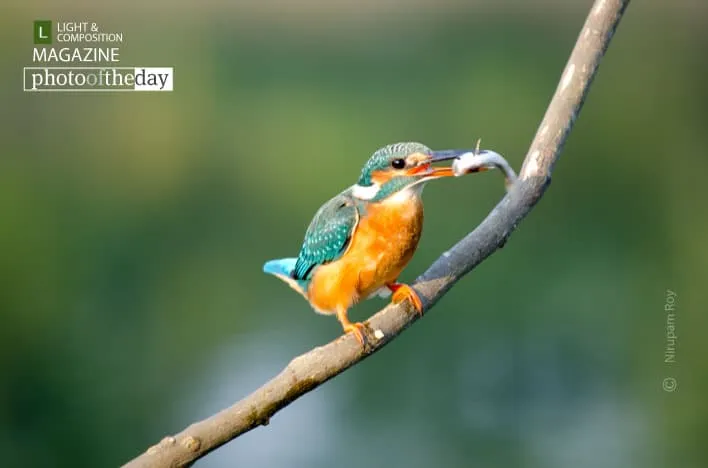
Captured in the quiet wilderness of Salbari, this image of an Alcedo atthis—the common kingfisher—represents the culmination of immense patience and fieldcraft. To secure this intimate portrait, the photographer constructed a custom hide, waiting for hours behind a concealed perch to minimize disturbance. The technical decision to use a 300mm focal length allowed for a striking, detailed composition that highlights the bird’s vibrant plumage and focused intensity. This photograph is award-worthy for its masterful blend of technical precision and the raw, unscripted beauty of wildlife in its natural habitat, rewarding the photographer's dedication to the craft.
Nirupam Roy
Based in Tufanganj, West Bengal, Nirupam Roy is a dedicated school teacher who discovered his passion for photography during a family trip to the coast of Odisha. What began as a simple desire to document his son and the scenic landscapes evolved into a profound artistic journey that has reshaped his perspective on nature and humanity. Through his lens, Roy finds a sense of peace and spiritual connection, consistently striving to capture the fleeting, beautiful moments of the natural world with patience and technical rigor.
Resonance Score Breakdown
Transparency Note: The resonance score (13.0/20) is calculated based on social engagement metrics collected before the award announcement.
Expert Photography Reviews · 7
The Art of Waiting
I spent forty minutes in the grocery store checkout line this morning. Usually, I would be tapping my foot, checking my watch, or scrolling through my phone to make the time disappear. But today, I just watched the woman in front of me.
Read the reflection →The Weight of Stillness
The smell of damp earth after a long drought is a heavy, velvet thing that clings to the back of the throat. It is the scent of anticipation, the way the air thickens just before the world decides to move.
Read the reflection →Reviews & Comments
Share your thoughts about this award-winning photograph. Your reviews contribute to the community engagement score.
Most wildlife shots are just trophies, but this kingfisher lingers. Of the thousands I’ve reviewed, it’s the bird’s singular, predatory focus that anchors the frame. The 300mm compression flattens the background just enough to make that electric blue plumage vibrate against the muted reeds. It’s a rare, quiet intensity that makes me hold my breath. In thirty years, we won’t care about the custom hide; we’ll care that someone finally caught the stillness before the strike.
The kingfisher’s plumage burns with an intensity that demands our gaze, yet it’s the encroaching gloom behind the branch that truly anchors the soul. I’ve spent hours staring into that murky, suffocating green, feeling the weight of the bird’s isolation. It doesn’t merely exist; it resists the void. When I look at those sharp, predatory eyes, I feel a sudden, cold shiver of insignificance. Shadows aren’t empty here; they are the bird’s silent, heavy accomplice.
Before the eye identifies the kingfisher, something in the chest tightens. It’s that sudden, suspended stillness of a predator mid-gaze. The electric blue plumage triggers a sharp, visceral alertness in me; I’ve felt this exact tension while waiting for a secret to be told. Returning to it a year later, the bird’s intensity hasn’t faded. It’s a quiet, piercing reminder of how we hold our breath when we finally catch sight of something truly wild.
The kingfisher’s plumage, a startling, electric cerulean that recalls the sharp, piercing light of a Vermeer window, vibrates against the muted, muddy ochres of the Salbari reeds. It’s a chromatic collision that makes my heart ache with its sheer, unadulterated intensity. One finds the tonal transition from the bird’s burnt-orange breast to the shadowed, mossy water quite sublime, as if Turner himself had brushed the light into the very depths of the riverbank.
The kingfisher’s posture dictates the frame’s geometry. Its beak creates a sharp vector, slicing through the negative space with clinical intent. The plumage provides a necessary tonal anchor against the muted background. It’s a rigid, calculated architecture. I’ve grown weary of wildlife shots that rely on mere proximity, yet this composition holds its own. The spatial tension between the bird and the frame’s edge is precise. It doesn’t falter. It’s a rare moment of structural clarity.
At 300mm, the Nikkor’s focal plane is razor-thin, yet Roy’s alignment with the Alcedo atthis is precise. The diffraction limit at f/7.1 hasn’t softened the plumage; instead, it’s rendered the iridescence with clinical clarity. I’m genuinely breathless at the way the light refracts off those cobalt feathers. It’s a rare moment where the glass doesn’t just record the subject, it reveals the biological architecture of the bird itself. It’s an optical triumph of patience.
The kingfisher waits. It’s a study in stillness. The branch holds the bird, but the surrounding air holds the weight. I’ve spent minutes just breathing with it. The space around the feathers isn’t void. It’s a deliberate pause. Nothing here is accidental. The empty corner is not empty. It’s the silence before the dive. I feel my own pulse slow down. It’s rare to find such quiet in a frame. A beautiful, sharp restraint.
Beautiful picture, congratulations!
thanks Team Light & Composition.