Pleasing Time by Nirupam Roy
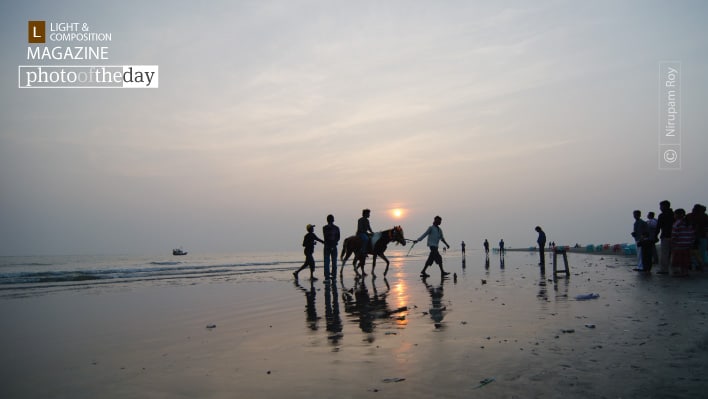
Captured during a serene transition period at the Bakkhali seaside in West Bengal, this photograph encapsulates the quiet beauty of a scenic sunset. The photographer observed travelers as they enjoyed the cool, comfortable evening, skillfully timing the shutter to document their natural gestures against the fading light. By focusing on the human element within the vast coastal landscape, the image transforms a common moment into a compelling narrative. Its award-worthy quality lies in the harmonious balance between the atmospheric lighting and the candid, emotive interaction of the subjects, reflecting a deep appreciation for the fleeting, peaceful rhythms of life.
Nirupam Roy
Hailing from the small town of Tufanganj in West Bengal, India, Nirupam Roy balances his professional life as a school teacher with a profound dedication to photography. His creative journey began during a family trip to Odisha, where a desire to document scenic landscapes and his son sparked an enduring passion for the craft. Now deeply committed to exploring new conceptual approaches, Roy views photography as a transformative pursuit that has reshaped his perspective on nature and humanity, providing a sense of peace and artistic fulfillment.
Resonance Score Breakdown
Transparency Note: The resonance score (12.7/20) is calculated based on social engagement metrics collected before the award announcement.
Expert Photography Reviews · 6
The Weight of Fading Light
Why do we feel a sudden, sharp ache when the sun begins its descent? It is as if the day itself is a promise we are not quite ready to release.
Read the reflection →The Architecture of the Pause
In the nineteenth century, clockmakers spoke of the 'dead beat'—a mechanism designed to stop the pendulum for a fraction of a second, ensuring that time did not merely flow, but pulsed.
Read the reflection →Reviews & Comments
Share your thoughts about this award-winning photograph. Your reviews contribute to the community engagement score.
Most sunset shots are forgettable clutter, but this one lingers. I’ve seen thousands of coastal silhouettes, yet Roy’s framing of these figures against the tide’s mirror-finish keeps me looking. It’s the way the light hits the wet sand, grounding the vast sky. I actually felt a quiet ache for that specific, humid evening in Bakkhali. It’s not just a pretty view; it’s a rare, honest slice of human stillness that will still matter in thirty years.
The ochre of the Bakkhali sands bleeds into a bruised, violet horizon, echoing the melancholic stillness one finds in a Morandi study. It’s a chromatic sigh, really, where the light doesn’t just fall; it clings to the figures like damp silk. I’ve felt my own pulse slow watching these silhouettes dissolve into that bruised, tidal indigo. It’s a rare, aching harmony that makes me want to weep for the day’s quiet, inevitable surrender to night.
Bakkhali’s horizon doesn’t invite; it demands a reckoning with the void. Roy’s figures are mere silhouettes, ghosts tethered to a fading sun. I’ve stared at these dark, elongated shapes until my own pulse slowed, feeling the crushing weight of the tide. It’s not a serene sunset, but a quiet erasure. The shadows here aren’t just absence; they’re the heavy, ink-stained silence where the day finally surrenders its meaning to the encroaching, inevitable night.
The tide retreats. It leaves a mirror of wet sand. The figures are small, mere silhouettes against the vast, fading light of Bakkhali. I feel a sudden, sharp ache for that stillness. It’s the weight of the horizon. The space between the people and the water isn’t just distance. It’s breath. Nothing here is accidental. The empty corner is not empty. It’s a pause. A quiet I’ve been waiting for all day.
1/500sec at f/4, 12mm, ISO 100. A wide-angle gamble on a coastal horizon. The shutter speed is overkill for human subjects, yet it freezes the motion effectively. At f/4, the Tokina’s edges soften, but the center holds. I’ve spent years staring at these Bakkhali sunsets, and frankly, the technical discipline here actually irritates me—it’s too clean. You didn’t need that much speed, but you didn’t miss the focus either. It’s a precise, cold execution.
At 12mm, the Tokina’s wide-angle distortion stretches the Bakkhali horizon, yet the focal plane remains remarkably crisp across the sand. Shooting at f/4, Roy avoids the diffraction limit, keeping the subjects’ silhouettes sharp against the receding tide. I’m genuinely moved by how the light refracts through the salt-heavy air, creating a soft, ethereal glow around the figures. It’s a rare moment where the lens’s glass perfectly captures the physics of a fading, humid West Bengal sunset.