Playtime by Prasanta Singha
Captured in the remote village of Nurpur, India, this evocative image documents a spontaneous moment of joy as local children play along the banks of the river Ganges. The photographer utilized a wide 20mm focal length to immerse the viewer in the scene, balancing the bright, natural light with a fast shutter speed to freeze the motion of the children. This photograph is award-worthy for its authentic portrayal of rural life, capturing the raw energy and innocence of childhood against the timeless, flowing backdrop of one of the world's most significant rivers.
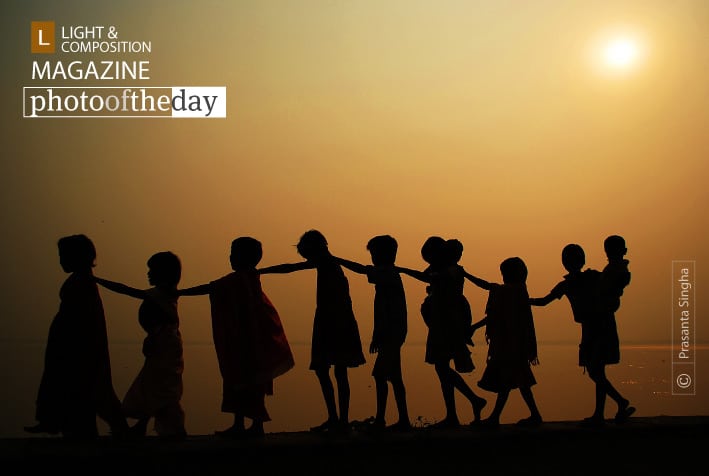
Prasanta Singha
Based in Kolkata, India, Prasanta Singha is a dedicated travel photographer with a profound passion for documenting the lives and portraits of people within their natural surroundings. Driven by an innate creative impulse, he strives to capture the essence of the human experience through his lens. Singha continues to hone his craft with the aspiration of making a meaningful and lasting contribution to the global photographic community.
Resonance Score Breakdown
Transparency Note: The resonance score (13.3/20) is calculated based on social engagement metrics collected before the award announcement.
Expert Photography Reviews · 3
The Weight of Gravity
In the physics of childhood, gravity seems to function differently. For the adult, the earth is a surface to be traversed, a series of obstacles to be navigated with caution and measured steps.
Read the reflection →The Grit of Laughter
The taste of river water is never just water; it is the metallic tang of wet silt, the cool, sharp bite of stones that have been tumbled for centuries, and the faint, earthy musk of mud drying on skin.
Read the reflection →Reviews & Comments
Share your thoughts about this award-winning photograph. Your reviews contribute to the community engagement score.
The 20mm lens forces a chaotic geometry upon the frame. It’s a precarious balancing act. The children’s kinetic energy threatens to collapse the composition, yet the river’s horizon line acts as a necessary anchor. I’m genuinely unsettled by how the foreground figures nearly breach the picture plane. It’s a risky spatial tension. Without that rigid horizontal fulcrum, the entire structure would dissolve into mere noise. It barely holds, but it holds. That’s enough.
Sunlight here doesn’t just illuminate; it interrogates. By freezing these children against the Ganges, Singha forces us to confront the fleeting nature of their joy. It’s a violent clarity. I’ve spent hours staring at the way the shadows cling to their limbs, refusing to let them dissolve into the brightness. It’s haunting. We aren’t watching play; we’re watching time being stolen. When the light is this aggressive, the darkness becomes the only place left to breathe.
Of the thousands of rural scenes I’ve reviewed, most feel staged or sentimental. This one avoids that trap because the 20mm lens forces us into the mud with them. It’s the chaotic, blurred geometry of the limbs against the Ganges that makes me smile; it feels like a memory I’ve actually lived. It’s not just a snapshot of play; it’s a frantic, honest grab at fleeting childhood that will still feel urgent thirty years from now.
We all are happy for your success.