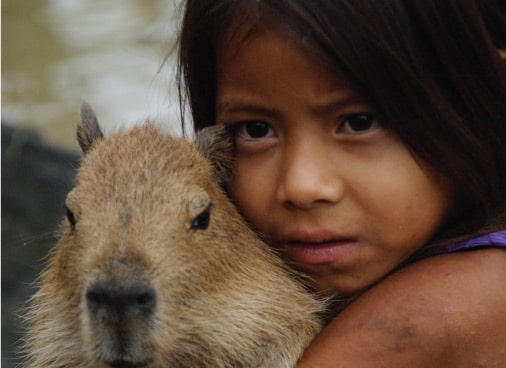
Peruvian Girl and Friend by Claudio Bacinello
Captured along the Ucayali River, this poignant portrait highlights a young girl and her sister navigating the waters in a traditional dugout boat. The photographer was struck by the girl’s tender interaction with a capybara, which she cradled with the devotion usually reserved for a cherished toy. This image is award-worthy for its raw emotional depth, capturing a fleeting moment of innocence and protection amidst a life of simplicity. The composition masterfully draws the viewer into the girl’s world, emphasizing the profound bond between the child and her unusual companion.
Claudio Bacinello
Born in Italy, Claudio Bacinello is a seasoned photographer currently based in Thornhill, Canada. With a distinguished career spanning three decades, he has mastered diverse disciplines ranging from portraiture and weddings to corporate and stock photography. His current artistic focus centers on travel, wildlife, and nature, frequently taking him to Africa and South America in search of compelling stories. Bacinello’s evocative work has earned global recognition and is widely collected as fine art for both private and corporate environments.
Resonance Score Breakdown
Transparency Note: The resonance score (12.8/20) is calculated based on social engagement metrics collected before the award announcement.
Expert Photography Reviews · 8
The Weight of Small Things
I found a stray kitten behind the bins this morning, shivering and quiet. I didn't have much to offer, just a bit of milk and a dry towel, but as I held it, I felt that strange, sudden shift in my own chest. It is a heavy thing, isn't it?
Read the reflection →The Weight of Small Lives
Why do we assume that the capacity to love is measured by the size of the object we hold? We often look for grandeur in our attachments, seeking connections that mirror our own complexity or status.
Read the reflection →Reviews & Comments
Share your thoughts about this award-winning photograph. Your reviews contribute to the community engagement score.

The ochre silt of the Ucayali bleeds into the girl’s skin, a tonal marriage reminiscent of a Morandi still life, where the muddy browns of the riverbank dissolve into the soft, dusty amber of her cheeks. It’s a quiet, humid palette that I find utterly devastating. When the light catches the capybara’s coarse, umber fur, one feels the damp heat of the jungle pressing against the lens, turning this simple encounter into a sacred, chromatic prayer.
It’s easy to snap a shutter when the light is kind, but one wonders how many hours Bacinello spent drifting that river before the girl stopped noticing his lens. That capybara isn’t a prop; it’s a life. I’ve spent enough damp mornings in a blind to know when someone’s earned their keep. He didn’t just find this; he sat with it until the world quieted down. It’s a rare, honest bit of patience.
1/1000sec at f/5.6, 125mm, ISO 400. The shutter speed is overkill, but it freezes the boat’s motion perfectly. At 125mm, f/5.6 is a tight margin; the focus on the girl’s eyes is sharp. It’s technically sound. I’m usually cold to sentiment, but the capybara’s texture against her skin is rendered with surprising clarity. Bacinello didn’t waste the light. He chose the right glass for the distance. It’s a clean, disciplined execution. I respect the precision here.
At 125mm, the Sigma’s focal plane renders the girl’s skin texture with surprising fidelity, despite the sensor’s limitations. The f/5.6 aperture keeps the capybara’s coarse fur within the depth of field, revealing a tactile reality the naked eye usually misses. I’m genuinely moved by how the light catches the water’s edge; it’s a delicate optical dance. It doesn’t just capture a moment; it resolves the quiet, fragile physics of a bond I’ve rarely seen so clearly defined.
The river stretches. It’s a vast, grey silence. She holds the creature close, a weight against her chest. The boat doesn’t drift; it suspends. I’ve spent minutes looking at the water behind them. It’s heavy with potential. Nothing here is accidental. The empty corner is not empty. It’s the space where their lives breathe. I feel a sudden, sharp ache for that stillness. It’s rare to find such quiet in a frame.
Before the eye identifies the girl or the capybara, something in the chest softens. It’s the weight of that small, wild creature against her ribs that triggers a sudden, protective stillness in me. I’ve returned to this frame for years, and it still slows my pulse. It’s not just a portrait; it’s a quiet, visceral reminder of how we anchor ourselves to the living world when the river feels too wide and too deep.
The Ucayali’s light is heavy, thick with the humidity of the riverbank. She sat there, cradling that capybara as if it were the only anchor in a shifting world. I’ve spent enough hours waiting for the water to settle to recognize the stillness in her eyes. It’s a quiet, sacred devotion. Looking at her, I feel a sudden, sharp ache for the simplicity of that boat. It’s not just a portrait; it’s a prayer.
Of the thousands of portraits I’ve reviewed, most fade because they rely on sentimentality. This succeeds because of the girl’s grip on that capybara. It’s not just a pet; it’s a heavy, wild anchor in her arms. I’m genuinely moved by the tension in her fingers. It’s a raw, honest record of a life I’ll never lead. Thirty years from now, this quiet, strange intimacy will still feel like a secret worth keeping.