Perfectly Perfect by Andres Felipe Bermudez Mesa
Captured in the soft glow of natural light, this image celebrates the raw beauty of nature through the humble onion. To overcome the harshness of midday sun, the photographer utilized a diffuser to soften the illumination, creating a gentle, high-quality light that highlights the textures of the wood table and the intricate layers of the produce. By slicing one onion in half, the photographer reveals the hidden geometry and organic perfection within. This composition is award-worthy for its minimalist approach, transforming a simple culinary subject into a sophisticated study of light, form, and natural detail.
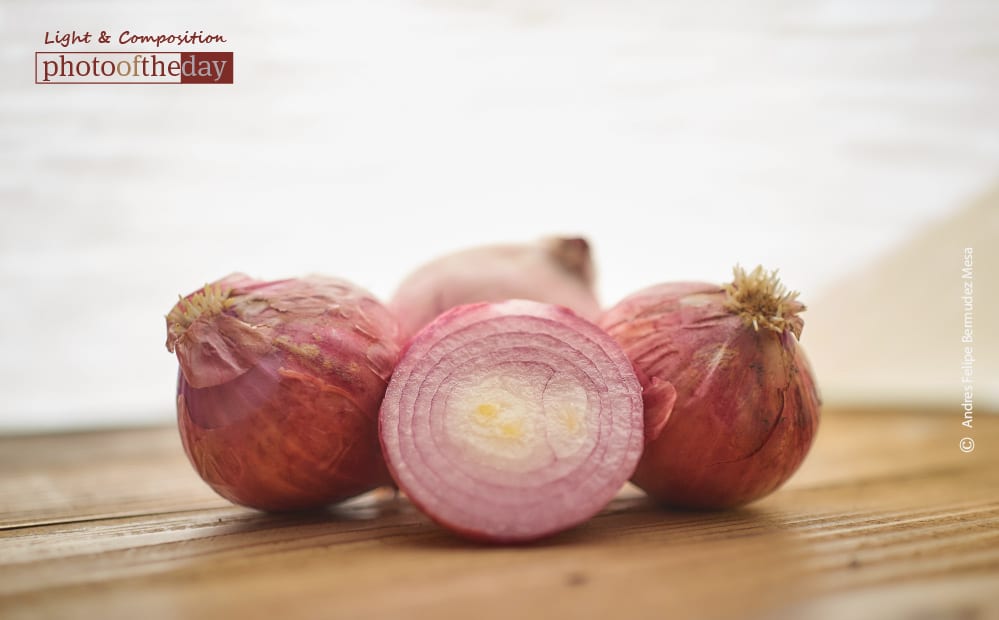
Andres Felipe Bermudez Mesa
Born in Colombia, Andres Felipe Bermudez Mesa is based in Medellín and views himself as a global citizen. With a background in engineering, he eventually pivoted his focus toward a deep-seated passion for photography, specializing in food and portraiture. His artistic philosophy centers on simplicity, aiming to capture the essence of his subjects with clarity and purpose. Through his work, he seeks to make a meaningful contribution to society, dedicating his professional efforts to the craft of visual storytelling.
Resonance Score Breakdown
Transparency Note: The resonance score (12.2/20) is calculated based on social engagement metrics collected before the award announcement.
Expert Photography Reviews · 4
The Architecture of Quiet
We often overlook the humble, seeing only the surface of things as we rush toward the next task. Yet, if we pause, we find that nature does not hurry, and its most profound truths are hidden in the layers of the ordinary.
Read the reflection →The Geometry of Home
I keep a small, silver paring knife in my kitchen drawer, its handle worn smooth by my grandmother’s thumb. It is a heavy, quiet thing that has spent decades parting the skin of roots and bulbs, revealing the pale, hidden architecture of the earth.
Read the reflection →Reviews & Comments
Share your thoughts about this award-winning photograph. Your reviews contribute to the community engagement score.
The onion’s concentric rings provide a rigid, mathematical anchor. It’s a study in radial symmetry that demands total focus. The wood grain’s horizontal lines create a necessary friction against the circular subject, preventing the frame from collapsing into mere decoration. It’s structurally sound, though I’d prefer a tighter crop to eliminate the peripheral clutter. Still, the geometry holds. It’s rare to see such discipline in food photography. The tension here is precise. It’s quite satisfying.
f/2.8 at 100mm. A shallow plane of focus that isolates the onion’s concentric rings with clinical precision. It’s a sharp choice. The diffuser effectively neutralized the midday harshness, preventing blown highlights on the translucent layers. I’ve seen enough food shots ruined by over-exposure, but this holds its integrity. The geometry is clean. It’s technically sound, and honestly, the symmetry of those layers is the first time I’ve actually enjoyed looking at an onion.
The onion sits. It’s a quiet geometry. I’ve spent minutes watching the light settle into the wood grain. It doesn’t demand attention. It simply exists. The space around the bulb isn’t just air; it’s a breath. I feel a sudden, sharp stillness in my chest looking at it. Nothing here is accidental. The empty corner is not empty. It’s a deliberate pause. A rare, honest silence in a world that’s always shouting.
Why do we insist on aestheticizing the mundane? Bermudez Mesa treats this onion like a sacred relic, yet it’s just a vegetable on a table in Envigado. I find the clinical obsession with its geometry unsettling. Does this focus on “perfection” erase the labor behind the harvest? It’s technically polished, sure, but it feels hollow. Why are we so afraid of the dirt and the mess that actually define the food we eat?