On the Swing by Ryszard Wierzbicki
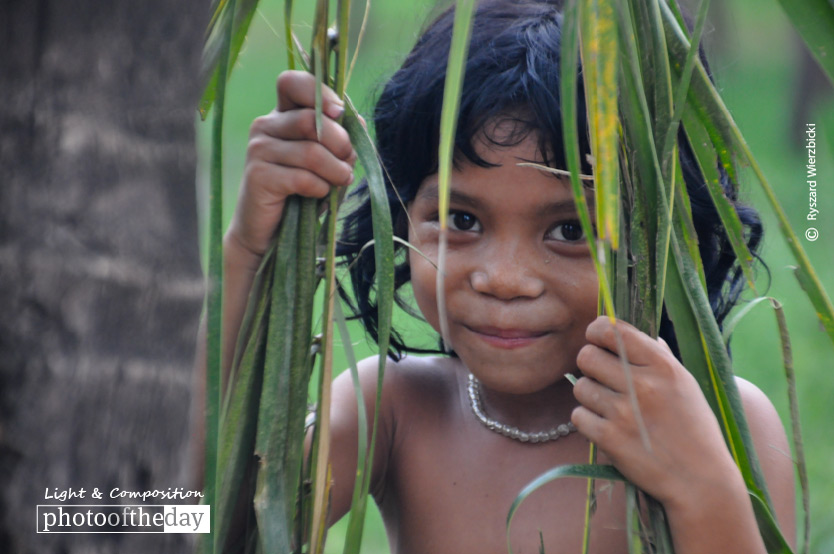
Captured in the rural outskirts of Siem Reap, Cambodia, this portrait documents a fleeting moment of childhood joy on a makeshift swing. The photographer seized the opportunity to engage with local villagers, whose openness allowed for a candid and authentic interaction. By positioning the subject within her natural environment, the image transcends a simple portrait to become a narrative of cultural curiosity and human connection. The composition is particularly striking, earning high marks for its ability to frame the innocence of the child against the backdrop of a unique, unfamiliar landscape, showcasing the photographer’s keen eye for natural light and spontaneous emotion.
Ryszard Wierzbicki
Born in 1963 and a graduate of the University of Gdansk, Ryszard Wierzbicki transitioned from a career in social sciences and marketing to become a dedicated traveler and photographer after emigrating to the United Kingdom in 2006. His work is deeply influenced by his extensive explorations of South-East Asia and his volunteer efforts with orphanages in the region. As the founder of the travel and photography forums Instant Travelling and World Around, he balances his professional life as a marketing advisor with a profound passion for documenting the world through his lens.
Resonance Score Breakdown
Transparency Note: The resonance score (12.3/20) is calculated based on social engagement metrics collected before the award announcement.
Expert Photography Reviews · 8
The Weight of Air
I spent this morning trying to fix a loose hinge on my kitchen cabinet. It was one of those small, nagging tasks I had been putting off for weeks. As I struggled with the screwdriver, my mind kept drifting back to the playground near my old primary school.
Read the reflection →The Weight of Air
There is a specific gravity to childhood. It is not found in the things we hold, but in the space between the ground and the sky. We spend our lives trying to return to that suspension, to the moment when the body forgets its own weight and trusts the arc.
Read the reflection →Reviews & Comments
Share your thoughts about this award-winning photograph. Your reviews contribute to the community engagement score.
Most portraits from Siem Reap rely on the exoticism of the setting, but this one survives because of the girl’s grip on those frayed ropes. It’s a raw, tactile detail that anchors the fleeting joy. I’ve seen thousands of children on swings, yet the tension in her knuckles makes me ache for her future. It doesn’t just capture a moment; it preserves a specific, fragile childhood that will be gone in thirty years. That’s why it endures.
It’s easy to snap a child on a swing and call it a day. Most wouldn’t bother with the dust or the heat of a Siem Reap afternoon. Yet, Wierzbicki clearly didn’t just pass through; he stayed until the light settled into that f/14 crispness. I’ve spent enough hours in similar humidity to know the discomfort involved. It’s a quiet, earned moment. I find myself wishing I’d been the one holding the camera.
At f/14, the Nikon D90 pushes toward the diffraction limit, yet the 27mm lens resolves the child’s skin texture with startling clarity. I’m genuinely moved by how the focal plane captures the swing’s kinetic energy against the soft, atmospheric haze of the Cambodian outskirts. It’s a rare instance where the optics don’t just record light; they preserve the fleeting biology of joy. It’s technically constrained, yet it’s undeniably alive. I’ve rarely seen such honest resolution.
We look at this girl on her makeshift swing and we see the rhythm of Siem Reap. Before the shutter clicked, Wierzbicki must have sat in the dust, listening to the quiet hum of the village. It’s not just a portrait; it’s a conversation held in mid-air. I feel a sudden, sharp ache for the simplicity of her joy. We aren’t just watching a child; we’re invited into her world. It’s a photograph that asks to be returned to.
Before the eye identifies the swing, a sudden stillness settles in the chest. It’s the weightlessness of the child’s arc that triggers a phantom vertigo, a somatic echo of my own forgotten summers. When I return to this frame, the Siem Reap dust feels less like a backdrop and more like a sensory memory. I’ve caught myself holding my breath, waiting for the descent. It’s a quiet, aching reminder of how joy leaves its mark.
The light in Siem Reap doesn’t just fall; it settles, heavy and humid. He stood here in the cooling hour, waiting for the child to find her rhythm. It’s not just a portrait; it’s a conversation with the landscape itself. I feel a strange, quiet ache in my chest looking at the way the dust hangs in the air. He didn’t rush the moment. He let the swing carry the weight of the afternoon.
The swing hangs in a void, suspended between the child’s fleeting momentum and the encroaching Cambodian dusk. It’s not joy I see here, but the gravity of a world that doesn’t care for play. The shadows beneath the frame swallow the earth, reminding me that innocence is merely a temporary truce with the dark. I’ve felt that same cold ache in Tarkovsky’s frames; it’s the weight of time, pulling everything back into the silence of the soil.
The shutter snaps, and the motion freezes mid-arc. It’s a perfect cut. The swing hangs suspended in the humid Siem Reap air, a kinetic energy held captive by the f/14 aperture. I’ve seen a thousand portraits, but this one hits me right in the chest—that fleeting, unscripted joy. Wierzbicki didn’t just take a picture; he held the frame until the rhythm peaked. It’s the shot the editor keeps, the one that tells the whole story.