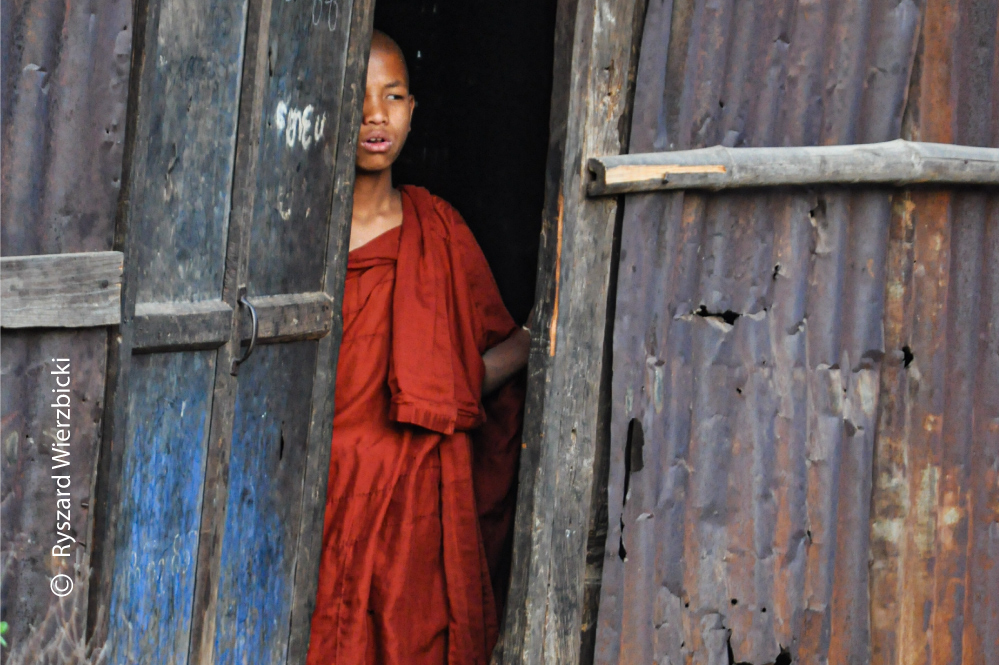
Novice Monk at the Door by Ryszard Wierzbicki
Captured near the serene Inle Lake in Myanmar, this photograph offers a rare, intimate glimpse into the life of a novice monk. The photographer navigated the challenges of restricted access to these young practitioners, choosing a long focal length to maintain a respectful distance while capturing the quiet dignity of the monastery grounds. The composition highlights the wooden architecture and the solitary presence of the subject, emphasizing the contrast between the monk's disciplined life and the surrounding environment. This image is award-worthy for its ability to bridge the gap between the lay world and a secluded spiritual community through patient, observant storytelling.
Ryszard Wierzbicki
Born in 1963 and a graduate of the University of Gdańsk, Ryszard Wierzbicki transitioned from a career in social sciences and marketing to become a dedicated traveler and photographer after moving to the UK in 2006. His work is deeply influenced by his extensive explorations of South-East Asia and his volunteer efforts with orphanages in the region. Currently based in Swindon, he balances his professional life as a marketing advisor with a profound commitment to documenting the world through his lens, often sharing his experiences through his travel and photography forums.
Resonance Score Breakdown
Transparency Note: The resonance score (8.3/20) is calculated based on social engagement metrics collected before the award announcement.
Expert Photography Reviews · 7
The Threshold of Silence
Epictetus taught that the most important task in life is to distinguish between what we can control and what we cannot.
Read the reflection →The Threshold of Silence
There is a specific quality to the light that gathers in the corners of an old room just before the sun fully retreats. It is not the sharp, demanding light of midday, nor the heavy, bruised violet of a coming storm.
Read the reflection →Reviews & Comments
Share your thoughts about this award-winning photograph. Your reviews contribute to the community engagement score.

The vertical axis of the door frame creates a rigid, binary division, forcing the monk into the negative quadrant. It’s a precise 1:3 ratio of subject to architecture that anchors the composition. I’m genuinely struck by how the repetitive horizontal slats of the wood resolve the visual tension; they act as a rhythmic grid, grounding the monk’s stillness. It’s a beautifully solved spatial equation where the geometry doesn’t just contain the subject—it defines his entire existence.
Most portraits in this category rely on the subject’s gaze to do the heavy lifting, but Wierzbicki’s choice to keep the novice monk turned away is what secures its legacy. It’s a quiet defiance of expectation. I’ve seen thousands of monk portraits, yet this one lingers because the frame’s geometry traps the subject in that weathered doorway. It makes me ache for the silence of that monastery. It’s a rare, honest study of solitude.
That 200mm lens creates a wall, doesn’t it? I see the boy’s stillness, but I don’t feel his permission. He’s a subject observed from afar, not a partner in the frame. It’s a clean, quiet composition, yet it lacks that spark of shared humanity I crave. I find myself wishing the photographer had stepped closer, risked the discomfort, and earned a look. This face has a whole life in it, but we’re still just watching from the doorway.
The wood grain holds the light. A sliver of saffron against the dark timber. It’s quiet. I’ve spent minutes looking at the shadow behind the door, and it’s heavy with intention. The monk doesn’t look at us. He doesn’t need to. He is simply there. Nothing here is accidental. The empty corner is not empty. It’s a breath held in the monastery. I feel a sudden, sharp ache for that stillness. It’s rare.
The light here doesn’t demand attention; it settles into the teak grain like a soft, whispered prayer. He stood there for a long time, I’m certain, waiting for the novice to find that perfect stillness against the frame. It’s a quiet, heavy silence that I’ve felt in my own bones. Looking at the way the shadows cradle the boy, I feel a sudden, sharp ache for that kind of peace. It’s truly beautiful.
1/125sec at f/5, ISO 1250, 200mm. The Nikon D5000 sensor struggles here; the noise at ISO 1250 is intrusive, muddying the monk’s robes. Using 200mm was the correct tactical choice to compress the architecture, but the shutter speed is dangerously sluggish for that focal length. I’ve seen enough motion blur to know it’s a gamble. It’s technically compromised, yet the compression creates a claustrophobic intimacy I can’t help but respect. The math is flawed, but the result persists.
The frame breathes. It’s a quiet master shot, the kind where the editor holds the cut just to let the stillness sink in. That 200mm compression flattens the wooden slats, turning the monastery into a stage. I’ve spent hours watching monks, but this boy’s gaze feels like a scene I’ve lived. It’s not just a portrait; it’s the exact moment the film stops, leaving us suspended in his solitude. It’s perfect. I’m genuinely moved.