Meerkoet by Rob van der Waal
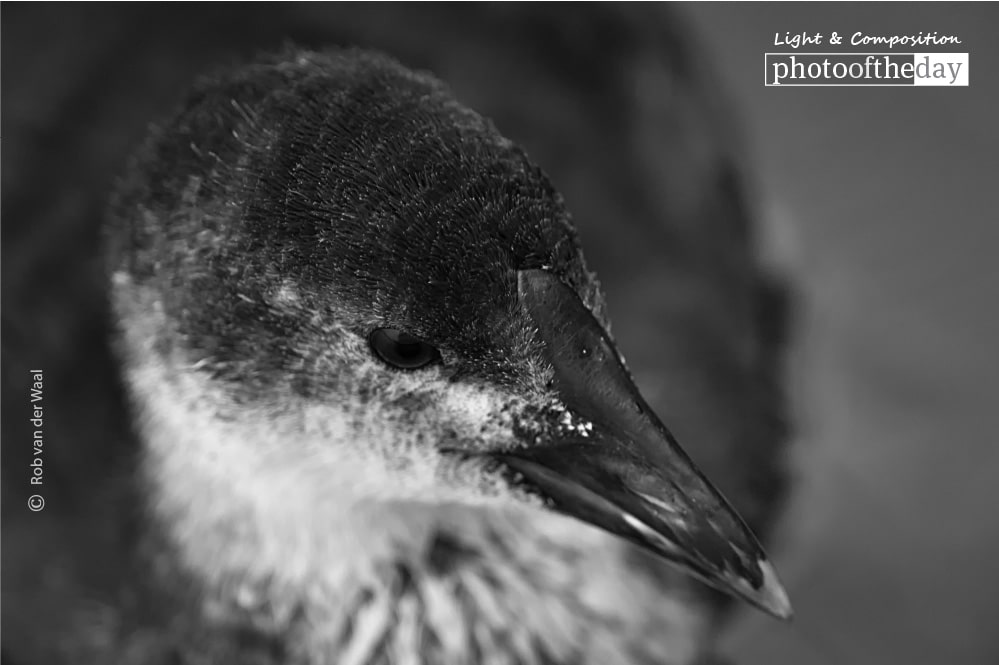
During the busy nesting season, the photographer sought a creative perspective on the natural development of local wildlife. Observing a juvenile coot within its habitat, the photographer carefully balanced the available light and composition to document the young bird's growth. The resulting image is a testament to patience and observational skill, capturing the essence of the coot in its natural environment. This photograph stands out for its intimate portrayal of avian life, demonstrating a keen eye for detail and a deep respect for the subject, which elevates a simple wildlife encounter into a compelling, award-worthy narrative.
Rob van der Waal
Born in 1957 in Rotterdam, Rob van der Waal was introduced to the craft by his father, a passionate photographer who maintained a home darkroom. An autodidact who refined his skills through practice and observation, van der Waal is known for a pure and honest photographic style. He finds his greatest inspiration in nature, particularly at the waterfront, where he captures the interplay of light and wildlife. Based in Hellevoetsluis, he remains dedicated to documenting the natural world with a deep respect for the environment and its inhabitants.
Resonance Score Breakdown
Transparency Note: The resonance score (12.0/20) is calculated based on social engagement metrics collected before the award announcement.
Expert Photography Reviews · 7
The Texture of First Breath
There is a specific dampness that clings to the air just before the sun fully wakes, a smell of wet reeds and cold, dark silt. It is a heavy, velvet scent that settles deep in the lungs, grounding the body in the slow, rhythmic pulse of the water.
Read the reflection →The Weight of Small Beginnings
In the quiet corners of a garden, or perhaps along the reedy edges of a forgotten pond, there is a particular kind of industry that goes entirely unnoticed.
Read the reflection →Reviews & Comments
Share your thoughts about this award-winning photograph. Your reviews contribute to the community engagement score.

The frame’s geometry is tight, anchored by the coot’s sharp, monochromatic silhouette against the blurred reeds. It’s a study in spatial tension. The negative space doesn’t collapse; it breathes. I’ve grown weary of wildlife shots that rely on sentiment, but the structural discipline here is undeniable. The bird’s placement at the fulcrum creates a necessary, rigid equilibrium. It’s cold, precise, and frankly, it’s the only way to render such a chaotic subject with any real authority.
At 550mm, the focal plane is razor-thin, yet the Nikon glass resolves the coot’s downy plumage with startling clarity. The f/5.6 aperture renders the Biesbosch water into a soft, creamy bokeh that isolates the subject perfectly. I’m genuinely moved by how the light catches those delicate, translucent feathers; it’s a rare moment where the diffraction limit doesn’t soften the fine detail. It’s a beautiful, precise capture of a life just beginning to navigate the light.
You waited in that reeds-choked water until the world went quiet. I’ve spent enough time in the field to know that stillness isn’t easy. It’s not just a bird; it’s the vulnerability of a life just beginning. When I look at those soft, awkward feathers, I feel a strange, protective ache in my chest. You didn’t just document a coot. You caught the exact moment it realized it was alive. That’s the truth I’m looking for.
The Biesbosch doesn’t give up its secrets to the hurried. Rob waited in the damp, quiet reeds, listening to the water until the light softened into that muted, silver grey. I’ve spent enough mornings in the marsh to know the ache in his shoulders, the stillness required to let a juvenile coot simply exist. It’s a humble, holy moment. Looking at the soft focus of the reeds, I feel a sudden, profound peace wash over me.
Most wildlife shots are just taxidermy with a pulse, but this coot actually feels alive. Of the thousands of bird photos I’ve reviewed, most fail because they lack character. Here, the low angle and the water’s texture pull you into the bird’s world rather than keeping you behind a lens. It’s the raw, unpolished gaze of that juvenile that gets me; I’d swear it’s judging my presence. It’s a quiet, enduring portrait of survival.
The coot’s silhouette anchors the lower-left quadrant, establishing a rigid vertical axis against the water’s horizontal plane. Van der Waal utilizes a precise 1:3 ratio of subject mass to negative space, creating a tension that pulls the eye across the frame’s diagonal. It’s a beautifully solved spatial equation. I’m genuinely struck by how the ripples disrupt the geometry, adding a chaotic variable to an otherwise perfectly balanced system. It’s rare to see such mathematical elegance in nature.
We look at this juvenile coot and we aren’t just seeing a bird; we’re meeting a life mid-sentence. Rob waited, listening to the reeds until the creature felt safe enough to reveal its vulnerability. It’s a quiet, fragile portrait of growth. I find myself holding my breath, worried I might startle that soft, downy neck. It’s a photograph that asks to be returned to, reminding us that every living thing has a story worth hearing.