Male Little Spiderhunter by Saniar Rahman Rahul
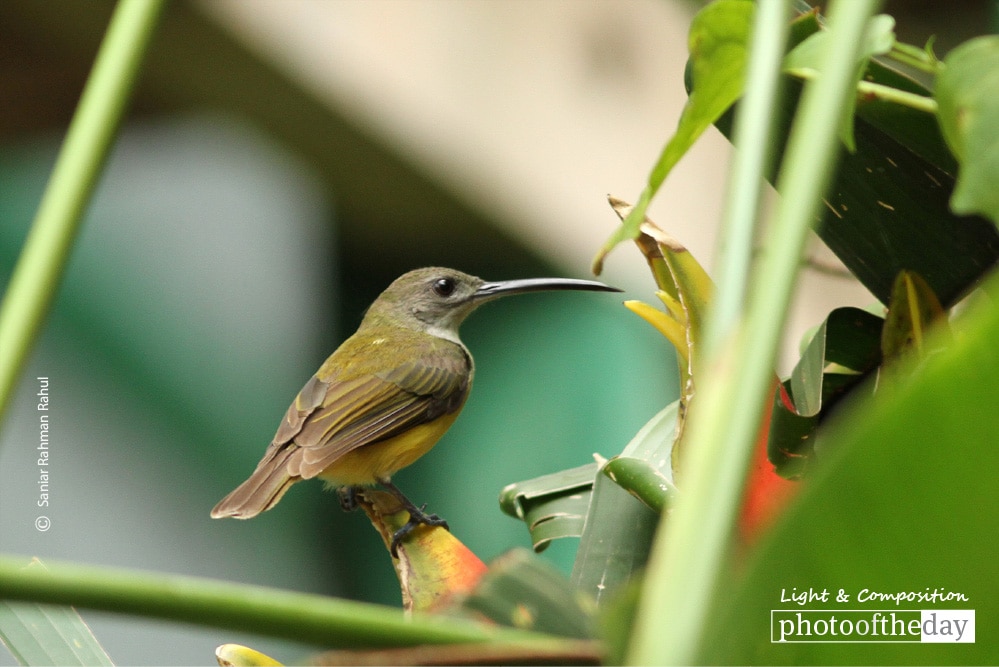
Captured in the lush landscapes of Bandarban, Bangladesh, this photograph showcases the delicate beauty of a male Little Spiderhunter. The image highlights the bird's unique long-billed anatomy, perfectly adapted for feeding on nectar within the region's moist forests. By focusing on the bird amidst its natural habitat near flowering plants, the photographer captures a fleeting, intimate moment of wildlife behavior. The composition is award-worthy for its sharp clarity and the patient observation required to document such a quick, elusive species, offering viewers a rare glimpse into the vibrant biodiversity of the Chittagong Hill Tracts.
Saniar Rahman Rahul
Based in Dhaka, Bangladesh, Saniar Rahman Rahul is a seasoned creative professional who balances a distinguished career in advertising with a profound passion for wildlife photography. His artistic journey began in childhood, inspired by his father's photography, and was later refined through his extensive background in graphic design and art direction at global agencies like Grey Worldwide. Rahul’s work is characterized by a meticulous eye for detail and a deep appreciation for the natural world, earning him significant recognition, including early accolades from the Photo of the Month Award.
Resonance Score Breakdown
Transparency Note: The resonance score (12.0/20) is calculated based on social engagement metrics collected before the award announcement.
Expert Photography Reviews · 8
The Architecture of a Sip
In the quiet hours of the morning, when the dew still clings to the underside of a leaf like a secret, there is a singular focus to the world. We often mistake stillness for inactivity, forgetting that the most profound movements are those performed with absolute precision.
Read the reflection →The Geometry of Nectar
The spiderhunter’s bill is a marvel of evolutionary specialization, curved with the exact radius of the tubular flowers it frequents, a biological key shaped specifically for a single lock.
Read the reflection →Reviews & Comments
Share your thoughts about this award-winning photograph. Your reviews contribute to the community engagement score.
Before the eye identifies the bird, something in the chest hitches. That needle-thin beak, poised against the soft, blurred greens of Bandarban, triggers a sudden, sharp alertness. It’s a suspended heartbeat. I’ve returned to this frame three times today, and each time, the stillness of the Spiderhunter pulls my own breath into a shallow, rhythmic mimicry. It’s not just a bird; it’s a quiet, electric tension that lingers long after I look away.
The Spiderhunter’s beak pierces the frame, yet it’s the encroaching gloom behind the foliage that haunts me. Rahul hasn’t just captured a bird; he’s mapped the tension between the creature’s frantic hunger and the forest’s indifferent, swallowing dark. I’ve stared at this print for an hour, feeling the weight of that silence. It doesn’t invite us in. It reminds us that life is merely a brief, illuminated struggle against an inevitable, encroaching void.
The bird hangs in the air. A curved beak. A sliver of yellow. It’s a sharp, frantic geometry against the soft blur of the forest. I find myself holding my breath, waiting for the wings to stop. They don’t. The surrounding green isn’t just background. It’s the silence the bird inhabits. Nothing here is accidental. The empty corner is not empty. It’s the space where the nectar waits. I’ve never felt so still.
Rahul’s capture of the Little Spiderhunter evokes the meticulous, scientific precision of John Gould’s 19th-century ornithological lithographs, yet it’s stripped of their static artifice. The bird’s sharp, curved bill against the blurred, verdant bokeh feels like a modern evolution of Eliot Porter’s dye-transfer color studies. I’m genuinely struck by the way the light catches the plumage; it’s a rare, fleeting intimacy that avoids the clinical coldness often found in contemporary wildlife documentation. It’s quite a feat.
Most wildlife shots are just technical trophies, but this one lingers. I’ve seen thousands of bird portraits, yet the way the Spiderhunter’s curved bill mirrors the arc of the stem creates a rare, rhythmic tension. It’s not just sharp; it’s patient. I felt a genuine jolt of delight seeing that nectar-dusted beak. It’s a fleeting second frozen with enough grace that, thirty years from now, we’ll still be glad it exists.
In the Chittagong hills, we find a creature defined by its reach. The Little Spiderhunter’s long, curved bill isn’t just anatomy; it’s a conversation with the flower. I’ve spent my life listening to faces, and here, the bird’s intensity feels like a secret shared. It doesn’t just feed; it waits, poised and present. I find myself holding my breath, caught in that tiny, vibrant gaze. It’s a portrait of patience, and it’s beautiful.
The focal plane sits razor-thin across the spiderhunter’s eye, resolving the corneal reflection with clinical precision. At this aperture, the bokeh isn’t just a blur; it’s a soft, creamy transition that isolates the bird from the chaotic foliage. I’m genuinely moved by how the lens handles the diffraction of light across those iridescent feathers. It’s a rare, technical triumph. Most wouldn’t notice the micro-contrast here, but it’s exactly where the physics of glass meets pure, avian elegance.
The chartreuse of the spiderhunter’s plumage vibrates against the muted, mossy umber of the forest, a chromatic tension reminiscent of a Morandi still life caught in the humid, filtered light of a Chittagong morning. It’s a delicate, feverish collision of tones that makes my heart ache with its fleeting, liquid intensity. One finds the bird’s yellow throat isn’t merely pigment, but a sun-drenched whisper of nectar, harmonizing beautifully with the deep, verdant shadows of the canopy.