Lubitel and the Bokeh by Jabbar Jamil
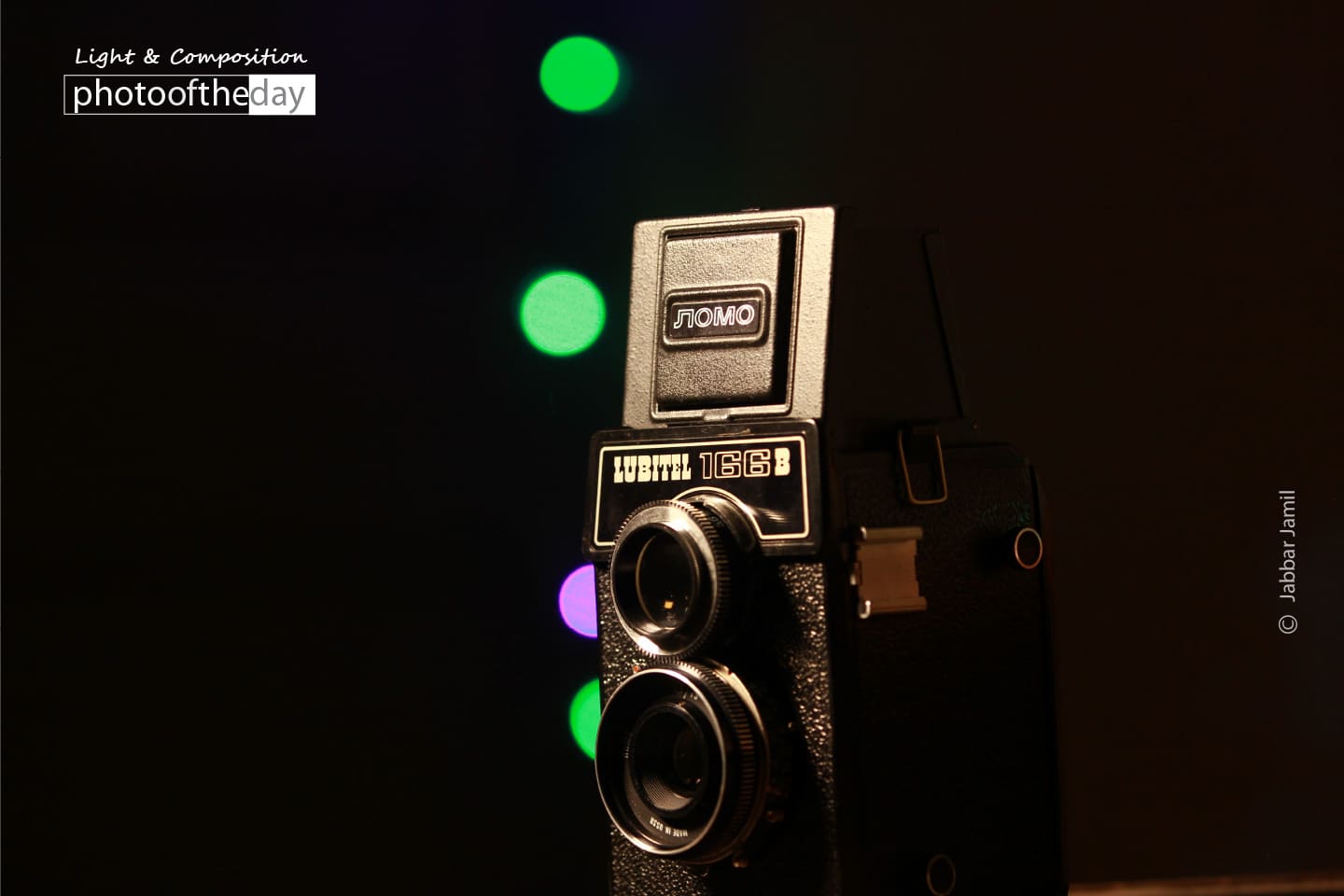
Jabbar Jamil captures a compelling still life featuring a vintage Lubitel camera, a gift from a friend whose grandfather was a dedicated collector. To elevate the composition, the photographer experimented with colorful LED lighting placed behind the subject to generate a vibrant bokeh effect. Although the final result diverged from his initial vision, the image stands as a testament to creative persistence and technical curiosity. The photograph is award-worthy for its unique blend of analog nostalgia and modern lighting techniques, transforming a simple piece of photographic history into a visually arresting study of light and texture.
Jabbar Jamil
Based in Sialkot, Pakistan, Jabbar Jamil is a dedicated street photographer who views his craft as a vital bridge to the outside world. By stepping outside his comfort zone, he uses photography to forge human connections and express his inner creativity, often finding beauty in the raw, unfiltered reality of his surroundings. His work serves as both a personal stress-reliever and a profound exploration of the environment, documenting the world exactly as he perceives it.
Resonance Score Breakdown
Transparency Note: The resonance score (11.7/20) is calculated based on social engagement metrics collected before the award announcement.
Expert Photography Reviews · 6
The Ghost of a Memory
We often treat our past like a heavy trunk, something to be locked away and dusted only when the seasons turn cold. But memory is not a static object; it is a living, breathing thing that shifts its shape whenever we look at it.
Read the reflection →The Weight of Held Light
There is a particular thickness to the air just before the winter solstice, when the sun hangs low and heavy, casting long, bruised shadows against the frost-rimmed glass. In these moments, light does not merely illuminate; it accumulates.
Read the reflection →Reviews & Comments
Share your thoughts about this award-winning photograph. Your reviews contribute to the community engagement score.
There’s a quiet ache in seeing a Lubitel treated like a relic rather than a tool. It’s a beautiful machine, but it’s missing the pulse of a human subject. I’ve spent my life chasing the light in people’s eyes, and here, I’m just looking at glass and LEDs. It’s technically sharp, sure, but it feels lonely. I miss the messy, unpredictable trust of a real portrait. This camera deserves to be held by someone, not just posed.
The Lubitel’s rigid, mechanical massing creates a compelling datum against the chaotic, luminous bokeh. It’s a study in threshold; the lens housing acts as a solid anchor, while the LED-induced light dissolves the surrounding void into pure atmosphere. I’m genuinely struck by how the vintage glass catches that artificial glow. It’s a strange, temporal collision. By flattening the depth of the camera’s own architecture, Jamil forces us to reconsider the space between object and light.
The Lubitel sits in the dark. It’s a relic, yet the light behind it breathes. I’ve spent minutes watching those blurred circles of color. They don’t crowd the frame; they hold it. It’s a quiet tension between the mechanical past and the digital glow. I feel a sudden, sharp ache for the grandfather who held this camera first. Nothing here is accidental. The empty corner is not empty. It’s a pause. A deep, resonant breath.
Placing a Lubitel against such aggressive, synthetic bokeh feels like a collision between Soviet-era utilitarianism and the neon excess of contemporary digital aesthetics. It’s a jarring juxtaposition that I’ve rarely seen executed with this much grit. While the Lubitel’s TLR optics usually demand a soft, atmospheric rendering reminiscent of early 20th-century pictorialism, Jamil forces a confrontation. Honestly, the way those LED flares bleed into the camera’s Bakelite frame makes my pulse quicken. It’s refreshingly, unapologetically weird.
Most still lifes of vintage gear are tiresome exercises in nostalgia, but this one avoids the trap. By pushing the Lubitel against a chaotic, neon-drenched background, Jamil forces a collision between analog history and digital-age light. It’s a jarring, honest friction. I’ve seen thousands of camera portraits, yet this one actually made me smile. It’s the tension between the rigid, mechanical lens and that bleeding, synthetic bokeh that ensures this shot will still matter in thirty years.
The Lubitel’s rigid geometry anchors the frame, providing a necessary fulcrum against the chaotic bokeh. It’s a calculated collision of analog mass and digital-adjacent light. The spatial tension holds because the lens barrel bisects the vertical plane with such clinical precision. I’ve rarely seen such a disciplined use of chromatic distraction. It doesn’t collapse into sentimentality. The composition demands attention, and frankly, it’s earned its place here. The frame is tight, controlled, and entirely sufficient.