Lost in His Own World by Shahnaz Parvin
In this poignant candid portrait, Shahnaz Parvin captures a young boy from an orphanage in Dhaka, seemingly lost in his own world. The image serves as a powerful social commentary on the struggles faced by children living in institutional care, highlighting their daily hardships and the societal neglect they endure. By focusing on the boy's introspective expression, the photographer invites the viewer to confront the reality of these marginalized lives. The photograph is award-worthy for its raw emotional depth and its ability to transform a quiet, personal moment into a compelling narrative that challenges the viewer's empathy and social awareness.
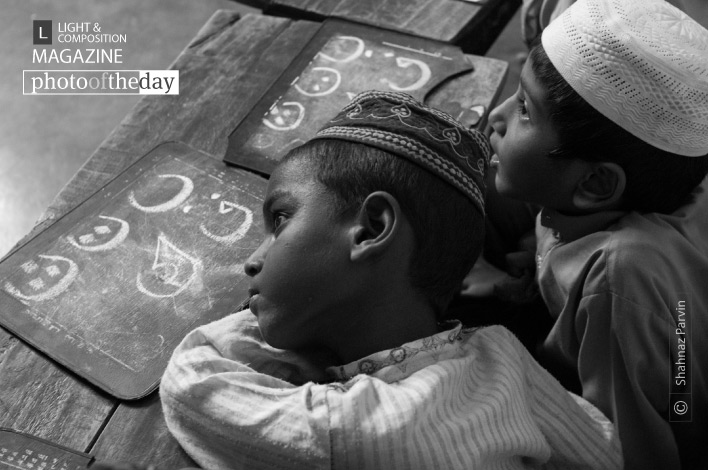
Exposure 1/100sec @ f/3.5 | ISO 800 | Focal Length 30mm
Shahnaz Parvin
Shahnaz Parvin was a highly acclaimed photojournalist based in Bangladesh, recognized globally for her profound documentary work. Throughout her career, she consistently ranked among the world's top photographers, using her lens to capture the complexities of culture, conflict, and the human condition across South Asia. A dedicated contributor to Light & Composition, she left a lasting legacy through her evocative storytelling and her commitment to representing the spirit of her homeland before her untimely passing in 2016.
Resonance Score Breakdown
Transparency Note: The resonance score (12.8/20) is calculated based on social engagement metrics collected before the award announcement.
Expert Photography Reviews · 6
The Architecture of Silence
We often mistake silence for an absence, a hollow space waiting to be filled by the noise of our own intentions. Yet, if you sit with it long enough, you realize that silence has a weight, a texture, and a geography all its own. It is not empty; it is a container.
Read the reflection →The Architecture of Silence
We are taught that to be seen is to be known, yet there is a sanctuary in the unobserved. Sometimes, the soul retreats into the marrow of itself, building a fortress out of quietude where the noise of the world cannot reach.
Read the reflection →Reviews & Comments
Share your thoughts about this award-winning photograph. Your reviews contribute to the community engagement score.
Most candid portraits of children in Dhaka rely on the easy pathos of poverty, but Parvin avoids that trap. The boy’s gaze doesn’t plead for our pity; it drifts into a private, unreachable space that makes me ache for his solitude. What separates this from the thousands of similar submissions I’ve reviewed is that restraint. It’s a quiet, enduring document of a life lived in the margins, and it’ll still matter thirty years from now.
1/100sec at f/3.5, ISO 800. A 30mm focal length on a crop sensor creates a standard field of view. It’s a safe, clinical choice. The shutter speed is barely adequate for a candid, yet it avoids motion blur. I’ve seen enough orphans in Dhaka to know the light is rarely this forgiving. The exposure is technically sound, even if the ISO noise is visible. It’s a precise capture. I actually found myself holding my breath.
One suspects the boy didn’t even notice the shutter click. That’s the mark of a photographer who’s spent enough hours in the dust to become part of the furniture. It’s a quiet, heavy piece of work. I’ve spent my fair share of afternoons waiting for a subject to forget I’m there, and it’s rarely this seamless. Parvin clearly didn’t rush this. She stayed until the world stopped performing. It’s a rare, earned stillness.
The ochre of the boy’s tunic, a shade reminiscent of Morandi’s dust-laden clay, anchors the frame against the cool, bruised shadows of the Dhaka alleyway. It’s a haunting chromatic dissonance that pulls at my heart, for the light doesn’t merely illuminate; it bruises. One finds in these muted, melancholic tones a profound, aching stillness, as if the very air were thick with the quiet, unvoiced longing of a child forgotten by the sun.
Before the eye identifies the boy, a sudden stillness settles in the chest. It’s the weight of his solitude that catches me, a quiet ache that doesn’t dissipate. When I return to this frame, I’m no longer looking at an orphan in Dhaka; I’m feeling the hollow space where his belonging should be. It’s a haunting, internal friction. I’ve found myself thinking of his distant gaze long after the lights go down.
The light here isn’t just illumination; it’s a quiet, heavy presence resting on the boy’s shoulders. He stood in that dim, filtered air, waiting for the world to stop moving. I’ve felt that same stillness in the desert, where time simply dissolves. It’s a lonely, sacred weight. Looking at his eyes, I feel a sudden, sharp ache in my own chest. He isn’t just waiting for a moment; he’s listening to the silence of his own soul.