Little House on the Hill by Shirren Lim
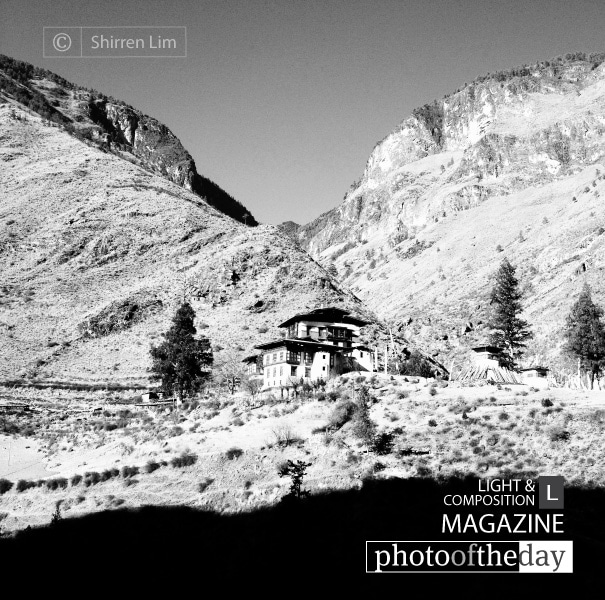
Captured during a journey between Thimphu and Paro, this photograph highlights the stark, serene beauty of the Bhutanese winter landscape. The photographer was struck by the sight of a solitary house perched atop a hill, a scene emblematic of the region's sparse and evocative terrain. By framing this humble structure against the vast, quiet backdrop, the image serves as a poignant representative of Bhutan’s unique geography. The composition is celebrated for its ability to distill the essence of a place into a single, quiet moment, demonstrating a keen eye for finding profound beauty in the simplicity of rural life.
Shirren Lim
Born in Penang Island, Malaysia, in 1970, Shirren Lim is a Jakarta-based photographer who discovered her true passion for the craft in 2009. While she specializes in portraiture, aiming to capture the sincere and uncovered expressions of humanity, her work is consistently described as intense and earthy. Deeply inspired by the iconic imagery of Steve McCurry, Lim strives to create photographs that resonate with the same emotional power and global significance, seeking to capture that singular, world-changing moment through her lens.
Resonance Score Breakdown
Transparency Note: The resonance score (12.3/20) is calculated based on social engagement metrics collected before the award announcement.
Expert Photography Reviews · 4
The Architecture of Solitude
My grandmother’s kitchen table was once scarred by the heat of a heavy iron kettle, a mark that proved she had been there, moving through the morning.
Read the reflection →The Weight of Silence
To live on a slope is to accept the gravity of the earth. You build because you must, placing stone upon stone against the vast, indifferent sky.
Read the reflection →Reviews & Comments
Share your thoughts about this award-winning photograph. Your reviews contribute to the community engagement score.
Lim’s frame isn’t merely a landscape; it’s a confrontation with the void. That solitary house clings to the ridge like a desperate thought against the encroaching winter grey. It’s here that the shadow doesn’t just define the hill—it consumes the silence. I’ve stared at this iPhone capture until my eyes ached, feeling the cold seep through the pixels. It’s a brutal, honest refusal to be comforted by the light. We are all that house, eventually.
The frame operates on a strict 1:3 ratio, anchoring the house in the upper-right quadrant to create a powerful diagonal tension against the valley’s slope. It’s a masterclass in negative space; the vast, monochromatic void forces the eye to resolve the structure’s weight against the horizon. I’m genuinely struck by how the iPhone’s limited sensor captures such precise geometric clarity. It’s a perfectly solved spatial equation, proving that simplicity is just complex math stripped bare.
The air in Thimphu is thin, and you can feel it here. She stood in that biting winter chill, waiting for the light to settle against the hillside. It’s a quiet, humble existence, isn’t it? Looking at this, I’m struck by how the iPhone’s sensor caught that flat, honest clarity. It doesn’t demand attention; it simply waits. I’ve felt that same stillness in the mountains, where the land finally lets you see it.
The silence here is deafening. It’s a wide shot that refuses to cut, holding the house against that vast, frozen slope like a single beat in a long, quiet film. I’ve stared at this frame for ten minutes, and I’m still shivering. The iPhone 4S captured the light with such brutal, honest clarity that you can feel the thin air. It’s a perfect edit; any movement would’ve ruined the tension of that solitary, lonely climb.