Lady Just Waiting by José J. Rivera-Negrón
I saw this lady lying on the sidewalk in the streets of old Arecibo city. She was just starring at nowhere like if she was waiting for someone with her bags. Ever wonder on what homeless people are thinking when you see them on the side walks or anywhere around? I guess will never know.
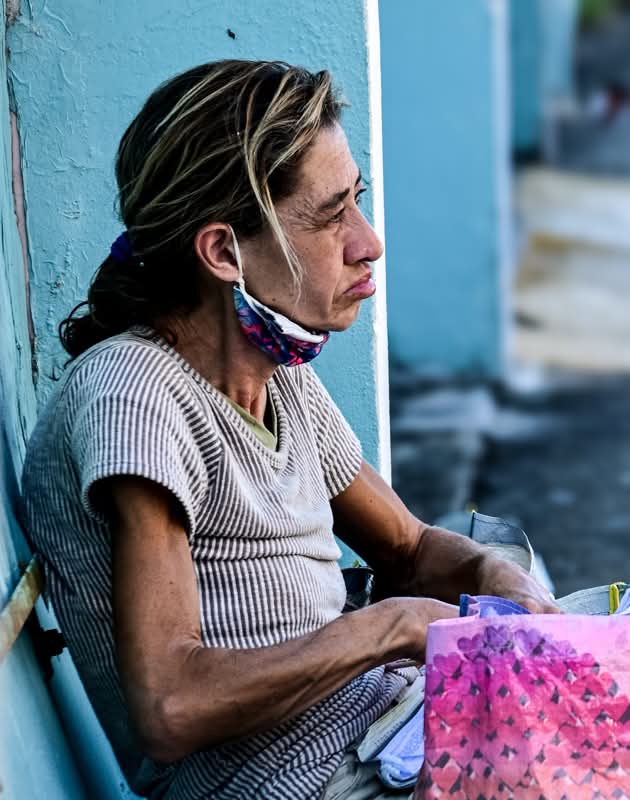
Exposure 1/160sec @ f/5.6 | ISO 125 | Focal Length 292mm
José J. Rivera-Negrón
José J. Rivera-Negrón was born in Puerto Rico and later moved to the United States, where he faced years of addiction, poverty, and life on the streets. After reaching a personal turning point, he sought help, completed rehabilitation, and made a firm decision to change his life. Those difficult experiences deeply shaped his perspective and eventually led him to photography—a medium through which he could express truth, struggle, and hope.
Today, Jose is a photographer whose work reflects resilience, recovery, and human connection. Through his travels, he documents diverse cultures and tells stories that carry messages of awareness, especially around addiction recovery and mental health. Working with Light and Composition has allowed him to share his vision with a wider audience. His journey stands as a reminder that even after the darkest chapters, it is always possible to start again and pursue one’s purpose.
Resonance Score Breakdown
Transparency Note: The resonance score (1.5/20) is calculated based on social engagement metrics collected before the award announcement.
Expert Photography Reviews · 6
The Geometry of Stillness
If we are defined by our movement, what becomes of us when we simply stop? We spend our lives constructing narratives of progress, measuring our worth by the distance covered or the tasks completed.
Read the reflection →The Weight of the Unseen
When I was seven, my grandmother kept a wicker chair on the porch that faced the main road. She would sit there for hours, her hands folded over her apron, watching the cars pass as if she were waiting for a specific engine sound that never arrived.
Read the reflection →Reviews & Comments
Share your thoughts about this award-winning photograph. Your reviews contribute to the community engagement score.
The stillness here isn’t the calm of a resting athlete; it’s the heavy, hollow tension of a body that’s given up. I’ve spent my life chasing the millisecond of peak extension, but this frame captures the exact opposite: the collapse. Her gaze is fixed on nothing, a total muscular surrender. It’s haunting. I feel a sharp, cold ache in my own chest looking at her. You didn’t miss the moment; you caught the exhaustion.
1/160s at f/5.6, 292mm equivalent. You’ve pushed the Z50’s reach, yet the compression flattens the subject into the pavement. It’s a clinical choice that isolates her, but the shutter speed is sluggish for handheld telephoto work; there’s micro-blur in the textures. I’m bothered by the lack of sharpness on her eyes. It’s a technical failure that undermines the narrative. You had the distance, but you didn’t have the stability to make the shot land.
There’s a heavy distance here. You’ve captured a woman on the Arecibo sidewalk, but she’s a prop in your narrative rather than a participant. When you shoot from across the street with a long lens, you aren’t receiving a gift; you’re taking a secret. It makes me ache to see her so exposed yet so unknown. I’d have preferred you put the camera down and sat beside her. That’s how you earn a real story.
Before the eye identifies the bags or the sidewalk, a sudden, heavy stillness settles in the chest. It’s the physiological weight of someone else’s suspended time. I feel a sharp, cold ache in my own throat looking at her gaze. When I return to this a year from now, I suspect the sidewalk will have vanished, leaving only that hollow, waiting silence. It’s an activation of empathy that doesn’t resolve; it just lingers, restless and unresolved.
The framing echoes the stark, observational detachment of Walker Evans’s street work, yet the compression from that 292mm focal length flattens the Arecibo pavement into a claustrophobic stage. It’s a precarious balance. While the subject’s posture recalls the weary dignity found in Dorothea Lange’s Depression-era portraits, the digital crispness feels jarringly modern. I’ve spent decades cataloging such solitude, but the raw, unvarnished ache in her eyes genuinely caught me off guard. It’s a haunting, necessary interruption.
Arecibo’s heat radiates off this frame. You caught her stillness against the city’s frantic pace, and that’s the hook. It’s raw. I’ve spent years chasing these ghosts, and the way she stares into the void hits me right in the gut. One tenth of a second later and the light shifts, the tension evaporates. You didn’t hesitate. You held the line between empathy and voyeurism. That’s the decisive moment, pure and unvarnished. You were paying attention.