Keep Clear by Keeny Newton
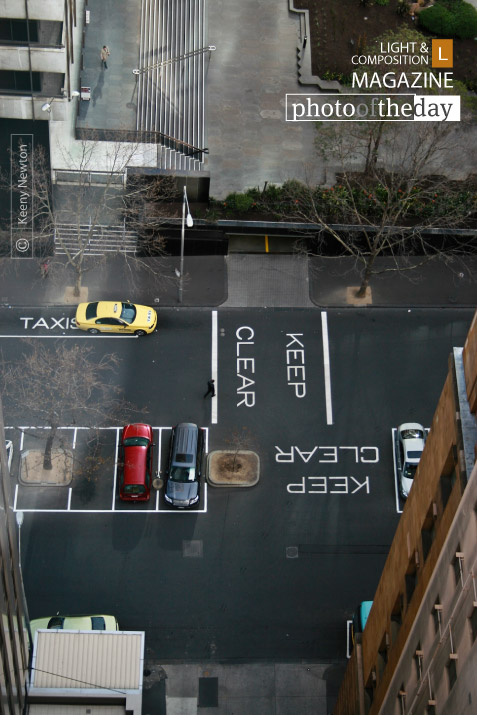
Captured from the vantage point of a hotel room in Melbourne, this image transforms a mundane urban intersection into a study of timing and geometry. The photographer spent a week observing the rhythmic flow of Market Street, waiting for the perfect convergence of traffic and human presence. By isolating a single pedestrian within the frame at the precise moment the road cleared, the photographer highlights the intersection of urban infrastructure and individual movement. The composition’s strength lies in its patient observation, turning a transient street scene into a deliberate, award-worthy narrative of city life.
Keeny Newton
Based in Bangalore, India, Keeny Newton balances a professional career as an IT consultant with a deep-seated passion for the visual arts. His photographic practice is defined by a creative exploration of fashion and travel, where he seeks to capture the aesthetic nuances of his subjects. Through his lens, Newton translates his artistic inclinations into compelling imagery, establishing himself as a versatile photographer with a keen eye for the world around him.
Resonance Score Breakdown
Transparency Note: The resonance score (13.2/20) is calculated based on social engagement metrics collected before the award announcement.
Expert Photography Reviews · 5
The Architecture of Solitude
We are taught that the city is a chorus, a relentless hum of iron and breath, yet there is a profound, quiet geometry to being alone in a crowd.
Read the reflection →The Geometry of Waiting
There is a peculiar rhythm to the city that most of us choose to ignore. We move through intersections like water through a sieve, rarely pausing to consider the lines we trace against the concrete.
Read the reflection →Reviews & Comments
Share your thoughts about this award-winning photograph. Your reviews contribute to the community engagement score.
One suspects the hotel room was a comfortable enough perch, but a week spent watching a Melbourne intersection for a single frame is a rare sort of penance. It’s a disciplined study of geometry, and I’ll admit, the solitude of that lone pedestrian in the clearing traffic actually made me shiver. It’s a quiet, earned moment. Most would’ve clicked and left for lunch, but Newton stayed until the city finally behaved. That’s proper work.
From that hotel window, Keeny watched the city breathe. It’s a rare patience, waiting for the asphalt to empty until only one soul remains in the geometry of Market Street. I’ve spent enough hours in the cold to know the ache in his shoulders as he waited for that precise alignment. When the light hit the pavement just so, he didn’t force it; he simply listened to the intersection until it finally surrendered its silence.
Most urban shots are just noise, but Newton’s patience here paid off. By waiting for that solitary pedestrian to hit the exact center of the yellow box, the chaos of Melbourne’s grid dissolves into a quiet, geometric study. It’s the negative space that makes me hold my breath; it feels like a rare, silent heartbeat in a frantic city. Thirty years from now, this won’t just be a street scene—it’ll be a perfect, frozen moment of solitude.
The geometry of Market Street dictates the frame. The pedestrian acts as a necessary fulcrum, anchoring the vast, grey expanse of asphalt. It’s a rigid, calculated placement. The negative space doesn’t just exist; it exerts pressure on the subject, forcing a stillness that’s rare in urban documentation. I’ve stared at this intersection for hours, and frankly, the structural discipline here is intoxicating. The frame holds. It’s a rare instance where the architecture of the city finally obeys.
The asphalt’s bruised, slate-grey melancholia, reminiscent of a Morandi still life, anchors the frame, yet it’s the pedestrian’s singular, sharp ochre coat that truly arrests one’s breath. It’s a startling, sun-drenched punctuation against the city’s muted, industrial indifference. I’ve found myself mesmerized by how this singular warmth vibrates against the cool, shadowed concrete; it’s a quiet, chromatic rebellion that feels almost fragile, as if the entire intersection might dissolve into pure, unadulterated light.