Just Catch by Nirupam Roy
In this captivating wildlife study, a kingfisher is captured in a moment of triumph, clutching its prey with precision. The photographer observed the bird as it struggled to find a stable perch, intent on consuming its catch. This image highlights the fleeting, high-stakes nature of avian life, requiring immense patience and focus to document. By capturing the bird’s intense concentration and the delicate balance of its posture, the photographer provides a rare, intimate look at a common yet beautiful natural phenomenon, earning recognition for its technical clarity and evocative composition.
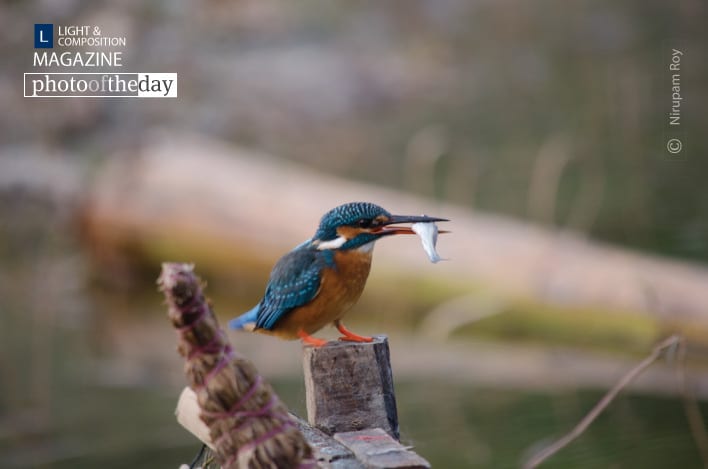
Exposure 1/125sec @ f/6.3 | ISO 400 | Focal Length 280mm
Nirupam Roy
Hailing from the town of Tufanganj in West Bengal, India, Nirupam Roy balances his professional life as a school teacher with a profound dedication to photography. His transition into the medium began during a family trip to the coast, where he discovered a desire to document the beauty of the natural world. Since then, photography has evolved from a simple interest into a deep-seated passion, fundamentally shifting his perspective on nature and humanity. Roy continues to explore new creative concepts, finding peace and inspiration through his lens.
Resonance Score Breakdown
Transparency Note: The resonance score (12.8/20) is calculated based on social engagement metrics collected before the award announcement.
Expert Photography Reviews · 8
The Weight of the Hunger
There is a violence in the morning that we prefer to ignore. We wake, we drink coffee, we watch the light change, and we forget that the world is a series of transactions. To live is to take.
Read the reflection →The Weight of a Moment
There is a profound gravity in the way nature sustains itself. We often move through our days with a sense of lightness, forgetting that every breath we draw is part of an ancient, rhythmic exchange.
Read the reflection →Reviews & Comments
Share your thoughts about this award-winning photograph. Your reviews contribute to the community engagement score.
At 280mm, the Nikon’s optics struggle against the diffraction limit, yet the focal plane holds the kingfisher’s eye with startling, clinical sharpness. The bokeh, a function of that f/6.3 aperture, renders the Rasik Bill foliage into a soft, chromatic wash that isolates the subject’s frantic energy. I’m genuinely moved by how the lens resolves the iridescent plumage against the prey’s struggle. It’s a rare, precise intersection of glass and biology that feels almost alive.
The kingfisher’s prize isn’t merely sustenance; it’s a violent rupture in the stillness of Rasik Bill. I’m struck by how the shadows here don’t just frame the bird—they swallow the periphery, forcing us to confront the cruelty of the hunt. It’s a cold, precise geometry of survival. When light abandons the background, the struggle becomes absolute. It doesn’t invite our sympathy; it demands we acknowledge that life is sustained only by what we choose to kill.
The kingfisher holds its prize. The branch is thin. It doesn’t crowd the frame. I find myself holding my breath, waiting for the bird to swallow. There is so much air around the subject. It’s a quiet tension. The background dissolves into soft, muted greens. Nothing here is accidental. The empty corner is not empty. It’s the silence before the gulp. I’ve never felt such stillness in a hunt. It’s perfect.
The air at Rasik Bill holds a heavy, humid stillness. Nirupam must have waited until his limbs ached, listening to the reeds. When the kingfisher finally landed, the light was soft, diffused by the canopy. I feel a sudden, sharp ache in my own shoulders just looking at that tense, feathered posture. It’s a quiet, fleeting grace. He didn’t just take a picture; he surrendered to the bird’s rhythm, waiting for the land to breathe.
Before the eye identifies the kingfisher, something in the chest tightens. It’s the sudden, sharp tension of the hunt suspended in amber. I feel a strange, sympathetic ache in my own throat watching that fish struggle. When I return to this a year later, the bird’s frantic posture doesn’t just show survival; it triggers a visceral, restless anxiety. It’s a beautiful, brutal reminder that life is always just one snap away from being consumed.
The kingfisher’s plumage, a startling electric cobalt reminiscent of Vermeer’s lapis lazuli, vibrates against the muted, muddy ochre of the Rasik Bill wetlands, creating a chromatic tension that feels almost violent in its precision. It’s a breathtaking collision of temperatures; I’m genuinely moved by how the bird’s iridescent turquoise cuts through that stagnant, swampy gloom like a sudden, sharp intake of breath, turning a simple hunt into a profound, painterly event of pure light.
Most wildlife shots are just trophies, but this kingfisher’s desperate grip on its wriggling catch feels visceral. Of the thousands of avian frames I’ve reviewed, most fail because they lack this raw, frantic energy. The shutter speed here didn’t just freeze motion; it captured the bird’s genuine, hungry intent. I find myself holding my breath watching that beak. It’s not just a technical success; it’s a brutal, honest slice of survival that will still matter in thirty years.
One suspects the kingfisher didn’t make this easy. It’s a messy, frantic business, isn’t it? I’ve spent enough mornings in damp hides to know that capturing this precise, precarious grip requires more than just a quick shutter finger. It demands a stubborn refusal to leave until the bird finally cooperates. I find myself genuinely envious of the stillness required here. Nirupam didn’t just find this moment; he clearly sat in the mud until he earned it.