Install Industry by Saniar Rahman Rahul
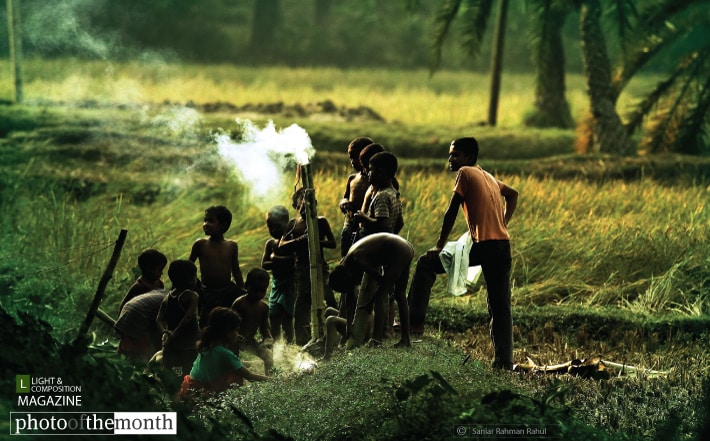
In the heart of a sprawling rice field, a poignant scene of childhood ingenuity unfolds. Several young children, dressed simply, transform humble banana tree stalks into a makeshift toy industry, demonstrating remarkable resilience and creativity. The photographer captures this moment with a long lens, isolating the subjects against the lush, vibrant greenery of the landscape. This image is award-worthy for its ability to elevate a candid, everyday scene into a powerful narrative about human resourcefulness, framed with a keen eye for composition and the gentle, authentic spirit of rural life.
Saniar Rahman Rahul
Saniar Rahman Rahul is a distinguished photographer and Art Director based in Dhaka, Bangladesh. His creative journey began in childhood, inspired by his father’s photography, and was later refined through a successful career in graphic design and advertising at global agencies like Grey Worldwide. Since winning his first major photography award in 2010, Rahul has balanced his professional expertise in pre-press and advertising with a deep passion for capturing the authentic, human stories found within his home country and beyond.
Resonance Score Breakdown
Transparency Note: The resonance score (15.0/20) is calculated based on social engagement metrics collected before the award announcement.
Expert Photography Reviews · 4
The Texture of Invented Play
The smell of crushed green stalks always brings me back to the damp earth of a backyard after a heavy monsoon. It is a sharp, vegetal scent—the smell of sap staining your palms a sticky, permanent brown.
Read the reflection →The Weight of Play
We are taught that work is a heavy thing, a burden to be carried into the gray hours of the morning. We measure our worth by what we produce, by the steel and stone we stack against the sky.
Read the reflection →Reviews & Comments
Share your thoughts about this award-winning photograph. Your reviews contribute to the community engagement score.
The banana stalks aren’t merely toys; they’re the raw material of a fragile, unfolding industry. I’m struck by how the long lens compresses the space, forcing these children into a claustrophobic, verdant cage. It’s a haunting tension. The light here doesn’t illuminate; it interrogates. It’s a cruel, bright exposure that refuses to let the shadows hide the weight of their labor. They’ve built a world, yet it feels like they’re already being consumed by it.
Of the thousands of images I’ve reviewed, most capture poverty as a spectacle. Rahul avoids that trap. By using a 600mm lens to compress the distance, he turns these children’s banana-stalk toys into a serious, industrial architecture. It’s a quiet, dignified defiance of circumstance. I’ll admit, it made me smile—a rare thing in this business. It endures because it doesn’t pity the subjects; it respects the gravity of their play. That’s why it’s winning.
A 600mm lens suggests a photographer who kept their distance, perhaps to avoid disturbing the scene. It’s a clean capture, though one wonders if the photographer spent enough hours in those fields to become part of the scenery. I’ve spent enough time in the damp to know that intimacy requires more than just reach. Still, the children’s focus is genuine. It’s a decent effort, even if I suspect they didn’t linger long enough to get truly muddy.
The verdant, suffocating chlorophyll of these Bangladeshi fields evokes a Morandi-esque stillness, yet it’s the startling, pale flesh-tones of the children—like unbaked dough against the emerald—that truly ache. One finds the humidity palpable, a heavy, saturated green that swallows the light, making those makeshift banana-stalk toys feel like fragile, ephemeral relics. I’m genuinely moved by how the palette doesn’t just describe the scene; it breathes, it’s alive, and it’s utterly, devastatingly beautiful.