Hope for Better Life by Soumya Geetha
Captured with a shallow depth of field, this poignant portrait highlights the raw perseverance of a hardworking soul striving for a better future. The photographer was drawn to the subject’s quiet resilience and the stark reality of his circumstances, choosing an 85mm lens at f/1.4 to isolate the subject against a soft background, effectively drawing the viewer’s focus to his expressive eyes. This image is award-worthy for its profound emotional resonance and the photographer's ability to transform a fleeting street encounter into a powerful narrative of hope, dignity, and the human spirit’s capacity to endure despite hardship.
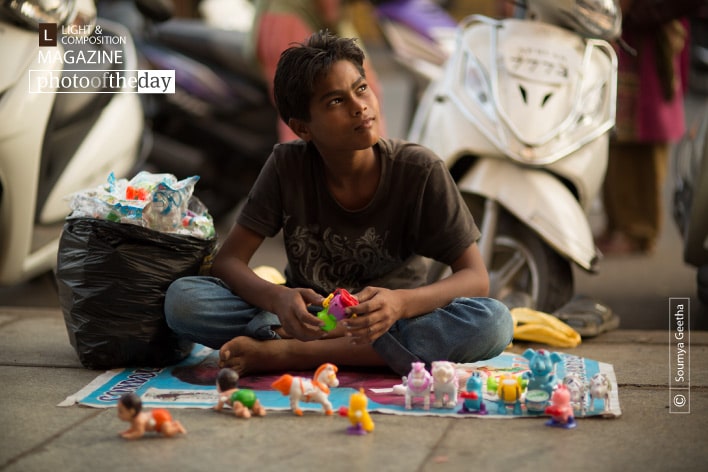
Exposure 1/500sec @ f/1.4 | ISO 100 | Focal Length 85mm
Soumya Geetha
Based in Dubai, United Arab Emirates, Soumya Geetha is a professional consultant who balances her career with a deep passion for photography. Her journey began unexpectedly while blogging about her garden, eventually leading her to master the DSLR and focus her lens on travel and street photography. Currently, she is dedicated to a project exploring the hidden cultural nuances of South India, showcasing her commitment to capturing authentic human stories through her self-taught artistic lens.
Resonance Score Breakdown
Transparency Note: The resonance score (12.8/20) is calculated based on social engagement metrics collected before the award announcement.
Expert Photography Reviews · 7
The Weight of Tomorrow
There is a quiet gravity in the way we carry our intentions. Often, we move through the world as if we are merely passing through, yet our eyes reveal the truth of our internal landscape.
Read the reflection →The Weight of Tomorrow
I was standing in line at the grocery store this morning, watching the man in front of me count out his coins. He was slow, deliberate, and his hands were calloused and worn from years of work. He didn’t look up once, just focused entirely on the small pile of metal in his palm.
Read the reflection →Reviews & Comments
Share your thoughts about this award-winning photograph. Your reviews contribute to the community engagement score.

Of the thousands of portraits I’ve reviewed, most rely on shallow depth of field to hide a lack of intent. Here, the f/1.4 aperture isn’t a crutch; it’s a scalpel. By isolating those eyes, Geetha forces us to confront a gaze that isn’t asking for pity, but demanding recognition. It’s rare to find such dignity in a street encounter. Honestly, it made me look away, then look back. That’s why this will endure.
The light here doesn’t just fall; it lingers, caught in the soft blur of a Bangalore afternoon. I’ve spent enough hours waiting for the sun to soften like this to know she didn’t rush him. She waited until the world behind him dissolved into a quiet, amber hum. Looking into those eyes, I feel a sudden, sharp ache in my chest. It’s the weight of a soul that’s still listening, even when the city is loud.
The blur behind him isn’t just a lens choice. It’s a wall. A barrier of light. He sits in the center, yet he’s surrounded by a vast, unmapped silence. I’ve stared at his eyes for ten minutes now. They don’t ask for pity. They just hold the space. Nothing here is accidental. The empty corner is not empty. It’s the weight of everything he hasn’t said yet. It’s quiet. It’s enough.
The 85mm compression flattens the plane, forcing a claustrophobic intimacy. The subject’s gaze anchors the frame, yet the shallow depth of field dissolves the context into mere chromatic noise. It’s a precarious balance. While the structural weight leans heavily on the eyes, the background’s blur lacks the necessary geometric friction to sustain interest. I’m exhausted by this reliance on bokeh to manufacture depth. The architecture doesn’t hold. It’s sentimentality masquerading as formal precision.
An 85mm lens at f/1.4 is a lazy man’s shortcut to depth, yet here, it’s earned. One wonders if Geetha spent the morning in that Bangalore heat, or simply happened upon the man. The eyes suggest a long, weary conversation preceded the shutter click. I’ve spent enough hours shivering in the Highlands to recognize the look of a photographer who actually stayed. It’s a rare, quiet dignity. I’m genuinely moved by the restraint.
At f/1.4, the 85mm focal plane is razor-thin, isolating the subject’s iris with clinical precision. The bokeh, a function of that wide aperture, renders the Bangalore street into a soft, chromatic blur that doesn’t distract from the ocular detail. It’s the diffraction of light across his weathered skin that truly moves me; it’s a visceral, optical honesty. I’ve rarely seen such a delicate balance between the lens’s mechanical limits and the raw, human weight of a gaze.
Before the eye identifies the subject, a sudden stillness settles in the chest. That f/1.4 blur doesn’t just isolate him; it forces a claustrophobic intimacy, pushing his gaze directly into your own. I’ve felt my pulse hitch looking at those eyes—they hold a heavy, quiet exhaustion that lingers long after I look away. Returning a year later, the hope isn’t in his face, but in the way your own breath catches, mirroring his silent, enduring resolve.